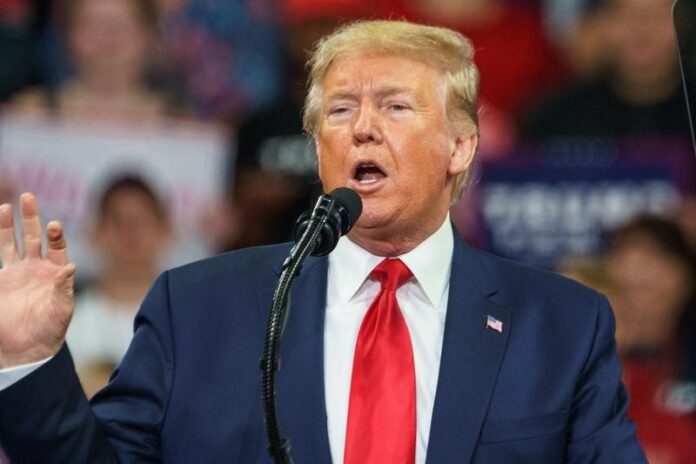
In an Oval Office interview, President Donald Trump responded to questions regarding his father’s struggle with Alzheimer’s disease. However, he briefly had difficulty recalling the term, which was provided to him by White House Press Secretary Karoline Leavitt.
The president, aged 79, conversed about his personal health with New York Magazine on January 27, 2026. He recounted his father, Fred Trump’s, health history, who passed away in 1999 at the age of 93. According to Trump, his father had a robust heart and virtually no health issues, except for a problem that arose later in life.
Trump, during the interview, said, “At a certain age, about 86, 87, he started getting, what do they call it?” as he gestured towards his forehead and glanced at Leavitt.
“Alzheimer’s,” responded Leavitt.
Trump then clarified that he does not suffer from the disease.
The conversation garnered attention due to rampant speculation about the president’s physical and cognitive abilities. Trump, who was 78 at his inauguration and will turn 80 on June 14, 2026, is among the oldest presidents to serve in office.
When asked about the potential risk of developing Alzheimer’s due to his family history, Trump dismissed the idea entirely. The president stated that he does not dwell on it, maintaining an attitude of accepting whatever may come.
Alzheimer’s disease is a progressive neurological disorder that erodes memory and cognitive abilities. Medical professionals estimate that around six million Americans above the age of 65 live with the condition. The disease generally starts with mild memory loss and can ultimately result in the inability to engage in conversation or respond to their surroundings.
The president’s 60-year-old niece, Mary Trump, provided a contrasting viewpoint to New York Magazine. She suggested that the president occasionally exhibits a startled look that reminds her of her grandfather, Fred Trump, during his decline. Mary Trump stated that her uncle sometimes seems disoriented and out of touch with time and place.
Throughout the interview, Trump consistently asserted his claims of excellent health. He was joined in the Oval Office by doctors from Walter Reed National Military Medical Center, including Dr. James Jones, who affirmed that Trump’s health is excellent. The president told the magazine that he feels as healthy as he did 40 years ago. Jones affirmed that Trump’s health is indeed excellent.
Public scrutiny of Trump’s health has escalated, especially due to noticeable bruising on both his right and left hands. The right-hand bruising has been repeatedly captured in photographs over the past year. In Davos, Switzerland, bruising was also observed on his left hand.
Sean Barbabella attributed the bruising to the president’s daily consumption of aspirin and frequent handshaking. Trump takes 325 milligrams of aspirin every day, a regimen he has followed for 30 years. The president stated that his doctors disagree with the dosage, but it works for him, and he is not inclined to change it now that he’s in the Oval Office.
Medical imaging was also discussed when Trump clarified a previous medical visit. Dr. Jones informed the magazine that Trump had a CT scan of his chest and abdomen, not an MRI as initially reported. Trump added that the scan was conducted without any specific reason, but rather because the machine was available.
Jones clarified that the imaging was routine for a patient of Trump’s age and was conducted to preemptively identify potential issues. He stated that the results showed no abnormalities.
It was also revealed by the White House that Trump has been diagnosed with chronic venous insufficiency. This circulatory disorder happens when leg blood vessels are damaged, causing blood to accumulate and leading to swelling. This condition may explain some of the visible symptoms noted by observers.
Questions about Trump’s alertness during meetings were also raised. The president seemed to be sleeping during a Cabinet meeting in December, although officials insisted he was actively listening. Trump himself provided a different explanation during a subsequent Cabinet meeting in January 2026, saying the meeting was “pretty boring.” He mentioned, “I didn’t sleep. I just closed them because I wanted to get the hell outta here,” adding that he has to endure long meetings.
The president’s last official physical examination put his weight at 224 pounds. However, Trump informed the magazine that he currently weighs around 235 pounds.
Other administration officials have echoed similar sentiments, with some claiming Trump works harder now than at any point in his life, including during his years in real estate.
The discrepancy between Trump’s self-evaluation and external observations has sparked ongoing discussions about the transparency of presidential health. The issue has gained renewed importance following concerns about former President Joe Biden’s cognitive state during his tenure, making health and fitness a highly sensitive subject for any sitting president.
Trump’s conversation about his health occurs as he manages the physical demands of the presidency at an age when many Americans are already retired. The conjunction of his familial medical history, visible symptoms, and public speculation has fueled sustained interest in the president’s physical condition and his capability to perform the duties of office.