
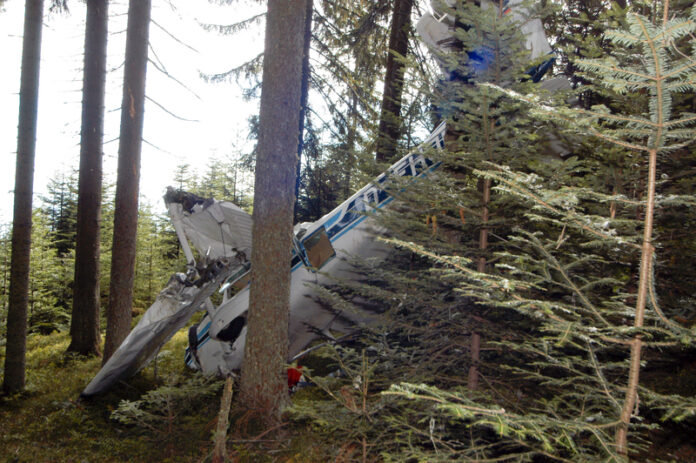
A small plane crashed January 28, 2026, in northeast Colombia, killing all 15 people on board, including a congressman who was a prominent human rights defender in the country’s troubled border region with Venezuela.
The aircraft, operated by state-owned airline Satena, took off at 11:42 a.m. local time from the airport in Cúcuta, the capital of Norte de Santander province, bound for Ocaña, a municipality surrounded by mountains. The flight typically lasts about 40 minutes.
The plane’s last communication with air traffic control occurred shortly after departure, according to Satena’s official statement. Residents in Curasica alerted authorities to the crash site, prompting the dispatch of a rescue team to check on the passengers.
Colombia’s Transportation Ministry subsequently issued a statement confirming that “once the aircraft was found at the location, authorities sadly verified there were no survivors.”
The small plane, a Beechcraft 1900 with registration number HK4709, was carrying two crew members and 13 passengers when it went down in a mountainous rural area. Among the victims was Diógenes Quintero, 36, a member of the House of Representatives for the Catatumbo region. Also killed was Carlos Salcedo, a social leader who was running for Congress in the upcoming March elections, and Natalia Acosta, a member of Quintero’s team.
Officials did not provide a cause for the crash, but said there would be an investigation. The aircraft’s emergency beacon had not been activated, adding to the mystery of what brought the plane down in the rugged terrain near the Venezuelan border.
Quintero was a well-known human rights advocate in the volatile Catatumbo region, his birthplace and the site of the crash. A lawyer by trade, he won election in 2022 as one of 16 lower chamber representatives serving the 9 million victims of Colombia’s prolonged armed conflict.
These special seats were created as part of a landmark 2016 peace agreement between the Colombian government and the country’s largest guerrilla group known as the FARC. The peace deal established these dedicated congressional positions to give a voice to communities that had suffered disproportionately during the violence. The creation of these seats represented a historic commitment to victims’ rights and political participation in Colombia’s democratic process.
The Catatumbo region where Quintero worked is one of Colombia’s most challenging areas, located in a mountainous zone near the Venezuelan border. The area is planted with coca leaves, the raw material for cocaine production, and remains contested by illegal armed groups including the National Liberation Army and dissident factions that refused to join the 2016 peace agreement. Human rights defenders in such regions face constant threats from multiple armed actors competing for territorial control.
Quintero’s party, the U Party, expressed their remorse for his death and said he was “a leader committed to his region.”
Colombian President Gustavo Petro said via social media: “I am deeply saddened by these deaths. My heartfelt condolences to their families. May they rest in peace.”
Vice President Francia Marquez also offered condolences to the families.
The crash site’s location in a mountainous rural area complicated rescue efforts and the initial investigation. The terrain in Norte de Santander province is particularly challenging, with steep mountains and limited road access making it difficult for emergency responders to reach remote crash sites quickly. Such geographical obstacles are common in Colombia’s Andean regions, where small aircraft provide crucial transportation links between communities that lack adequate road infrastructure.
Small aircraft like the Beechcraft 1900 play a vital role in Colombia’s transportation network, connecting remote regions with major cities. These planes serve areas where road travel can take many hours or prove impossible during certain seasons due to weather or security concerns.
Satena, the state-owned airline operating the fatal flight, has a long history of serving Colombia’s remote regions, including areas with limited commercial aviation options. The carrier specializes in routes to smaller municipalities and regions where private airlines find it unprofitable to operate, making it a lifeline for communities in Colombia’s vast rural areas.
The loss of Salcedo, who was running for Congress, comes just weeks before Colombia’s congressional elections scheduled for March. His death, along with Quintero’s, represents a significant blow to political representation in a region that has historically struggled with violence and limited access to government services.
The crash underscores the risks faced by political leaders and activists working in Colombia’s conflict-affected regions, where travel often requires small aircraft due to poor road infrastructure and security concerns. Despite the 2016 peace agreement with the FARC, many rural areas continue to experience violence from remaining armed groups competing for control of drug trafficking routes and illegal mining operations.
Aviation safety investigators will now examine the wreckage to determine what caused the aircraft to lose contact with air traffic control so quickly after takeoff. The fact that the emergency beacon was not activated suggests the incident may have occurred suddenly, giving the crew no time to signal distress. Weather conditions, mechanical failure, and pilot error will all be considered as potential factors in the investigation.
The tragedy has drawn attention to the ongoing challenges facing human rights defenders and political representatives in Colombia’s most vulnerable regions, where the work of leaders like Quintero remains essential despite persistent dangers.