
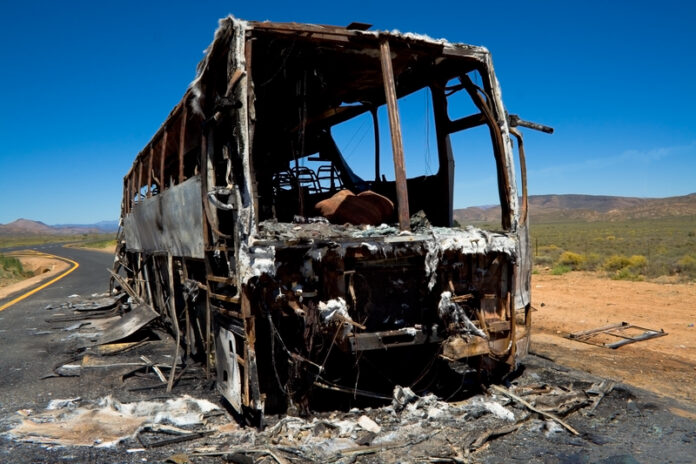
Two city buses were operating on a street in Kramatorsk, eastern Ukraine, when a Russian guided bomb slammed into it at about 10 a.m. local time on Thursday, Oct. 8, 2026, in the Donetsk region. At least 33 people died and 18 were wounded, making it one of the largest single attacks in Ukraine this year.
As of Oct. 9, there had still been no public claim of responsibility from the Russian side for the attack on the buses. Ukrainian cities and towns have been pounded regularly since the full-scale invasion began in February 2022, yet Russia denies targeting civilians.
Regional authorities and the Donetsk Regional Prosecutor’s Office settled on 33 dead only after the count rose through the day, standing at first 12 and later 30. The prosecutor’s office’s initial Oct. 8 figure was 12 dead and 14 injured, before the toll was revised to 30 and then 33; the figures changed as rescue efforts continued.
Accounts of the casualties differ. Ukraine’s State Emergency Service put the Oct. 8 toll at at least 30 killed and 18 injured, while other reports gave at least 33 dead and 18 wounded. Donetsk Gov. Vadym Filashkin later said 22 people were injured.
Two of the victims had not yet been identified, President Volodymyr Zelenskyy said, and he cautioned that the death toll could still rise. He described the targeted site as a bus stop. “This strike will not go unanswered,” Zelenskyy said.
Rescuers Hit by Drones
Oleksandr Honcharenko, head of Kramatorsk’s city military administration, said the rescue effort had been hampered by subsequent Russian attacks using small drones. “There is no doubt that Russia is cynically targeting civilians,” Honcharenko said of the Oct. 8 strike.
Bodies lay scattered across a road littered with debris, alongside the charred shell of what appeared to be a bus, in Images released by police. Prosecutors said Russian forces likely used guided bombs against the vehicles. Police said the buses were hit with a glide bomb.
Filashkin ordered city authorities in Kramatorsk and neighboring Sloviansk to stop all public transport. Anyone still living in the eastern front-line region should move to safer parts of Ukraine, he appealed.
“For them (the Russians), a bus with passengers is an attractive target precisely because one strike can kill as many people as possible,” Filashkin said on Telegram. Speaking of the Oct. 8 victims, he said: “These are not the consequences of war, nor dry statistics. These are people killed by the Russian army.” He separately said: “Russia is coming to Ukrainian soil with death.”
Russia’s leadership has no intention of stopping the killing, said Ukraine’s Foreign Minister Andrii Sybiha. Moscow is methodically wrecking the city and terrorizing the residents who remain, charged Dmytro Lubinets, the Ukrainian parliament’s commissioner for human rights.
Two more people died in a later drone strike in Kramatorsk. Russian forces reportedly killed three in nearby Bilenke.
Fortress Belt Under Pressure
Moscow’s forces have stepped up drone and guided-bomb strikes on both Kramatorsk and Sloviansk, the twin anchors of the so-called fortress belt that forms the backbone of Ukraine’s defenses in Donetsk. Kyiv must surrender the rest of the region before the fighting stops, Russia has demanded, a demand Ukraine rejects.
The Kremlin is pressing to seize the rest of Donetsk, with most of Luhansk already under Russian control. Those battlefield gains have come at a significantly slower pace this year. Ukraine’s military used Kramatorsk as a logistics and supply hub for much of the war; the city now absorbs near-daily attack as Russian troops press toward its eastern edge.
Winglets fitted to glide bombs let them travel toward a target rather than simply fall. The city came under as many as nine of them in a single day in late August. Such weapons lack the accuracy of ballistic missiles or first-person-view drones, Al Jazeera correspondent Audrey MacAlpine said, so there is no way to know whether the buses were deliberately hit. She called the attack one of the largest and deadliest aerial strikes in recent months.
Strikes Across the Country
A massive Russian air attack across Ukraine on Wednesday, Oct. 7, had preceded the strike, aimed primarily at the power grid and killing at least 32 people nationwide, including four in Kyiv. A missile struck a five-story apartment block in Pryluky, in the Chernihiv region about 150 kilometers (93 miles) east of Kyiv, killing 22 people, among them five children — three of them only one year old. About 55 others were wounded.
Zelenskyy noted that the barrage fell on the birthday of Putin, the Russian leader, saying Russian forces had destroyed the building as a birthday gift to him. British Foreign Secretary Ed Miliband toured the Pryluky site with Zelenskyy and announced new sanctions aimed at Russia’s shadow fleet, oil companies and the financing of the war.
Mayor Vitali Klitschko said morning drone strikes on Kyiv, also on Oct. 8, killed three people and wounded 14. Across the country, strikes over the previous two days had killed 78 people and wounded 215, Zelenskyy said. The U.N. announced Oct. 2 that Ukraine recorded 15,280 civilians killed or injured in the first eight months of 2026, up 55 percent from the same period of 2025.
Ukrainian drones knocked a Yandex data center in Russia’s Ryazan region offline on Oct. 8, and Zelenskyy confirmed the hit as mirroring earlier Russian attacks. The Gazprom Neftekhim Salavat refinery in Bashkortostan was set ablaze by Ukrainian forces, who also said they struck Russia’s largest refinery, in Omsk, Siberia. Air defenses destroyed 399 Ukrainian drones overnight, Russia’s Defense Ministry said.
Ukrainian negotiators would travel to the United States for talks on Friday, Oct. 9, and Saturday, Oct. 10, Zelenskyy said, urging President Donald Trump to intensify pressure on Moscow. The war is at a stalemate and Washington will keep working to facilitate a settlement, U.S. Secretary of State Marco Rubio told reporters in Portugal.