
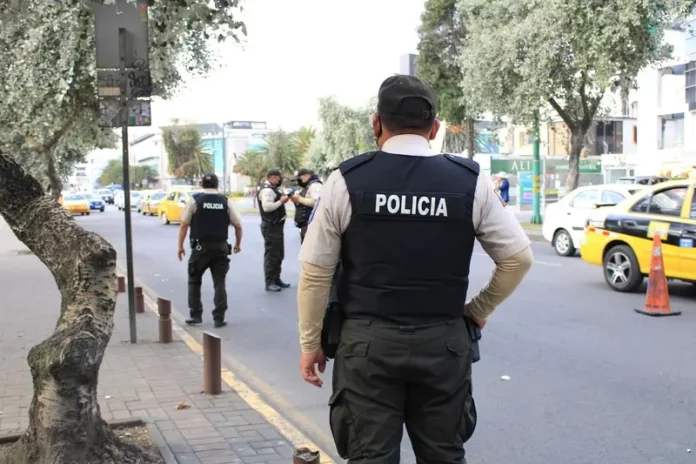
Two gunmen on a motorcycle pulled alongside a car in Machala, Ecuador, in broad daylight on Monday, May 11, 2026, and shot dead the woman behind the wheel: Lady Gissela Pachar Huanga, 41, a judge in the criminal judicial unit of Santa Rosa, who was on her way to a gym. Two bodyguards had been assigned to protect her. Neither was with her.
Machala is the capital of El Oro province, close to the Peruvian border, and Pachar became the newest name on the casualty list of Ecuador’s war with the powerful cocaine trafficking organizations that have made the small Andean country one of Latin America’s deadliest. Threats had already reached the judge before the ambush, and she was targeted in retaliation for releasing gang members, according to a police source who spoke to AFP (Agence France-Presse) on May 12.
16 Killed Since 2022
As of the day Pachar died, at least 16 judges or prosecutors had been killed in Ecuador since 2022, a figure AFP attributed to Human Rights Watch. The Observatory of Rights and Justice keeps a broader tally that begins in 2020 and counts court and prosecution staff as well as judges and prosecutors; that figure stands at 26. Marcos Mendoza, another judge, was shot dead by assassins in October 2025 as he arrived at a school in Montecristi, Manabi province, to drop off his son — a killing that held the national spotlight briefly before being swallowed by the steady churn of cartel-related violence.
Roughly 70 percent of the cocaine coming out of Colombia and Peru — the world’s largest and second-largest producers — moves through Ecuador’s ports and Pacific coastline, which places the country at the heart of the trade. Trafficking networks that depend on corrupting or terrorizing the justice system to keep operating have made the courts, the prisons and the prosecutors’ offices prime targets.
A state of emergency declared specifically to fight organized crime was in force when the judge was murdered, and that detail has sharpened criticism of the government’s approach.
A Protective Detail That Wasn’t There
Authorities had flagged Pachar as a target, and Ecuador’s Judicial Council confirmed that protective measures had been ordered for her. On the day she died, those safeguards failed catastrophically.
“It should be noted that the judge had previously been assigned protective measures; however, these measures were not in place at the time of the attack,” the council said in a translated statement.
The gap in her security was a specific one. One of the two police custodians assigned to her was away at a training course in Quito, and police said the other had been in touch with her only by telephone because she was working remotely. Police in Machala confirmed that no agent was with the judge when the gunmen struck; the National Police commander for Zone 7, which covers El Oro, is Col. Renato González. Threats against Pachar dated back to 2024, and in October 2025 threatening pamphlets carried her name alongside those of four other Machala judges, prompting authorities to raise her personal risk rating.
Judges and prosecutors across Ecuador have been pointing out the same systemic failure for years: protection that exists in official records and nowhere else. Pachar’s vehicle reached its destination with the judge dead inside, and her killers had vanished.
In a statement released May 11, 2026, Ecuador’s Judicial Council condemned the attack as a “serious attack against justice and the rule of law in Ecuador” and demanded a full investigation. The Ecuadorian Association of Magistrates and Judges said the following day that Ecuadorian justice was in mourning and that the killing laid bare the deterioration of the conditions for independent and safe judicial work. A formal complaint over the killing was filed at the provincial prosecutor’s office in El Oro on May 15, 2026, by Judicial Council president Mercedes Caicedo, who travelled there and said the institution wanted to keep the crime from going unpunished. Two weeks before the murder, at her swearing-in before the National Assembly, Caicedo had told legislators there is no justice without independent judges.
15 Weeks On, No Arrests
No arrests have been announced more than three months after the assassination. An incinerated car and an abandoned motorcycle believed to have been used in the attack were recovered by police hours after the shooting, but no suspect has been publicly named. Whether Pachar was killed in retaliation for her rulings in organized crime cases remains under examination by investigators, and a separate internal review is under way into why her assigned protection was not in place.
The pattern that killed her has continued. A gunman killed prosecutor Gloria Alexandra Bravo Cedeño and her sister on June 14, 2026, as Bravo walked to her car in Manta, on the Manabi coast. Homicide, kidnapping and organized crime cases had been part of her caseload, and she was the third prosecutor murdered in that city since 2022. The Attorney General’s Office called the killing a reprisal for the institution’s fight against organized crime. Two other officials from the prosecutor’s office had been killed the previous month. August 2026 brought more of the same: public defender Lenín Steven Zambrano Salcedo, 37, was shot dead in Manta on August 14, and José Luis Merchán Perero, secretary of the aquatic crimes unit at the Salinas prosecutor’s office in Santa Elena province, was killed outside his workplace on August 17. In the Merchán case, three suspects were detained that same night and announced the following day — an outcome the Pachar investigation has yet to produce.
Noboa’s Hard-Line Bet
Confronting the cartels has been the core of President Daniel Noboa’s presidency since he assumed power in November 2023, a posture that has made him one of President Trump’s staunchest allies on the continent. He has put soldiers in the streets and inside the prisons, ordered dramatic raids on drug strongholds and declared states of emergency again and again. Human rights groups have fiercely criticized those tactics, raising alarms about security forces abusing expanded powers.
Violent deaths hit a record 9,216 in 2025, up 32 percent from 7,063 the year before. On paper, the trend has turned: about 515 fewer killings were logged in the first half of 2026 than in the same period of 2025, roughly 11 percent fewer violent deaths, police reported, with the rate dropping from 25.5 to 22.5 per 100,000 residents. Even so, Ecuador recorded 4,154 homicides across those six months — an average of 23 a day, or one every hour and two minutes — and the improvement has stalled, with homicides in June and July 2026 both exceeding the totals for the same months of 2025. Judicial officials, meanwhile, are still being hunted down; the decline has not slowed that at all.
American Commandos on the Ground
As conditions have deteriorated, Washington has stepped further into Ecuador’s security crisis. The United States and Ecuador launched joint military operations against designated terrorist organizations in early March 2026.
Weeks later, American commandos went in with Ecuadorian troops on Operation Lanza Marina, in a raid CBS News reported on April 1. The target was a compound believed to function as a staging area for high-speed boats connected to Los Choneros, among the country’s most violent gangs. American forces worked in advisory roles, accompanying their Ecuadorian counterparts as they moved against the site, according to two U.S. officials who spoke on the condition of anonymity because they were not authorized to discuss the operation publicly.
That raid is one piece of a broader effort to break up the maritime trafficking routes that have turned the Ecuadorian coastline into a launch point for cocaine headed north. Whether that kind of escalation can keep officials like Pachar alive is another question. She was alone, unprotected and moving through a predictable routine when her assassins found her — the exact vulnerability the cartels exploit easily in a country where institutional corruption remains pervasive.
The Judicial Council’s statement pressed a point larger than one death. A judiciary cannot function under intimidation or violence, it warned, and protecting its officers is fundamental to guaranteeing access to justice and the democratic order. The gunmen in Machala answered that argument on May 11. A month later in Manta, another pair answered it again.