Peru suspended the operations of sightseeing airline Aerodiana on Sunday after one of its small planes crashed in the country’s Ica region on Saturday, August 1, 2026, killing 11 European tourists and two crew members — leaving no survivors among the 13 people on board.
The Cessna 208B Grand Caravan, which can carry 12 passengers, departed Pisco Airport at about 1 p.m. local time on a sightseeing flight over the Nazca Lines, one of Peru’s most visited archaeological attractions. The aircraft lost contact with the control tower and went down at about 1:20 p.m., crashing near Pueblo Viejo, roughly four miles (6 km) from the city of Nazca and about 12 km from the Nazca Lines site itself.
Peru’s Ministry of Transportation and Communications ordered Aerodiana to halt all flights pending investigation, saying the company must remain grounded “until investigations are completed to verify the company’s compliance with the applicable aviation regulations, procedures and operating requirements.”
Mechanical Failure Reported Before Contact Was Lost
Peruvian Foreign Trade and Tourism Minister Rogers Valencia confirmed that the pilots radioed a distress call before the crash. Valencia said the aircraft experienced mechanical problems. That transmission to the Nazca airfield control tower was the last contact authorities received from the plane.
Investigators have not yet established whether the mechanical issue directly caused the crash. Peru’s Aviation Accident Investigation Commission is examining the distress call, the plane’s flight path and physical evidence recovered from the wreckage. Valencia said at the crash site that the assessment of the wreckage would provide an in-depth understanding of what went wrong, and that findings were expected promptly.
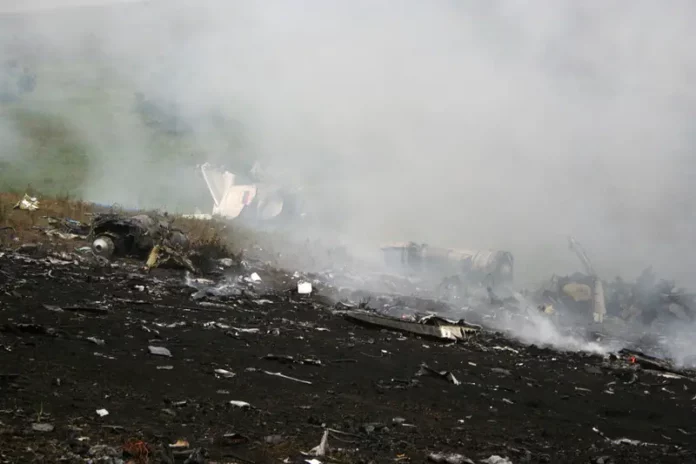
Police Major Jorge Andrade, speaking to reporters at the scene, confirmed the full death toll and noted the grim conditions facing rescue teams. The crash site ignited rapidly, with firefighters and police working amid smoldering wreckage in the desert. Because of the speed at which the wreckage became engulfed in flames, no rescues were possible.
Victims From Italy, Germany and Spain
Among the 11 tourists killed were seven Italian nationals between the ages of 18 and 54, two Spanish passengers both aged 52, and two German nationals aged 77 and 78. The two crew members were identified as pilot Americo Salazar Cuellar and copilot Irenka Guanilo del Carpio, both Peruvian.
Italian Prime Minister Giorgia Meloni expressed grief over the deaths of her country’s citizens, writing on social media that she offered her deepest condolences to the families of the victims “at this time of immense grief.” The Italian Foreign Ministry said its embassy in Lima had been coordinating with Peruvian authorities, and that families of the Italian victims had already been notified. The Italian and German consuls were both present at the crash site, according to Minister Valencia.
Peruvian President Keiko Fujimori expressed regret over the accident and said authorities were evaluating a temporary suspension of the airport, pending assessments from relevant ministries.
A UNESCO Site Best Seen From the Air
The Nazca Lines, a UNESCO World Heritage Site, are a sprawling collection of ancient geoglyphs etched into the desert floor in southern Peru, dating to between AD 200 and 700. The enormous drawings — depicting animals including monkeys, hummingbirds, cats and whales, as well as geometric figures stretching several kilometers — are largely invisible from the ground and must be viewed from the air to be fully appreciated. UNESCO has described the site as among archaeology’s greatest enigmas because of the quantity, nature, size and continuity of the markings.
That aerial requirement has made small-plane sightseeing flights a booming industry in the region — and a persistently dangerous one. Saturday’s crash is not the first to claim lives near the Nazca Lines. A small plane went down in 2022, killing seven people, including two Chilean and three Dutch nationals. In an earlier crash from October 2010, an AirNasca plane carrying British vacationers and Peruvian flight crew went down after touring the lines, leaving no survivors. Earlier in 2010, three Chileans and four Peruvians perished when a Cessna 206 crashed in the same region. In April 2008, five French tourists were killed in yet another overflight crash, though that plane’s pilot survived.
Aerodiana’s Safety Record Under Scrutiny
Aerodiana, which has operated sightseeing flights over the Nazca Lines for 18 years, issued a statement expressing that the crash had deeply affected the company and reaffirming its willingness to cooperate fully with investigators. The airline said it had maintained an unwavering commitment to passenger and crew safety throughout its history.
Peru is a major international tourism destination, drawing more than 4.1 million foreign visitors in 2025 to attractions including the Incan ruins of Machu Picchu and the Nazca Lines. The country has a population of just under 35 million. The repeated crashes near the Nazca Lines have prompted recurring concerns about the safety standards governing the small aircraft operators that serve the site, and Saturday’s disaster is likely to intensify those calls for tighter oversight as investigators work to determine a cause.