
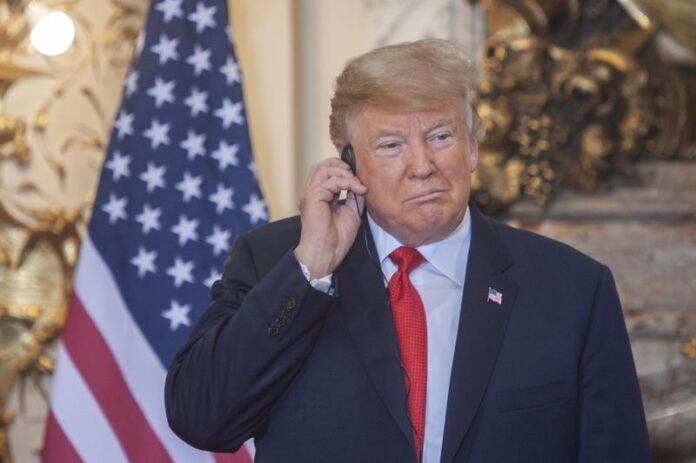
White House officials have forcefully dismissed claims from a Washington State University medical professor who believes President Donald Trump may have experienced a stroke, calling the speculation baseless and politically motivated.
Press Secretary Karoline Leavitt insisted Trump is in excellent health and rejected the assertions as politically motivated attacks. She called the claims “absolute nonsense” and described Professor Bruce Davidson as a left-wing extremist.
Leavitt emphasized Trump’s energy and accessibility to the public, drawing a contrast with health concerns that surrounded former President Joe Biden. She accused the media of spreading false narratives at a time when trust in journalism is at historic lows.
Davidson of Washington State University’s Elson S. Floyd College of Medicine raised the theory on the podcast The Court of History, hosted by Sidney Blumenthal and Sean Wilentz. He speculated that the suspected stroke might have occurred in the brain’s left hemisphere around six months earlier.
“I believe the stroke was on the left side of the brain, which affects the right side of the body,” Davidson told the hosts, noting several shifts in Trump’s physical appearance that he believes support the idea.
Davidson pointed to video clips showing Trump appearing to shuffle his feet—contrasting earlier footage of him walking confidently on golf courses. He also cited moments where Trump held his right hand with his left and instances of slurred speech in early 2025, though he acknowledged that Trump’s articulation seems to have improved more recently.
Davidson also referenced footage of Trump gripping the Air Force One staircase banister with his left hand, despite being right-handed, as a possible indication of left-hemisphere brain impairment. He further cited what he considers signs of excessive daytime drowsiness, or hypersomnolence, a condition often linked to stroke patients, noting multiple occasions where the president seemed to nod off during public events.
While Davidson did not specify which type of stroke he thinks may have occurred, he asserted that Trump appears to have recovered considerably if his assessment is correct.
“Some people develop humility and gratitude. Others experience euphoria—’I nearly died and now I’m back,'” Davidson said. “And some think, ‘I survived this once, so now I’m going to do everything I’ve ever wanted because the next one might be fatal.'”
Davidson suggested that some of Trump’s second-term behavior might fit patterns seen in stroke survivors, noting that strokes are serious, life-threatening events that can lead to a range of emotional and psychological responses.
Trump has often been seen with pronounced bruising on his hands, which he has attempted to conceal with makeup. The hand bruising became widely discussed in February 2025, when discoloration was visible through makeup during a meeting with French President Emmanuel Macron. Leavitt attributed the bruises to frequent handshakes and daily aspirin use, describing Trump as a man of the people who interacts with more Americans than any president before him.
In July 2025, the White House confirmed that Trump had been diagnosed with chronic venous insufficiency, leading to leg swelling. To address the issue, he wears compression socks and has acknowledged taking more aspirin than recommended by his doctors.
Chronic venous insufficiency occurs when leg veins fail to move blood efficiently back to the heart, leading to swelling, discomfort, and noticeable changes in the legs. Though typically not life-threatening, the condition is common in older adults and may signal broader cardiovascular problems if untreated.
Dr. Sean Barbabella explained that the bruising was consistent with mild soft tissue irritation caused by frequent handshaking combined with aspirin use as part of standard cardiovascular care.
Speaking with The Wall Street Journal in January 2026, Trump discussed several health matters, including his aspirin use for heart protection. He also clarified confusion about advanced imaging that followed his annual physical, explaining that he underwent a CT scan—not the previously reported MRI—to rule out cardiovascular issues. Barbabella stated that the scan showed no abnormalities.
Trump admitted he regretted undergoing the imaging because it sparked additional speculation about his condition. The medical evaluation took place in October 2025 at Walter Reed National Military Medical Center, with an October 10 note confirming the follow-up, though it offered few specifics.
Trump’s acknowledgment that he exceeds recommended aspirin doses also raises medical concerns. While low-dose aspirin is regularly prescribed for heart health, excessive use can heighten the risk of bleeding and bruising—possibly explaining the visible marks that have drawn public attention.
Another incident that drew attention occurred on September 11, 2025, when Trump appeared with one side of his face looking droopy. Social media users speculated about a possible stroke at the time, although no diagnosis was confirmed. Facial drooping can occur when blood flow to part of the brain is obstructed, affecting muscle tone on one side.
Photographers later captured a bright red rash extending from behind Trump’s right ear down his neck during a Medal of Honor ceremony in early 2026. A review of photos showed the irritation beginning in mid-February, becoming clearly visible by February 18 at a Black History Month event, and worsening through subsequent public appearances. Barbabella said the rash was caused by a prescribed skin cream used as a preventative skin treatment, noting the redness could persist for several weeks, though some medical experts questioned the White House’s limited explanation, especially since Barbabella declined to specify the underlying condition.
Some observers speculated that the rash might be a reaction to anti–skin cancer medications like Fluorouracil, commonly known as 5-FU.
The health of aging political leaders has long been a topic of concern in the U.S. Biden was 82 years and seven months old when he left office, frequently facing questions about his mental and physical capacity. Should Trump complete his current term, he will reach the same age, becoming the oldest president in American history.
Despite the White House’s explanations, public questions about Trump’s health continue. The limited release of medical records and Trump’s contradictory statements about his imaging procedures have intensified scrutiny. The initial MRI report, later corrected to a CT scan, raised further concerns about transparency.
Davidson’s remarks—acknowledged as speculative due to lack of access to Trump’s medical files—add to the ongoing discussion of the president’s health. Visible signs such as bruising, swollen ankles, and apparent fatigue at public events have been noted by various media outlets for months.
As Trump nears his 80th birthday in June, each new visible symptom continues to fuel a debate that the White House has so far avoided addressing with full transparency.