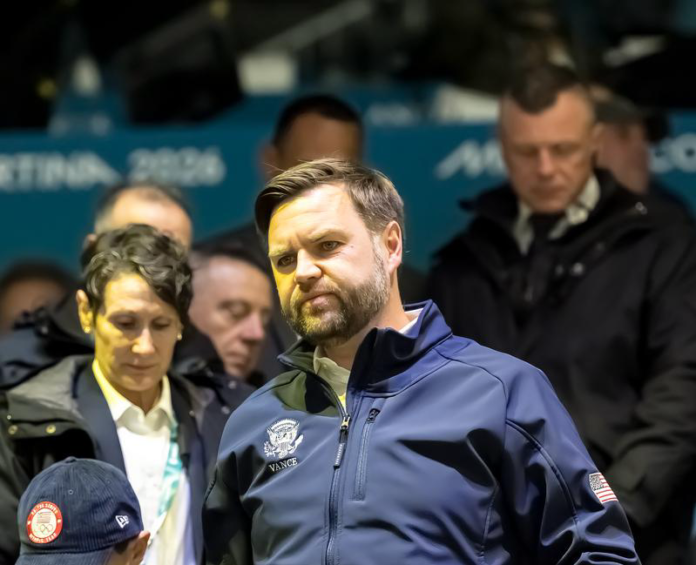
A Catholic convert who has made his faith a centerpiece of his political identity, Vice President JD Vance stumbled badly when asked about Cardinal Christophe Pierre during a Budapest press conference on Wednesday, April 8, 2026.
Vance, 41, was being questioned about a Free Press report claiming Pentagon officials had threatened the Vatican with American military power during a January meeting with Cardinal Pierre, the Holy See’s ambassador to the United States from 2016 until his March resignation.
“Who?!” Vance blurted out. “With no disrespect to the cardinal, I don’t know who Cardinal Christophe Pierre is.”
When a journalist reminded him that Pierre had represented the Vatican in America for years, the vice president quickly walked back his response. “Oh, okay, okay, I do. I’ve met him before. Sorry. I just didn’t remember the name,” he said.
The flub went viral on social media, triggering waves of mockery. How could someone who constantly emphasizes his Catholic credentials fail to recognize such a senior Church diplomat?
This latest misstep comes just weeks after Vance unveiled his upcoming memoir “Communion: Finding My Way Back to Faith” with a cover photo of Mount Zion United Methodist Church in Elk Creek, Virginia. The 304-page book details his journey to Catholicism, making the Methodist church gaffe especially puzzling. The small congregation has an average Sunday attendance of 17 worshippers.
The National Catholic Reporter has previously described his Catholicism as “little more than a political prop.”
Raised in a loosely evangelical, non-denominational tradition, Vance identified as an atheist during his college years before finding his way back to faith. In August 2019, Dominican priest Father Henry Stephan received him into the Church at St. Gertrude Priory in Cincinnati, where he selected St. Augustine as his patron saint.
The Free Press report at the center of Wednesday’s questioning alleged that Under Secretary of War for Policy Elbridge Colby summoned Cardinal Pierre to a closed-door meeting on January 22. According to the report, Pentagon officials referenced the 14th century Avignon Papacy—when the French monarchy used military force to dominate papal authority—and told the Vatican that America “has the military power to do whatever it wants in the world.”
A Department of Defense spokesperson rejected that account, calling it “highly exaggerated and distorted.” The meeting was “a respectful and reasonable discussion,” the spokesperson said, adding that the Pentagon maintains “nothing but the highest regard” for the Holy See.
The reported threats may have played a role in scuttling a planned papal visit to the United States for the nation’s 250th anniversary celebrations. Pope Leo XIV, the first American-born pontiff, will instead travel to Lampedusa on July 4—a tiny Mediterranean island where thousands of North African migrants arrive seeking refuge in Europe. Vatican observers noted the pointed symbolism of the date.
The Chicago-born pope has been a vocal critic of the administration’s deportation agenda, its support for Israel’s bombardment of Gaza, and its threats against Iran.
Last week, Pope Leo responded to President Donald Trump’s warning that “a whole civilization will die tonight” if Iran failed to meet U.S. demands. Speaking to reporters outside his residence in Castel Gandolfo, the pope declared, “This is truly unacceptable.”
President Trump fired back on Sunday, denouncing the pope as “very liberal” and suggesting he should “stop catering to the Radical Left.”
During the Budapest press conference, Vance sidestepped questions about the Pentagon meeting. “I’ve never seen this reporting. I’d like to actually talk to Cardinal Christophe Pierre and, frankly, to our people to figure out what actually happened,” he said. “I think it’s always a bad idea to offer an opinion on stories that are unconfirmed and uncorroborated.”
For a vice president whose Catholic identity has become central to his political brand, failing to immediately recognize the Vatican’s top diplomat to America proved especially damaging. Critics questioned the authenticity of his faith and his fitness for office.