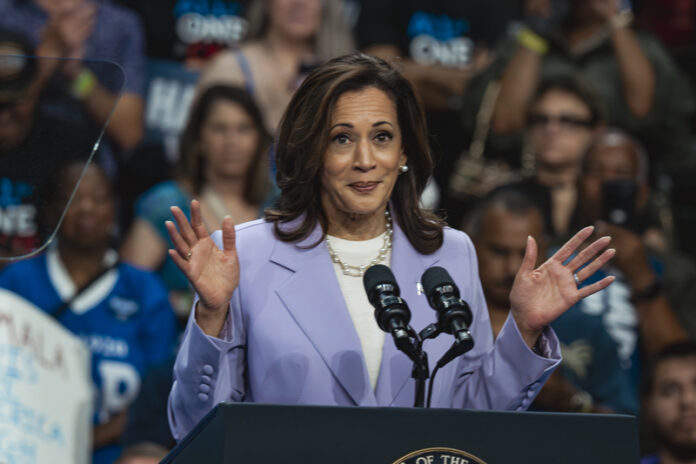
The political future of former Vice President Kamala Harris came into sharper focus this week when she told the National Action Network convention in New York City that she is actively considering a 2028 presidential campaign, marking her most direct statement yet about seeking the White House again.
When Rev. Al Sharpton posed the question directly during the April 1 event, Harris didn’t hesitate. “Listen, I might. I might. I’m thinking about it,” she said. She emphasized her experience from four years serving one heartbeat from the presidency and countless hours spent in both the West Wing and the Situation Room. “I know what the job is, and I know what it requires,” she said.
The announcement on Friday represented a significant shift from her more cautious October 2025 statement to the BBC, when she said she would “possibly” seek the presidency in the future. Her recent travels across the country to support Democrats, especially in the South, now appear to be laying groundwork for a national campaign.
Very early polling of a potential 2028 presidential race shows Harris at the top of the Democratic field nationally. A March 2026 Center Square poll of Democrats and left-leaning independents put her at 31 percent, with California Gov. Gavin Newsom second at 16 percent. However, a Berkeley IGS/LA Times poll found Harris in fourth place among California Democrats at just 9 percent, trailing Newsom (28 percent), Rep. Alexandria Ocasio-Cortez (14 percent), and former Transportation Secretary Pete Buttigieg (11 percent) — a notable weakness given that California is her political home state. Analysts note her national lead partly reflects higher name recognition compared to other potential candidates.
The Manhattan ballroom reception showed Harris still commands significant enthusiasm among key Democratic constituencies. The nation’s first Black female vice president and the Democrats’ 2024 presidential nominee received a hero’s welcome, earning the loudest cheers of any potential 2028 contender who appeared at the conference. Chants of “Run again!” erupted as Harris took the stage, while other Democratic hopefuls spoke to diminished crowds.
Sharpton praised Harris’s historic achievements, noting she was the first Black and South Asian woman to receive a major party nomination in U.S. history. He also pointed out that Harris received approximately 75 million votes in 2024, more than former Democratic Presidents Barack Obama and Bill Clinton earned in their winning campaigns.
Despite the enthusiasm at Sharpton’s conference, some Democratic operatives and donors privately express skepticism about another Harris campaign. Party insiders worry that her ties to the Biden administration could undermine Democrats’ need for a fresh direction after losing the White House. Harris previously dropped out of the 2020 presidential race before the start of the primary calendar and was later picked as Biden’s vice presidential nominee.
Harris lost the 2024 presidential election to President Donald Trump, who secured 312 Electoral College votes compared to her 226, after President Joe Biden stepped aside under heavy pressure from party leaders and endorsed her.
During her appearance, Harris didn’t shy away from attacking President Trump’s foreign policy. She criticized his “America First” approach, arguing that it withdraws from international relationships and connections. Harris also called the U.S. and Israeli war against Iran a “war of choice,” blaming Trump for starting an unnecessary conflict and for alienating long-standing U.S. allies. Then she adopted what she described as a mob boss persona: “So, then he’s kind of like, ‘Oh, well, you know, you take Eastern Europe, and I’ll take the Western Hemisphere.'”
The mimicry prompted swift criticism online. “Add ‘mafia boss’ to Kamala Harris’ list of embarrassing accents,” a Republican campaign account wrote. Harris, who was born in Oakland and grew up in Berkeley, California, sometimes adopted a southern accent while campaigning in 2024, drawing mockery from conservatives.
Harris also urged Black voters to be “transactional” with their votes in 2028, telling the audience to expect something in return for their support and to make clear demands of candidates seeking their votes.
The convention featured a parade of potential 2028 candidates, including Pennsylvania Gov. Josh Shapiro, former Transportation Secretary Pete Buttigieg, Illinois Gov. JB Pritzker, Maryland Gov. Wes Moore, Kentucky Gov. Andy Beshear, Arizona Sen. Mark Kelly, Arizona Sen. Ruben Gallego, California Representative Ro Khanna, House Minority Leader Hakeem Jeffries, and Representative Ayanna Pressley.
The Democrats’ next presidential primary season won’t begin in earnest until after November’s midterm elections, but this week’s conference showcased party leaders already jockeying for position in what promises to be a crowded competition.
For now, Harris told supporters she’s weighing her decision carefully, considering who can best serve the American people. “I’ll keep you posted,” she said, leaving the door wide open for another run at the nation’s highest office.