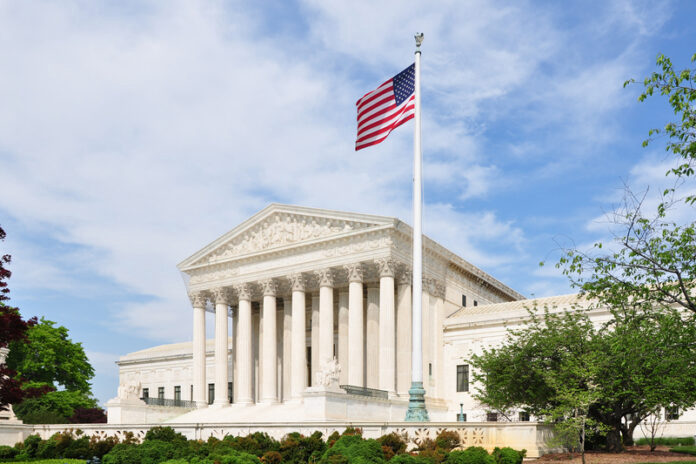
President Donald Trump’s own Supreme Court appointee delivered a crushing blow to his birthright citizenship executive order on Wednesday, exposing fundamental contradictions that threatened to undermine the very purpose of the 14th Amendment.
Justice Amy Coney Barrett dominated oral arguments in Trump v. Barbara, systematically questioning whether the administration’s legal theory would have excluded even the children of enslaved people from citizenship—the exact population the post-Civil War amendment was designed to protect.
The uncomfortable scene played out with Trump seated in the front row next to now-fired Attorney General Pam Bondi. On April 1, 2026, Trump became the first sitting president in U.S. history to witness Supreme Court oral arguments in person, but the unprecedented display of executive presence backfired badly.
Barrett pressed Solicitor General D. John Sauer on the practical implications of his theory that children don’t receive birthright citizenship if their parents lack “domicile” in the United States or hold “allegiance” to a foreign power. She asked about children born to women illegally trafficked into the United States. If enslaved people brought here against their will still “felt allegiance to the countries where they were from” and intended “to return as soon as they can,” wouldn’t their children be excluded from birthright citizenship under the government’s theory? And if so, how could the administration claim the 14th Amendment’s citizenship clause was designed solely to overturn Dred Scott and grant citizenship to newly freed slaves?
Professor Evan Bernick of Northern Illinois University College of Law later explained Barrett’s devastating logic on Slate’s Amicus podcast, noting that enslaved people had no “intent to remain” because they were forcibly brought to America. If domicile requires such intent, Bernick argued, then granting citizenship to the children of formerly enslaved people would be impossible under Sauer’s own theory—completely undermining the 14th Amendment’s core purpose.
Trump walked out of the courtroom midway through arguments, departing shortly after ACLU National Legal Director Cecillia Wang began her presentation defending broad birthright citizenship. He later posted on Truth Social that the nation was “STUPID” for allowing the fundamental right.
Other justices piled on with their own skepticism. Chief Justice John Roberts called the government’s examples “very quirky,” while Justice Ketanji Brown Jackson hammered away at the impossibility of implementing such a system, asking “So, are we bringing pregnant women in for depositions?”
Justice Neil Gorsuch forced Sauer into an awkward stumble when he asked whether Native Americans qualified as birthright citizens. Despite tribal people living on the land long before European colonizers arrived, Sauer could only say “I’m not sure, I have to think through that” before pointing to the Indian Citizenship Act of 1924.
The executive order at the center of the case was signed on Trump’s first day back in office on January 20, 2025. It moved to deny automatic citizenship to babies born to undocumented immigrants and many foreign nationals on temporary visas.
The policy would affect more than 250,000 babies born annually and could leave some children stateless, according to research cited in court briefs.
Lower courts unanimously blocked Trump’s order as likely unconstitutional and contrary to federal statute 8 U.S.C. § 1401, which mirrors the 14th Amendment’s language. The 1898 Supreme Court case Wong Kim Ark established that a child born in San Francisco to noncitizen parents of Chinese ancestry was a U.S. citizen, affirming the “ancient and fundamental rule” of jus soli—citizenship based on soil rather than descent.
Legal experts warn that enforcing limits would require expensive new federal verification infrastructure and risk errors that could render infants stateless. The Supreme Court is expected to issue a decision by late June or early July.
The justices could rule on statutory grounds without addressing the full constitutional scope of the 14th Amendment, or they could tackle the constitutional question directly. If the administration loses on the statute, it could seek legislation in Congress, though lawmakers have repeatedly considered but never passed measures to curb birthright citizenship.
The courtroom drama unfolded under extraordinary circumstances. While Trump sat in the gallery, his spiritual adviser Paula White-Cain compared him to Jesus Christ during an Easter lunch at the White House, telling the president “no one has paid the price like you have paid the price.”
For Trump, Wednesday’s arguments represented a rare moment of accountability, with even his own judicial appointees refusing to rubber-stamp his most aggressive constitutional gambit. His early departure from the courtroom suggested he understood what even casual legal observers recognized: this case is not going his way.