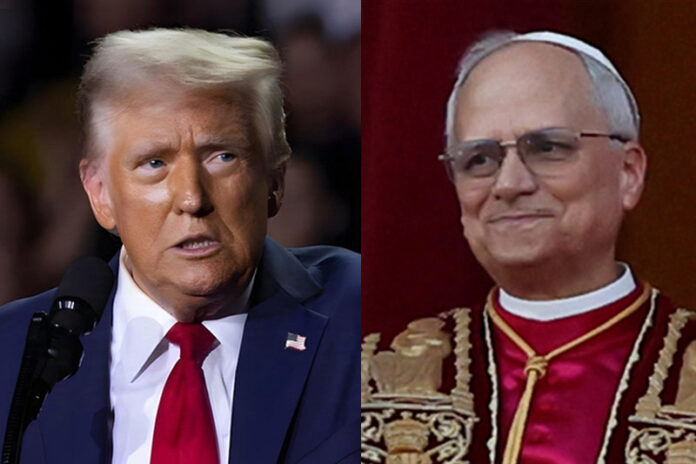
President Donald Trump intensified his public feud with Pope Leo XIV on Monday, telling CBS News the pontiff should stay out of politics while refusing to apologize for calling him “WEAK on Crime, and terrible for Foreign Policy” in a late-night Truth Social post.
The extraordinary clash between the American president and the first U.S.-born pope escalated further as Trump confirmed he had no plans to contact Pope Leo directly, dismissing the religious leader’s positions on mass deportations and the escalating Iran conflict.
In a phone interview with CBS News senior correspondent Norah O’Donnell, Trump stood firm. “He’s wrong on the issues,” Trump said of Pope Leo. “I don’t think he should be getting into politics.”
The president acknowledged he fired off his scathing Truth Social post after watching Sunday’s edition of “60 Minutes,” which featured Pope Leo’s disapproval of Trump’s policies on immigration enforcement and military action against Iran. When asked whether he would call the pope to smooth tensions, Trump gave a firm “no.”
The controversy deepened when Trump posted an AI-generated image depicting himself as a Jesus-like figure surrounded by medical personnel and Red Cross symbols. The image sparked immediate backlash from Christian conservatives, including activist Riley Gaines, who wrote on X that “a little humility would serve him well” and “God shall not be mocked.”
Trump deleted the image but defended his decision to post it, claiming he viewed it as depicting himself “as a doctor” helping people rather than a religious figure. He dismissed Gaines’ criticism, telling CBS News, “I didn’t listen to Riley Gaines. I’m not a big fan of Riley, actually.”
Speaking to reporters aboard his flight to Algeria on Monday, Pope Leo responded with measured words that emphasized his religious mission over political concerns. The Chicago-born pontiff, who was elected in May 2025 following the death of Pope Francis, said he had “no fear of the Trump administration” and vowed to continue speaking out on the message of the Gospel as a peacemaker.
Trump defended his record with the Catholic Church, claiming he gave the institution billions of dollars during COVID-19 when “they were gonna go under.” He added that he believes he has “done more for the Catholic Church than any president in the last hundred years,” making the pope’s criticism particularly stinging.
The religious controversy unfolded against the backdrop of mounting tensions with Iran over the Strait of Hormuz. Last week, Trump set an 8 p.m. EDT deadline for Iran to reopen the critical waterway, threatening to bomb the country’s bridges and power plants if his demands weren’t met. That deadline passed after a two-week ceasefire was announced, though peace talks in Islamabad subsequently collapsed.
The president had already drawn widespread condemnation for an Easter Sunday post on Truth Social that read: “Open the F***in’ Strait, you crazy bastards, or you’ll be living in ****. Praise be to Allah.”
Rep. Troy Carter (D-Louisiana) condemned both Trump’s language and his threatened military action, calling attacks on civilian infrastructure like hospitals and schools potentially “war crimes” under international law.
Professor Chris Fettweis, a Tulane University political scientist and foreign policy expert, was blunt in his assessment. Targeting civilian infrastructure would violate international law, he said, noting that Americans “used to take pride in the notion that its leaders didn’t commit war crimes.”
The Strait of Hormuz crisis has already hit American consumers hard, with the national average for gasoline rising above $4.16 per gallon—the highest since August 2022. Fettweis warned of broader economic consequences if the waterway remains blocked, describing it as a potential trigger for a global economic crisis.
Religious leaders across multiple cities, including Atlanta, Chicago, Philadelphia, and Fort Worth, have publicly supported Pope Leo XIV in the wake of Trump’s attacks, signaling a potentially significant rift between the administration and Catholic leadership.
Trump indicated he remains uncertain whether Pope Leo will visit the United States during his presidency. “I have no idea,” he said. “It’s up to him, not up to me.”
Louisiana Republican lawmakers, including Senators Bill Cassidy and John Kennedy and House Majority Leader Steve Scalise, declined to comment on either the papal feud or the Iran situation.