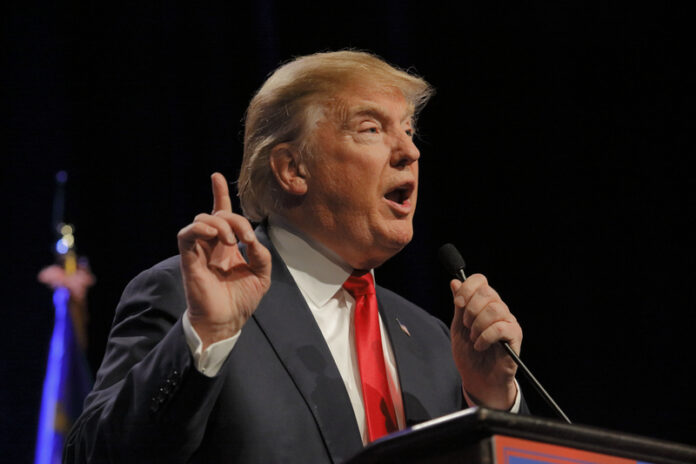
On Tuesday, President Donald Trump reiterated his call for Republicans to take control of elections, undermining the efforts of White House Press Secretary Karoline Leavitt to reinterpret his contentious remarks about federal oversight of voting.
The 79-year-old President echoed comments he made during a podcast interview with Dan Bongino, advocating that Republicans should “nationalize” elections by influencing the process of casting and counting ballots. Trump’s comments came shortly after Leavitt, 28, attempted to downplay his statements by asserting he was speaking about the passage of the SAVE Act.
“I want to see elections be honest,” Trump told reporters in the Oval Office when questioned about his intent behind the idea of federal control over elections.
Trump argued that states act as agents for the federal government in elections and proceeded to accuse several cities, such as Detroit, Michigan, Philadelphia, Pennsylvania, Atlanta, Georgia, and Fulton County, Georgia, of election corruption. These cities are primarily controlled by Democrats.
The President suggested that Republicans should take control of voting in at least 15 locations. He levied unsubstantiated accusations of election fraud and corruption against Democratic-held cities, providing no evidence to back his allegations. Further, Trump made claims about immigrants being brought to the United States to vote illegally, despite the fact that voting by noncitizens is already unlawful.
Earlier that day, Leavitt tried to clarify the president’s statement.
“What the president was referring to is the SAVE Act, which is a significant, sensible legislation that Republicans have backed and that President Trump is committed to signing into law during his tenure,” Leavitt stated.
Nevertheless, Trump did not refer to the SAVE Act during his Monday interview with Bongino. The proposed bill does not authorize the federal government to assume control of elections in particular states. Leavitt maintained that Trump had discussed the SAVE Act with House Speaker Mike Johnson.
The SAVE Act, also known as the Safeguard American Voter Eligibility Act, necessitates proof of citizenship to register to vote. The legislation was passed by the Republican-controlled House.
Trump’s comments represent another attempt to promote misinformation about elections and resurrect unfounded claims that U.S. elections are rigged. He was defeated in the 2020 election by Joe Biden.
The remarks surface as Trump expresses skepticism about his party’s chances in the upcoming November midterm elections. The 2026 midterms pose a significant challenge for Republicans aiming to retain control of Congress.
Even Republican leaders in Congress have resisted Trump’s call to nationalize voting. Senate Majority Leader John Thune expressed his disapproval of federalizing elections. House Speaker Johnson, 54, suggested that Trump was merely voicing his frustration with Democrat-controlled states.
U.S. elections are predominantly regulated by state law, with local officials across the nation administering voting. This system has been a fundamental part of American democracy since its inception, with states maintaining substantial autonomy over election procedures, registration requirements, and ballot counting methods.
The Constitution gives states wide power to conduct elections, with Congress having limited authority to regulate the “times, places and manner” of federal elections. Any move to federalize election administration would face significant constitutional hurdles and necessitate congressional action.
Trump’s call for a federal takeover of elections in specific areas is an unprecedented suggestion from a sitting president. Historical precedents for federal intervention in state elections have been confined to enforcement of voting rights laws, especially in cases of documented discrimination.
Recently, the FBI conducted a raid on the Fulton County, Georgia, elections offices, a location where the president has consistently made unfounded allegations of election fraud. Federal officials seized records but provided scant explanation as the Trump administration continues its quest for supposed voter fraud.
Election security experts point out that U.S. elections involve thousands of separate jurisdictions, each with its own processes and safeguards. This decentralized system makes large-scale fraud exceedingly difficult to orchestrate. Multiple audits and court cases after the 2020 election found no evidence of fraud that could alter the outcome.
The SAVE Act, which Leavitt referenced as the president’s main focus, would shift the burden of proof from election officials to individual voters. Currently, election officials verify eligibility using state and federal databases. The proposed bill would require all Americans to present documentary proof of citizenship when registering to vote or updating their registration.
Under the SAVE Act, government-issued driver’s licenses, including REAL IDs, as well as military and tribal IDs, would not count as sufficient documentation. The legislation would disrupt online and mail-in voter registration processes that millions of Americans currently utilize.
Critics warn that the SAVE Act would create obstacles for millions of U.S. citizens seeking to exercise their right to vote. Birth certificates and passports would become necessary documents for voter registration, potentially disenfranchising citizens who do not readily have access to such papers.
Republicans argue the bill is necessary to prevent noncitizen voting in federal elections. However, research has consistently shown that noncitizen voting is extremely rare in U.S. elections.
Johnson conceded he could not provide proof of fraud but expressed his concerns about Democrat-controlled states. When specifically asked about a “takeover,” Johnson firmly responded, “no, no, no” while departing from reporters.