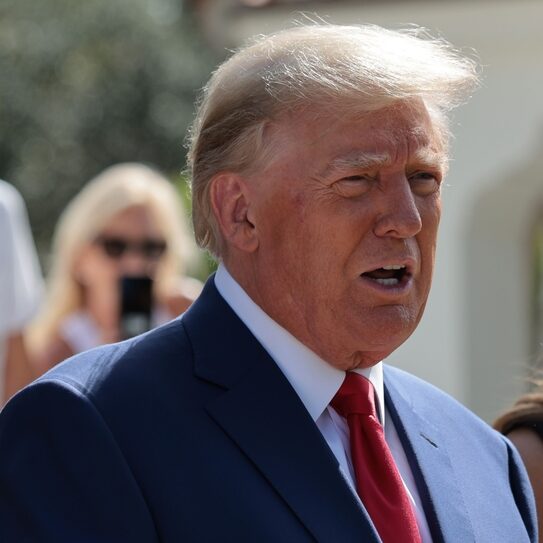
On December 28, President Donald Trump, 79, attracted criticism for his brief and impersonal statement to the families of American citizens who lost their lives fighting in Ukraine. Many critics highlighted the stark contrast between his terse message and his effusive praise for Russian President Vladimir Putin.
After a meeting with Ukrainian President Volodymyr Zelensky at Mar-a-Lago to discuss a potential peace deal, Trump was asked about his message to the families of the deceased Americans. “What a shame. They died in a foreign country,” Trump responded before promptly moving on to the next question.
Approximately 100 Americans have lost their lives fighting in Ukraine, with at least 92 killed as of September 2024, according to The New York Times. Several thousand Americans volunteered to fight for Ukraine after Putin initiated a full-scale invasion in 2022. The majority of the fallen Americans were U.S. military veterans who brought significant combat experience to the conflict.
Among those killed were Mike Meoli, 71, a retired Navy SEAL and firefighter who was killed in an accident in November 2024 while training medics in Ukraine. Nicholas Maimer, 45, an Army Special Forces veteran, was killed in May 2023 during an artillery barrage. Ian Frank Tortorici, 32, a retired U.S. Marine Corps corporal, died in June 2023 when a Russian missile struck a restaurant where he was eating while on leave.
The U.S. government refrained from providing aid to American combatants in Ukraine to avoid a potential direct confrontation with Russia, a nuclear-armed nation.
Trump’s curt condolences were markedly different from his statements about Putin during the same media event. Trump suggested that Putin was generous in his approach towards Ukraine and that he understood Putin’s refusal to agree to a ceasefire. This came despite Putin launching over 100 drones on Christmas Eve and Christmas Day, attacks that resulted in the death of at least seven civilians.
However, days later on January 3, 2026, Trump expressed frustration with the Russian leader, telling reporters at Mar-a-Lago: “I’m not thrilled with Putin. He’s killing too many people.” The comment came during a press conference about U.S. operations in Venezuela, as Trump acknowledged his disappointment with the lack of progress toward ending the war.
Trump’s comments were quickly compared on social media to a controversy from 2018, when Trump was reported to have referred to fallen World War I soldiers as suckers and losers during a visit to France. These comments became a significant issue during Trump’s first term.
Critics pointed out that Trump did not express gratitude to the fallen Americans for their sacrifice, commend their commitment to freedom and democracy, or offer personal condolences to their families. His brief acknowledgment of American deaths and his praise for Putin underscored what many perceived as misplaced priorities during a diplomatic meeting intended to further peace negotiations.
The discussions between Trump and Zelensky were designed to address security guarantees and potential territorial concessions. According to Zelensky, the U.S. has offered Ukraine security guarantees for a period of 15 years, with details including how a peace deal would be monitored and the ‘presence’ of partners, though he did not elaborate on specifics.
Meoli had journeyed to Ukraine specifically to train frontline medics, leveraging his experience as both a military professional and civilian firefighter. Maimer aided in training Ukrainian officers before his death. Tortorici fought on the front lines before being killed during what should have been a brief break from combat.
The meeting at Mar-a-Lago marked a crucial milestone in efforts to broker a resolution to the conflict that began in 2022. Trump has repeatedly pledged to swiftly resolve the war, although the pathway to peace remains uncertain given the significant difference in Russian and Ukrainian positions.
Trump’s comments about understanding Putin’s refusal to agree to a ceasefire might suggest he might lean more towards Russian interests than Ukrainian territorial integrity. This approach has raised concerns among Ukraine’s supporters about whether any peace deal would require significant Ukrainian concessions.