
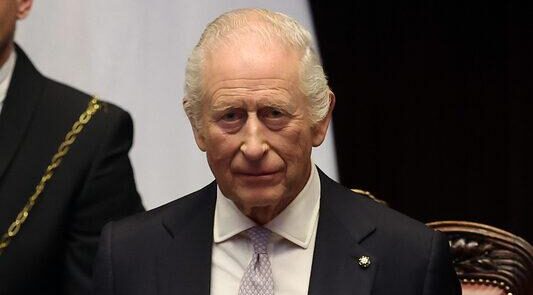
King Charles III’s state visit to Washington in late April was designed to celebrate Anglo-American solidarity, but a witty jab the British monarch delivered at a White House dinner has instead amplified the bitter feud between President Trump and French President Emmanuel Macron.
During the April 28 state dinner, Charles emphasized the enduring bond between Britain and America, referenced his mother Queen Elizabeth II’s 1957 visit that mended the “special relationship” after the Suez crisis, and landed a joke that drew thunderous applause in the East Room. The king quipped that without Britain, Americans would “be speaking French” — a clear riposte to Trump’s earlier claim at Davos that without the United States, Europeans would be speaking German.
Macron seized on the moment immediately. Within hours, he posted on X: “That would be chic!” The Élysée Palace amplified the dig, adding: “If ever… See you at the next Francophonie summit!” French observers read the exchange as a deliberate swipe at both Trump and the carefully choreographed display of Anglo-American unity.
Personal Attacks and Political Fallout
The French president’s playful trolling caps months of escalating hostility between the two leaders, whose relationship has deteriorated sharply since the rapport they enjoyed during Trump’s first term. The most recent explosion came at a White House Easter lunch on April 1, 2026, when Trump lambasted Macron for declining to support the ongoing U.S.-Israeli offensive against Iran. In a rambling monologue, Trump mocked Macron’s marriage to Brigitte and referenced a May 2025 viral video that appeared to show her pushing his face aboard their plane upon landing in Hanoi, Vietnam.
“I called up France, Macron, whose wife treats him extremely badly, (he is) still recovering from the right to the jaw,” Trump said. He then mimicked Macron’s French accent while recounting an alleged conversation about naval support in the Persian Gulf.
Brigitte Macron, 24 years older than her husband, has long been a sensitive subject for the French president. Last year, the couple filed a defamation lawsuit in Delaware Superior Court against U.S. podcaster Candace Owens over baseless conspiracy theories about Brigitte’s identity. The Easter lunch video briefly appeared on a White House YouTube channel before being removed, but not before spreading across France.
While visiting Seoul, South Korea, on April 2, Macron dismissed the remarks as “neither elegant nor up to standard.”
“There is too much talk, and it’s all over the place. We all need stability, calm, a return to peace — this isn’t a show!” Macron told reporters.
A Royal Intervention
Charles arrived in Washington in late April for a four-day state visit tied to the 250th anniversary of U.S. independence. Before the dinner, he delivered a historic address to a joint session of Congress — only the second time a British royal has done so — that proved unexpectedly political. Without naming Iran or Trump directly, the king called for “unyielding resolve” in support of Ukraine, championed NATO unity, invoked Magna Carta as the foundation of checks on executive power, and warned his audience to “ignore the clarion calls to become ever more inward-looking.” The speech drew a bipartisan standing ovation, including from Vice President JD Vance, one of the most prominent skeptics of continued U.S. aid to Kyiv.
The quip at the state dinner handed Macron an irresistible opening, transforming the evening into a three-way diplomatic spectacle.
Yaël Braun-Pivet, president of France’s National Assembly, condemned Trump’s earlier remarks about Macron’s marriage. “We are currently discussing the future of the world. Right now in Iran, this is having consequences for the lives of millions of people. People are dying on the battlefield, and we have a president who is laughing, who is mocking others,” she told French radio station France Info.
Even Manuel Bompard of the hard-left France Unbowed party broke ranks to defend Macron, calling Trump’s comments “absolutely unacceptable.”
Strategic Divides Behind the Insults
The personal insults obscure a deeper strategic divide. While European allies broadly supported U.S.-Israeli strikes on Iran’s nuclear infrastructure last year, the scale and ambiguity of the current campaign have eroded that backing. France has deployed jets and air defense systems to protect Arab allies in the Persian Gulf and stationed naval assets off the coast of Cyprus, an EU member state that has come under drone attack.
But Paris has refused to commit naval forces to reopen the Strait of Hormuz, joining Spain and Italy in barring U.S. aircraft from using its airbases for the bombing campaign. Trump, in turn, has lashed out at NATO allies, branding the alliance a “paper tiger.” The rift widened further on May 4, 2026, when Trump launched “Project Freedom,” deploying 15,000 U.S. personnel and naval assets to guide stranded commercial vessels out of the Strait of Hormuz. Speaking at a European Political Community summit in Yerevan, Armenia, Macron said he did not understand what the initiative entails and declared France would not join any operation under what he called an “unclear framework.” NATO Secretary General Mark Rutte said allies had “gotten the message” from Washington and were pre-positioning minesweepers for a post-war phase, but stopped short of endorsing active involvement now.
Macron’s Campaign for European Autonomy
The current spat is the culmination of months of friction. In a Jan. 8 speech to French ambassadors at the Élysée Palace, Macron accused Washington of “neocolonial aggressiveness”. He warned that the United States “is gradually turning away from some of its allies and breaking free from the international rules that it was until recently promoting.”
That speech came five days after U.S. forces struck Caracas and captured Venezuelan President Nicolás Maduro on Jan. 3, and as the Trump administration continued to insist on a possible acquisition of Greenland. Macron has since used every available platform to push for European strategic autonomy, telling diplomats at Davos that Europe rejects “new colonialism and new imperialism” and that “we do prefer respect to bullies.”
For now, the spectacle of a French president trolling an American one during a British state visit has only deepened the sense that the postwar Western order is fraying in real time. Whether King Charles’ jokes were a subtle rebuke to Trump, a crafty piece of diplomatic theater, or simply royal wit, they accomplished something rare in modern diplomacy: they made everyone watching pick a side.