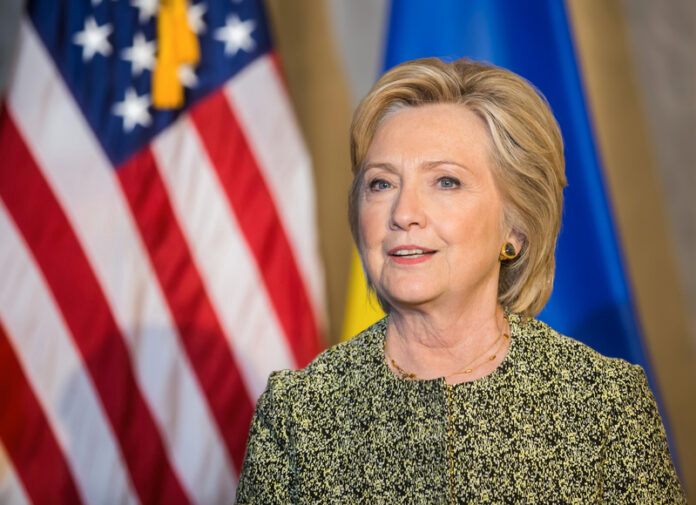
Former Secretary of State Hillary Clinton surprised many by stating she would nominate President Donald Trump for the Nobel Peace Prize if he were able to successfully end the Ukraine war without requiring Ukraine to cede territory to Russia. Clinton’s unexpected announcement came just before Trump’s summit with Russian President Vladimir Putin in Anchorage, Alaska.
Clinton made her remarks while appearing on the “Raging Moderates” podcast, suggesting that Trump could earn the prestigious honor if he addresses the Ukraine situation effectively. “I understand from everything I’ve read that [Trump] would very much like to receive a Nobel Peace Prize,” Clinton stated.
The former Democratic presidential candidate, first lady, and Secretary of State, outlined specific conditions for her support, indicating that Trump would have to end the conflict without compromising Ukraine’s position by granting land to Russia or endorsing Putin’s vision of a greater Russia.
Clinton emphasized that Trump should firmly confront Putin, advocating for a ceasefire without territorial concessions. She also insisted that Putin should retract any territorial gains made over time.
“Look, if we could pull that off, if President Trump were the architect of that, I’d nominate him for a Nobel Peace Prize, because my goal here is not to allow capitulation to Putin, aided and abetted by the United States,” Clinton said.
The statement came as Trump prepared to meet with Putin on Friday, August 15, 2025, at Joint Base Elmendorf-Richardson in Anchorage, Alaska. This was their first in-person meeting since 2019. Alaska holds symbolic significance as it is only about 55 miles from Russia across the Bering Strait.
Trump has been actively working to resolve the Ukraine conflict, ongoing for over three years since Russia’s invasion in February 2022. During his campaign, Trump pledged to end the war swiftly, even claiming he could do so within 24 hours.
However, Trump had indicated that a peace agreement might involve territorial exchanges, a notion that upset Ukrainian officials who maintain they will not cede any land to Russia. Ukrainian President Volodymyr Zelensky reiterated this stance, asserting Ukraine will not give its territory to the occupier.
The Ukrainian constitution prohibits territorial concessions without a national referendum, posing a significant challenge to peace talks involving land swaps.
Trump expressed frustration with both Putin and Zelensky over the slow progress in peace negotiations. He told Fox News Radio before the summit, “I’m convinced that he [Putin] is going to make a deal. He’s going to make a deal. I think he’s going to, and we’re going to find out. I’m going to know very quickly,” Trump said.
The president has portrayed himself as uniquely capable of negotiating with Putin due to their personal relationship and suggested that a successful Alaska meeting might lead to a three-way summit with Zelensky.
Trump’s aspiration for Nobel recognition has been a consistent theme throughout his political career. A White House official mentioned to NBC News that Trump felt he deserved the Nobel Peace Prize but doubted he would receive it, suggesting the prize might instead go to someone who writes about him.
The Trump administration has highlighted the president’s peace-making efforts, with White House Press Secretary Karoline Leavitt stating before the summit that Trump brokered approximately one peace deal or ceasefire per month during his six months in office. She noted it was time for Trump to be awarded the Nobel Peace Prize.
The administration cited several agreements Trump helped facilitate, including “deals” between Armenia and Azerbaijan, India and Pakistan, and Israel and Iran. However, a Russia-Ukraine peace deal would be Trump’s most significant achievement and a promising opportunity for the Nobel Prize.
The war in Ukraine has been the deadliest conflict in Europe in decades, resulting in hundreds of thousands of deaths and millions displaced. European leaders have expressed concerns that any peace deal rewarding Russian aggression could encourage further hostilities from Putin.
The August 15, 2025, summit between Trump and Putin in Alaska concluded without any binding agreement to halt the war in Ukraine. Both leaders described the talks as “productive,” but no concrete deal or ceasefire was reached. Putin said they had reached an “understanding” and floated the possibility of a future meeting in Moscow.
Observers broadly viewed the outcome as a diplomatic win for Russia—Putin secured a symbolic reaffirmation of his international legitimacy and avoided new U.S. sanctions—but gained little in terms of concessions toward a peace process.
Clinton’s offer to nominate Trump marked a notable shift from her typical criticism of his foreign policy. As one of Trump’s strongest Democratic critics, particularly regarding his interactions with Putin, her willingness to support a Nobel nomination underscores the seriousness of the Ukraine crisis and the significance of any successful peace agreement.
Analysts and Nobel watchers caution that Trump’s chances remain very low, citing the Norwegian Nobel Committee’s preference for long-term institution-building, sustained diplomacy, and cautiousness about political lobbying.
AP News recently noted that though Trump has been nominated before (e.g. for the Abraham Accords), his likelihood of winning in 2025 is considered remote.