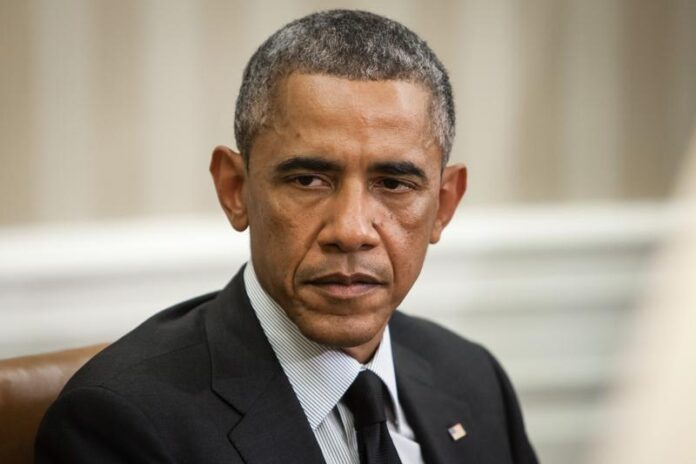
Barack Obama spent most of the midterm campaign on the sidelines, then spent its final week telling crowds that President Trump’s redecorated White House looks like a Cheesecake Factory opened by Saddam Hussein.
The midterm campaign ended Tuesday, Nov. 3, 2026, with Democrats winning control of both chambers of Congress, and the former president answered the outcome publicly, celebrating a Democratic comeback.
Democrats flipped Republican-held Senate seats in several states, a rebuke to Trump and the Republican Party. Voters decided all 435 House seats and 35 of the 100 Senate seats, and the results hand the House and Senate to Democrats for the rest of Trump’s second term.
Before the vote, nonpartisan analysts generally favored Democrats to capture the House, while they saw the Senate fight as very close.
Why Democrats Kept Him Offstage
The 2026 campaign ran on anti-incumbent sentiment, with some candidates shrugging off party labels and casting themselves as outsiders against the Washington establishment. Against that backdrop, Obama — 65 years old and out of office for nearly a decade — was not the obvious closer, and party strategists treated his late deployment as a calculated gamble.
Obama, America’s first Black president, stayed relatively quiet in public until the closing stretch, leaving room for a new generation of Democratic candidates to build their own identities before his star power arrived at the end. The stakes finally drove him back to the trail.
Trump spent the weeks before the vote holding grievance-filled rallies in traditional Republican strongholds, a blitz that underlined Republican fear of losing Congress for the last two years of his presidency. Neither man was on the ballot. Both took prominent roles in the campaign’s final week.
A Last, Best Chance in Georgia
Obama rallied voters in Morrow, Ga., near Atlanta, on Wednesday, Oct. 28, for Democratic Sen. Jon Ossoff and Democratic gubernatorial nominee Keisha Lance Bottoms. He hit tariffs and the war in Iran, mocked what he called Trump’s autocratic pretensions and derided his foreign policy misadventures in the Middle East. The suburban Atlanta arena crowd revived the chant of his 2008 campaign.
“This election is our last, best chance of at least reining him in, reining in some of the foolishness of this administration,” he said in Georgia.
Trump stumped the same day in Chillicothe, Ohio. Ossoff went on to win reelection over Republican Rep. Mike Collins.
When Saddam Met the Cheesecake Factory
Obama’s farthest-traveling line came at a rally in Cleveland, Ohio, where he said Trump’s gold-encrusted renovations left the White House looking as if “Saddam Hussein opened a Cheesecake Factory.” Right-wing media turned it into a mini-culture war — and the fight was not about the name-check of a murderous Iraqi dictator. Commentators objected to the use of a popular restaurant chain as shorthand for vulgar excess.
Trump answered the closing run of speeches with an impression of a lettuce leaf, waving his arms to mimic it and accusing Obama of snobbery. “Every piece of lettuce he eats has to be perfect, and I’m not that choosy,” he said. He defended his gilded decor and said Obama had left the executive mansion deteriorated.
Obama responded to the Republican criticism by name-checking the middle-class restaurants he patronized with his daughters: California Pizza Kitchen, Cheesecake Factory and Chuck E. Cheese.
He pointed to the episode as evidence of an administration mounting a government-wide response to a joke rather than to inflation. “These are not serious people. They don’t have solutions to actual problems,” he said, adding that Republicans would rather have “phony outrage.” Of the president, he said: “The president wasn’t even mad about the Saddam Hussein comparison.”
The rebuttal came on a sidewalk. Treasury Secretary Scott Bessent, a wealthy former hedge fund manager, staged a photo-op outside a Cheesecake Factory in Washington and ordered a French-dip cheeseburger, in an apparent attempt to knock down accusations of elitism. He urged critics to sample the chain’s multi-page menu.
The Knucklehead Line in Detroit
Obama also campaigned in Detroit for Senate candidate Abdul El-Sayed, who won Michigan’s Senate seat and will become the first Muslim U.S. senator. Obama acknowledged El-Sayed’s criticism of aspects of his own presidency, then defused it, telling the crowd that Michelle Obama does not agree with everything he does either — about five times a day, he said, his wife calls him a knucklehead and asks why he did whatever he just did.
The crowd laughed. The moment amounted to an attempt to stitch together two versions of the Democratic Party, the old and the new, on one stage.
David Litt, a former Obama White House speechwriter, said Obama still carries credibility and can drive turnout in a close race, particularly among young voters and Black voters, because he arrives to back candidates who emerged on their own. Litt added that attention is scarce in modern politics and that Obama can still command it — including from his successor, who keeps relitigating his own White House renovations instead of selling his record.
The White House, meanwhile, is still arguing about a chain restaurant.