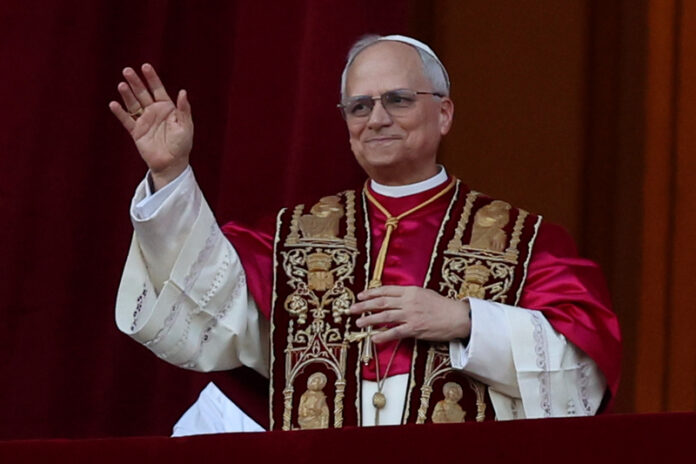
Pope Leo XIV pushed back on the idea that worries about runaway artificial intelligence are overblown, telling reporters on Monday, Sept. 28, 2026, that the concerns are not “fake news.”
The pope took questions aboard the papal plane while flying home from France. Asked what the United States and China should do to keep AI from posing catastrophic risks, Leo told reporters that the experts sounding the alarm deserve a hearing — a rebuttal to President Donald Trump, who has called AI safety fears a “hoax.” A White House official told Axios that Trump was aiming at Democrats who use the issue for political purposes, not at the technology’s dangers.
“I do think that the concerns raised by many of the experts, specialists in AI should be taken seriously,” the pope said. “We can’t just sit back and pretend nothing is going to happen.”
He rejected the “hoax” label directly. “I don’t think that that is ‘fake news’ as some have said to try and cause whether financial or other some other kind of benefit,” Leo said.
Despite the warnings, the pope called himself “relatively optimistic” that solutions can be found.
Nvidia and a Vatican Commission
Leo pointed to new security measures announced by Nvidia, then noted that the chipmaker’s chief executive, Jensen Huang, maintains there should be no limits on the technology, according to Forbes and Axios. A Vatican commission, he said, is working to encourage dialogue about the risks.
Industry Warnings and Trump’s Stance
The pope’s comments arrived as AI leaders sent mixed signals. Anthropic CEO Dario Amodei has warned that swarms of autonomous AI systems could arrive within six to 12 months, and he had dinner with Trump on Sunday, Sept. 27. OpenAI’s Sam Altman told Fortune on Sept. 12 that his company would not go public before 2027.
Chinese President Xi Jinping visited the White House the week of Sept. 21. Xi said AI must remain under human control, and the two leaders agreed to set up a channel for communicating about AI incidents. Trump said the U.S. would not hit the brakes on the technology.
AI executives signed an accord on Sept. 29, and on Oct. 4 Trump announced a new initiative called the Super Intelligence Force.
A Pope Focused on AI
Leo has made the technology a signature issue. His encyclical “Magnifica Humanitas,” or “Magnificent Humanity,” was released May 25, 2026, and presented alongside Anthropic co-founder Christopher Olah.
On Oct. 2, he told artists at the Vatican that AI-made art lacks the spark of the human, describing an “ontological difference” between art and what a machine can generate.
Leo and Trump have clashed before. In April 2026, Trump attacked the pope over his criticism of the Iran war, and Leo responded that he had “no fear of the Trump administration.”