
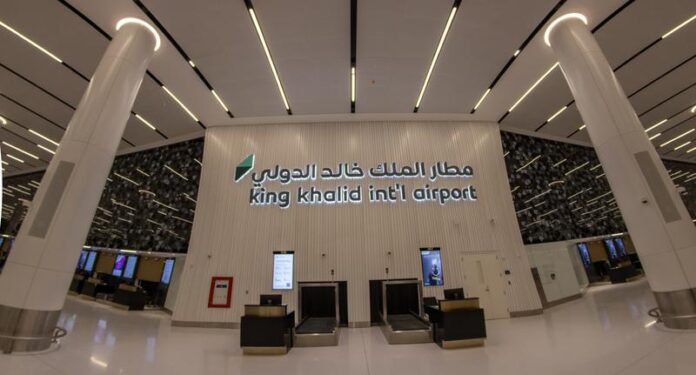
A Houthi missile struck the passenger terminal at King Khalid International Airport in Riyadh on Saturday, Oct. 10, 2026, killing 13 people, including an American citizen, and injuring 309. The attack was the deadliest in Saudi Arabia in more than a decade.
Maj. Gen. Turki Al Maliki, spokesman for the Saudi-led coalition, said the Houthis have attacked King Khalid International Airport 20 times since Oct. 1, at a press conference in Riyadh on Thursday, Oct. 15.
Al Maliki said strikes between Oct. 7 and Oct. 11 killed 17 people and injured 333. He said the Oct. 10 attack involved 10 drones as well as missiles and other projectiles.
An unidentified projectile hit the airport again on Sunday, striking Terminal 4 and starting a fire. Saudi civil aviation authorities said that strike killed one person and wounded 11 others. Saudi authorities said the person killed Sunday was a Pakistani national, and did not name him. The two strikes killed at least 14 people in total.
Saudi Arabia’s General Authority of Civil Aviation said the Riyadh airport was also hit twice on Oct. 8, with one strike on airport facilities and another on a Saudia aircraft that killed three Saudi nationals.
Video Shows Moment of Impact
Saudi Arabia’s Media Ministry released video of the moment of impact on Monday, Oct. 12. The footage shows travelers standing in orderly lines, waiting, and then the blast. Smoke swallows the hall and fire takes hold. Some passengers dive for cover while others sprint through security checkpoints. Airport workers crouch beneath their desks as pieces of the roof come down toward the floor.
Saudi authorities released other security-camera video showing travelers in line, many of them in white pilgrim robes. A fireball sent them scrambling, and flaming debris fell from the ceiling.
The Dead and the Wounded
The first official count from Saudi authorities put the toll at 12 dead and 309 injured, several of them critically. Mohammed Yusuf Ali, an Indian national from Hyderabad’s Mehdipatnam, died of his wounds on Sunday, pushing the number of dead to 13. The Indian Embassy in Riyadh confirmed his death in a post on X.
Two sons of Hyderabad lawmaker Asaduddin Owaisi were also hurt, along with an aunt, he said. Funeral rites were completed Oct. 12 in Riyadh, according to the embassy. The embassy said that of the 11 Indians injured, as of Tuesday four were in intensive care, four were in general wards and three had been discharged.
The remaining victims, according to a Saudi statement, were four Saudi citizens, two Bangladeshis, one Egyptian, one Jordanian, one Palestinian, one Syrian, one Sudanese and one American.
Azza Ramzi Mohamed Hassan, 28, a flight attendant with the Saudi carrier flynas, was among the dead, Egyptian media reports said. The Syrian Embassy identified Buthaina Ahmad Oweida as another of the dead. Oweida was a widow and a mother of four who had been living in Makkah and was returning from visiting her sister in Riyadh, her niece told The Associated Press.
Six Pakistani nationals were injured, Pakistani Prime Minister Shehbaz Sharif said. Three Filipinos were hurt, Philippines Migrant Workers Secretary Hans Leo Cacdac said, and two were recovering in intensive care units at Riyadh hospitals.
Interceptions and Houthi Claims
Coalition forces said their air defenses intercepted and destroyed a cruise missile in the vicinity of the airport that day, Sunday. The coalition later reported a drone destroyed in the Eastern Province, and said early Monday that a ballistic missile aimed at Khamis Mushait had been brought down.
In a televised speech on Sunday, the Houthi military spokesperson, Yahya Saree, took responsibility for Saturday’s attack. The group also struck King Fahd International Airport in Dammam and two Saudi Aramco facilities, Saree said. A passenger on a plane taxiing in Dammam told Reuters that a projectile struck the tarmac near parked aircraft at about 8:30 p.m. (1730 GMT) Sunday and started a fire.
The Houthis said the strikes answered Saudi attacks in Yemen. They asserted that a Saudi strike on a house wounded a woman and three children, and that the kingdom carried out 124 airstrikes in Yemen over the preceding 24 hours.
The group renewed its warning against using Saudi airports earlier Sunday. “We urge everyone to take our warnings seriously, and Saudi Arabia bears responsibility for any failed interceptions,” the group said.
The Houthis claimed new strikes on Riyadh’s airport and an air base at Khamis Mushait on Monday, Oct. 12, and the coalition said that day that it destroyed a ballistic missile aimed at Riyadh, according to ABC News Australia. An initial Saudi review found that drones were launched first to clear the way for cruise and ballistic missiles, and that the missiles flew more than 600 miles, the same report said.
The coalition said on Tuesday, Oct. 13, that it destroyed cruise missiles and two drones over Riyadh and southern areas. A witness told AFP he “saw a projectile cutting across the sky” above a mall. Debris from missiles intercepted Tuesday damaged 15 homes in Riyadh and injured four people.
The coalition said on Wednesday, Oct. 14, that it intercepted another Houthi ballistic missile aimed at the capital. The Houthis said that day that they targeted the airport, an Aramco refinery in Riyadh and Aramco facilities in Dhahran. The Saudi Energy Ministry confirmed that an administrative building in Dhahran was hit.
The coalition said Thursday, Oct. 15, that it intercepted and destroyed a cruise missile in the Madinah region. Saree denied the group carried out any operation against Saudi territory that day and dismissed the Saudi account as false.
Al Maliki announced coalition strikes in Sanaa, Dhamar and Saada on facilities used to “supply the war effort.”
Airport Closed, Flights Canceled
The airport has been closed since Saturday’s attack. Airlines canceled hundreds of flights scheduled to arrive at or depart from Riyadh on Monday. Saudi authorities extended the closure to Saturday, Oct. 17, ABC News Australia reported Tuesday.
The aviation analytics firm Cirium said 3,129 of 7,705 scheduled Saudi departures between Oct. 8 and Oct. 14 were canceled or marked no-fly as of 8 p.m. Riyadh time on Oct. 13, or 40.61 percent. Cirium said 296 of 334 departures from Riyadh were affected on Oct. 13, or 88.62 percent.
Emirates, Etihad Airways, FlyDubai and Air Arabia made cancellations and schedule changes on routes between the United Arab Emirates and Saudi Arabia. Air India and Air India Express suspended flights to Riyadh, Dammam and Jeddah until Oct. 17. IndiGo issued a travel advisory canceling flights to and from Riyadh, Jeddah, Dammam and Madinah through Oct. 24. Etihad canceled Abu Dhabi–Riyadh and Abu Dhabi–Dammam flights through Oct. 18, as of Oct. 15.
The five-day WPC Energy conference opened as planned Sunday at a Riyadh convention center. The second European Union–Gulf Cooperation Council summit, due in Riyadh on Oct. 24, has been postponed, and a new date is to be announced, as of Oct. 15.
Advisories and Reaction
Americans were told to watch for flight cancellations and airspace closures in a warning from the U.S. Embassy and consulates in Saudi Arabia, which noted that special authorization is required for U.S. government employees to use King Khalid Airport. Canadian officials advised their citizens to avoid the Riyadh airport. Britain’s embassy warned British nationals away from every Saudi airport except Medina, including Jeddah and Dammam, unless their trip was essential. American carriers were told by U.S. aviation authorities to use caution flying to or over Saudi Arabia.
Al Maliki called the attack a war crime. A violation of Saudi sovereignty was how the UAE Ministry of Foreign Affairs described the strikes in condemning them.
Joining Saudi strikes on the Houthis was under consideration by the United States, President Donald Trump said Saturday. The United States had not carried out strikes on the Houthis as of Tuesday.
Iran’s Foreign Minister Abbas Araqchi wrote on Telegram that he told his Saudi counterpart Tehran was ready to facilitate dialogue between Saudi Arabia and Yemen.
Saudi energy minister Prince Abdul Aziz bin Salman said the kingdom’s answer “must be equally serious.”