
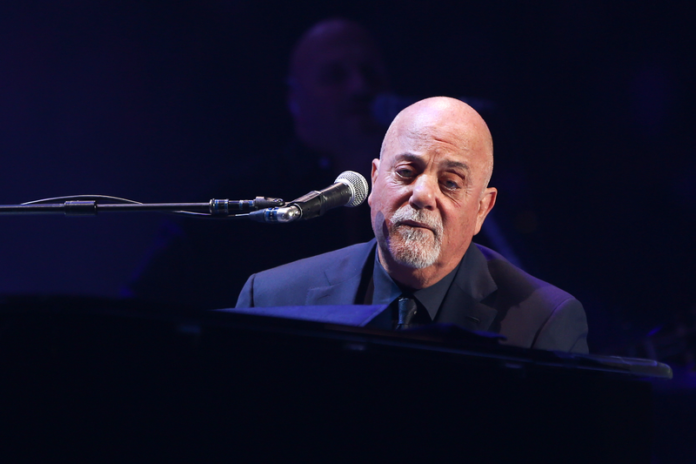
Billy Joel has an answer for the fans who have worried about him since he walked away from the stage: he had brain surgery, and he says it helped. The 77-year-old singer-songwriter behind “Piano Man” and “Uptown Girl” said on SiriusXM’s The Billy Joel Channel on Wednesday, September 9, 2026, that he agreed to have a shunt implanted in his brain to treat normal pressure hydrocephalus, the disorder he was diagnosed with in 2025.
“They implanted a shunt in my brain and it actually improved things,” he said. “My memory got better, my balance got a little better, my ability to function was better.”
When Joel disclosed the diagnosis on May 23, 2025, he also canceled all 17 of his scheduled concerts, a run that took in the United States, Canada and the U.K. and stretched into July 2026. The announcement said the condition “has been exacerbated by recent concert performances, leading to problems with hearing, vision, and balance,” and that he had been advised to stop performing while he recovered. “I’m sincerely sorry to disappoint our audience, and thank you for understanding,” he said at the time.
How the Symptoms Started
His balance went first. “I had this sense of being on a boat, like this rocking motion,” Joel said. “I wasn’t steady on my feet.” He had put it in nearly the same terms on Bill Maher’s podcast in July 2025: “My balance sucks. It’s like being on a boat.”
A visit to a neurologist produced the diagnosis of normal pressure hydrocephalus — “what they used to call water on the brain,” as he put it. He was told the condition could be progressive, and the recommendation was a shunt, a thin tube implanted to drain excess fluid.
Why He Turned Down Surgery at First
He said no at first. “I said, ‘Well, what does that entail?’ ‘Well, we drill a hole through your skull and we stick a shunt inside your brain.’ I said, ‘Nah, I think I’ll pass on that,’” he told the channel.
“But then I read up on it and I realized it can help improve your balance and can help your memory,” he said. “You know, I don’t want to lose my marbles. It’s hard to tell what’s age and what’s a condition.” He has not said when the operation took place.
What Normal Pressure Hydrocephalus Is
The neurological institute at the National Institutes of Health describes hydrocephalus as an abnormal buildup of cerebrospinal fluid deep within the brain. That extra fluid widens the ventricles, the brain’s cavities, “putting harmful pressure on the brain’s tissues.” The normal-pressure form, the institute says, “causes problems with walking, bladder control, and difficulties thinking and reasoning,” and although it can happen at any age, it is most common in older adults. Surgery is the usual treatment — a shunt, or a procedure that opens a new route for the fluid to drain.
Nobody is certain what causes hydrocephalus, Joel said. His own doctors, he said, pointed to his line of work.
What He Says His Doctors Told Him
“Because of my job, which is playing rock ’n’ roll music very loud, that it was giving me something like a concussion every time I did a show,” Joel said. “It was causing damage to my brain nerves, and I could be losing more brain cells the more shows I did, and I realized that means I shouldn’t be doing this right now. I got to improve.”
That account is Joel’s own, relayed from his doctors, and it sits outside the published record. Loud noise does not appear among the causes listed by the neurological institute, the Mayo Clinic, the Cleveland Clinic or the Hydrocephalus Association, all of which point instead to blocked or poorly absorbed fluid, bleeding, tumors, infection and head injury. Joel fell onstage at Mohegan Sun in February 2025, and head trauma is a recognized cause. His own announcement last year said only that concerts had aggravated the condition, not caused it.
For a performer whose catalog — “Piano Man,” “Uptown Girl,” “Vienna” — has kept arenas full for decades, it was a blunt verdict, and it recast the cancellations announced in May 2025 as something closer to medical necessity than a scheduling problem.
Where His Recovery Stands Now
Joel said he is doing physical therapy and following his doctors’ instructions to the letter. “They don’t want me to stress too much,” he said. “I’m doing whatever it is they tell me to do, because I don’t want to lose it, you know? So I’m always testing myself.”
He has already had one taste of the old life. Joel turned up unannounced at the Wellington Amphitheater in Wellington, Florida, on Friday, January 2, 2026, during the village’s 30th birthday celebration, and joined the Billy Joel tribute band Turnstiles for “We Didn’t Start the Fire” and “Big Shot.” It was his first performance since the diagnosis. He was 76 then, and his wife, Alexis Roderick, helped him to the stage, where he arrived with a cane. “I wasn’t planning on working tonight,” he told the crowd.
No return to touring has been announced, and his medical team is still setting the pace; he has no dates on the books. The message he wanted fans to hear was simpler than any of the medical detail. “I just want people to know, don’t worry about me,” Joel said. “I’m not going anywhere. I’m here. I’m still here.”
That line acquired an unwelcome second life on Thursday, September 17, when Google’s search results briefly showed Joel as having died that day. His publicist, Claire Mercuri, shot it down: “Billy’s not dead. I was just emailing with him.”