
Europe’s oldest monarch is dead at 89. King Harald V of Norway died at 6:35 a.m. on August 28, 2026, at Rikshospitalet in Oslo, bringing to a close a reign of 35 years that remade the country’s monarchy.
Word of the death came from the Royal House of Norway, in a notice on its website. The king had been taken to the hospital on August 17 for treatment of hemolytic anemia, in which red blood cells are destroyed faster than the body can replace them. He was admitted with a buildup of fluid that the palace said came not from the disease itself but from the cortisone he had been given to treat it. An infection followed, and his health declined sharply in his final days.
His only son, Haakon, 53, succeeds him and takes the regnal name Haakon VIII, the name a monarch rules under rather than the one on the birth certificate. A specially convened session of the council of state met later on August 28, where the new king formally informed his ministers of his father’s death. On September 1, he swore an oath of allegiance to Norway’s constitution before the Storting, promising in the words the constitution sets down to govern the kingdom in accordance with its laws. His daughter sat beside him; his wife, recovering from a lung transplant, did not. GB News reported on September 1 that the new Queen Mette-Marit missed the ceremony after “health complications,” with Princess Ingrid Alexandra accompanying her father instead — the first time the future monarch has taken part alongside a new sovereign. He has adopted the motto “All for Norway,” which dates back to his great-grandfather. Haakon’s daughter, Ingrid Alexandra, Harald’s granddaughter, becomes crown princess and heir to the Norwegian throne.
Delivering his first speech as monarch, broadcast live on public television at 7 p.m. on Saturday, August 29, King Haakon VIII eulogized his father: “I’m going to miss him. I’ll miss his laughter. His good-natured way of dealing with people and situations.” He also said: “Dear father, thank you for being a good father to Martha and me.” Holding back tears, he vowed to give everything for the country, saying being king “means — in the ultimate sense — being willing to risk everything, even one’s life, for Norway’s freedom and independence.”
Norway Enters National Mourning
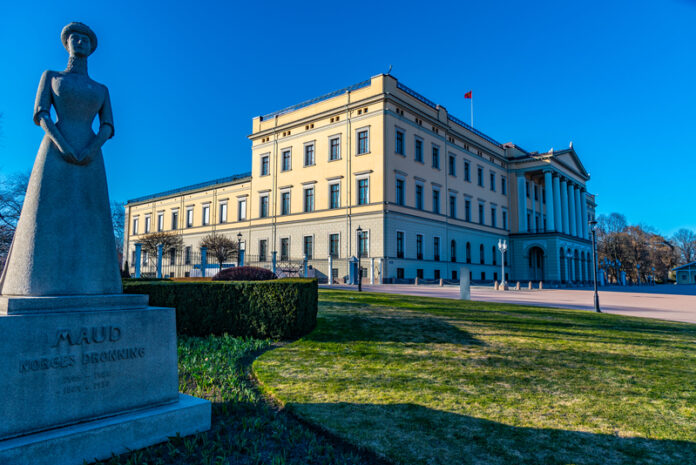
Above the palace in Oslo, the royal flag was lowered to half-mast as the country began a period of national mourning that runs until after the funeral. His coffin had been brought to the royal palace from the hospital that same Friday, August 28, and mourners packed the grounds in the days that followed, leaving flowers and flags at the gates. On the Friday night, huge crowds stood in pouring rain to watch the cortege travel from Oslo University Hospital to the palace.
The coffin was moved to the palace chapel late on Monday, August 31, and the public may file past it from 2 p.m. on September 1, then daily from 10 a.m. until 6 p.m. through September 8. More than 20,000 people had paid their respects at the Royal Palace by Saturday, August 29, with floral tributes piling up outside. Mourners queued for about three hours on September 2; the court expects at least 100,000 to pass through. The royal court has set the funeral for 1 p.m. on Wednesday, September 9, at Oslo Cathedral, led by Norway’s archbishop, Olav Fykse Tveit, with Oslo’s bishop, Sunniva Gylver. Processions will carry the coffin from the palace to the cathedral and afterward to Akershus Castle and Fortress, where the king will be laid in a sarcophagus beside his father and grandfather. Marius Borg Høiby, the queen’s son from a previous relationship, has been allowed to attend the funeral. King Willem-Alexander and Queen Máxima of the Netherlands are among those confirmed to attend, with Princess Amalia and Princess Beatrix; so are Denmark’s King Frederik and Queen Mary, who postponed a state visit to Belgium; Belgium’s King Philippe and Queen Mathilde; and Japan’s Crown Prince Akishino and Crown Princess Kiko. Norwegian security services are preparing for a possible visit by President Trump, whose attendance has not been confirmed.
Tens of thousands of Norwegians queued at cathedrals and churches nationwide for memorial services on Sunday, August 30, with the royal family attending a service at Asker Church, southwest of Oslo. Opening the service at Oslo Cathedral, Dean Pål Kristian Balstad said: “This Sunday is different. His Majesty King Harald is dead. A family has lost their spouse, father, grandfather, father-in-law.” Outside the palace, Veselina Vitanova, 43, a Bulgarian-born teacher, said of the late king: “So, thanks to him, I feel so Norwegian.” Some Norwegians postponed weddings and baptisms until after the mourning period.
Norwegian Prime Minister Jonas Gahr Støre said in a speech that “a whole nation is in mourning.” Norwegians, he said, were left with profound thankfulness for a lifetime given over to the service of the country. As flags were lowered to half-mast and church bells rang nationwide, Støre said: “An era has ended. A new one begins. The king is dead. Long live the king.”
Messages arrived from the Swedish, Danish and British royal households, and from political leaders in several countries. Britain’s King Charles III — whose mother, the late Queen Elizabeth II, was Harald’s second cousin — offered his most heartfelt condolences over the loss of a dear cousin. Warmth and humility, he said, had marked the way Harald guided Norway through times of great change, his “kindness, compassion and deep sense of duty” echoing from across the sea. Union flags flew at half-mast at Buckingham Palace, Clarence House, Windsor Castle and Holyroodhouse following Harald’s death, and Princess Anne is one of King Haakon’s godparents, alongside the late King Olav V, Princess Astrid of Norway, the late Prince Carl Bernadotte of Sweden, King Carl XVI Gustaf and Queen Margrethe of Denmark.
Sweden’s King Carl XVI Gustaf, godfather to the new Norwegian king, described Harald as a good friend to himself, to his family and to Sweden, and wished Haakon success and good fortune. Denmark’s King Frederik and Queen Mary called him “an extraordinary man, with a twinkle in his eye and a big heart,” recalling his unwavering calm, which put others at ease, and a warm, dry sense of humor.
In a Truth Social post on August 28, U.S. President Donald Trump described the late king as a “strong, proud, and greatly respected man,” highlighting Harald’s love for his country and the deep respect he had from the Norwegian people.
A Childhood Spent in Wartime Exile
Harald was born on February 21, 1937, at the Skaugum estate outside Oslo — the first Norwegian king born on home soil since the 14th century. The only son among three children, he stood to inherit a crown that the constitution of the day reserved for male heirs.
Nazi German forces invaded Norway during World War II when he was three years old. His mother, Crown Princess Märtha, fled to Sweden with her children; a few months on, at the invitation of President Franklin D. Roosevelt, the family sailed to the United States. They settled at Pooks Hill in Bethesda, Md. His grandfather, King Haakon VII, and his father, the future King Olav V, moved separately over the course of the war.
Harald was named crown prince in 1957, and between 1960 and 1962 he read social science, history and economics at Balliol College, Oxford. Sailing was a lifelong enthusiasm that he carried with him into his reign. Three times he sailed for Norway at the Olympics: Tokyo in 1964, where he carried the flag at the opening ceremony, then Mexico City in 1968 and Munich in 1972. An Olympic medal never came, though he took gold, silver and bronze at World Championships.
The King Who Wed a Commoner
Harald met Sonja Haraldsen at a party. She was the daughter of a businessman, and nine years passed before he was granted permission to marry her. They wed at Oslo Cathedral on August 29, 1968. Caroline Vagle, royal expert at Se og Hør magazine, said the match was a departure from royal tradition that helped close the chapter on a very male-dominated royal family. It also cleared the way for Harald’s two children to also marry commoners.
Harald came to the throne in 1991 at the age of 53. At their own request, he and Queen Sonja marked the accession with a consecration ceremony drawing on traditions rooted in the Middle Ages, held at Nidaros Cathedral in Trondheim on June 23, 1991. Next came a 10-day tour of southern Norway, and in 1992 the couple traveled for 22 days through the country’s four northernmost counties.
Like his father before him, Harald was known as the “people’s king.” Ole-Jørgen Schulsrud-Hansen, a historian and royal correspondent for TV 2, said the monarchy under his reign grew more egalitarian and more forthcoming about royal finances and health matters. Tove Taalesen, royal correspondent for Nettavisen, described the late monarch as one of the people, and Vagle said he had never drifted far from ordinary Norwegians.
“He has never been afraid to show emotion, humour or vulnerability, and that has made him very human,” Vagle told the BBC.
That instinct showed itself in 2011, after a bomber struck Oslo and a gunman opened fire on the island of Utøya. Harald urged Norwegians to stand by one another and refuse to let fear take over.
A Succession Under Family Strain
For the royal family, the handover arrives at a difficult moment. Haakon’s wife, Mette-Marit, who now becomes queen consort, has pulmonary fibrosis and underwent a lung transplant in June. Complications kept her from the Storting on September 1; King Haakon drove her to the National Hospital in Oslo that morning. “It is not uncommon for complications to occur after a lung transplant,” her pulmonologist, Are Holm, said. “The Queen has had complications on some occasions since the operation, including today.” She had to be observed through the day, he said. Crown Princess Ingrid Alexandra, 22, took the seat beside her father and signed her own oath in writing at the palace.
Her earlier contact with Jeffrey Epstein, the late sex offender, became public in February. And Oslo District Court convicted her son from a previous relationship, Marius Borg Høiby, on June 15 of two rapes and of abuse in a close relationship, acquitting him of two further rape charges and sentencing him to four years. Both he and the prosecution have appealed, and he is serving the sentence under house arrest with an ankle tag while he waits. Prosecutors granted him leave to attend the transfer of the coffin and the funeral. On September 2, the state attorney recommended that the Borgarting Court of Appeal refuse to hear his appeal at all, arguing the evidence against him was extensive; the court has yet to decide, and no hearing is expected before 2027.
A Norstat poll for NRK released on September 1 put support for the monarchy at 72 percent, up from 64 percent in May, with 20 percent preferring a republic. Queen Sonja, Harald’s wife of almost 58 years, survives him, along with their daughter, Princess Märtha Louise, their son, the new king, five grandchildren and a step-grandchild.