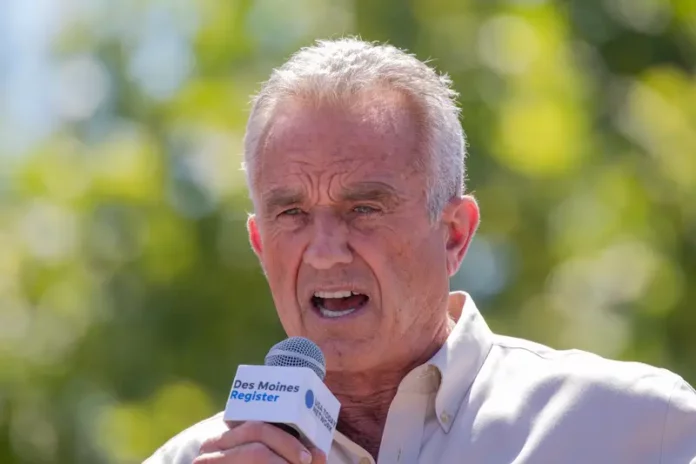
President Donald Trump berated Health and Human Services Secretary Robert F. Kennedy Jr. during an Oval Office meeting in June, warning him that he would be judged a failure if he could not demonstrate a long-disproven link between childhood vaccines and autism, according to a newly leaked account. The president complained that Kennedy had not done enough to establish the alleged connection and felt his health secretary should have accomplished more during his year and a half atop the department.
The confrontation reportedly left Kennedy, one of the country’s most prominent vaccine skeptics, taken aback by the intensity of the pressure. It was not the first time Trump had pushed the issue. At a May luncheon held at the president’s Virginia golf property, Trump questioned Kennedy about the pace of his efforts to examine the purported autism connection, accusing the health secretary of getting the “yips” for his hesitation, according to sources cited in the reporting.
A President Fixated on a Debunked Claim
While Trump, 80, has promoted COVID-19 vaccination and taken credit for Operation Warp Speed, he is not as deeply skeptical of immunizations as Kennedy, 72. However, Trump has long harbored doubts about vaccinating children and has repeatedly floated the idea of a link to autism — a claim with no scientific basis. He is reportedly so consumed by the matter that he “steers nearly every conversation” he has with Kennedy back to it. The president has also advanced the disputed assertion that pregnant women taking Tylenol may cause autism.
White House spokesman Kush Desai defended the administration’s approach, saying parents’ concerns about rising autism rates had been ignored or mocked, and that officials were committed to investigating them using rigorous science.
A department spokesperson declined to discuss private conversations between the two men but said Kennedy and Trump were aligned in their commitment to addressing chronic disease among American children through rigorous science.
Policy Follows the Pressure
The behind-the-scenes friction has coincided with sweeping policy changes. In May, Trump signed an executive order to sharply cut the number of vaccines given to American children. The order backed a department report recommending that routine childhood vaccinations be reduced from 17 to 11. The president has additionally weighed splitting the measles, mumps and rubella (MMR) vaccine into three separate shots, despite no scientific justification for doing so and numerous studies showing no connection between the MMR vaccine and autism.
The push comes as public health experts warn the consequences are already being felt. This year is seeing a record number of measles cases — the highest since the disease was declared eliminated in the United States in 2000. Cases of measles, pertussis and other serious infectious diseases are occurring primarily among unvaccinated, otherwise healthy individuals.
A Department of Health and Human Services video released in late 2025 drew sharp criticism from the Infectious Diseases Society of America (IDSA) for presenting immunizations as competing with healthy eating, physical activity and clean water initiatives. Dr. Tina Tan, the organization’s president, said in a public statement that Americans deserve access to evidence-based information and safe, effective vaccines. The group noted that decades of declines in infectious-disease deaths came only after vaccines were introduced and widely used.
A Controversial Tenure From the Start
Kennedy’s confirmation was contentious from the outset. On Feb. 14, 2025, the Senate confirmed him by a 52-48 vote as the 26th secretary of the department, which oversees $1.7 trillion in federal spending. Supreme Court Justice Neil Gorsuch swore him in, and Trump signed an executive order on childhood chronic disease the same day. Kennedy, who is not a medical doctor, scientist or health researcher, has for years sown doubt about vaccine safety and endorsed beliefs that Wi-Fi signals are linked to cancer, that coronavirus vaccines were designed to control people through computer chips, and that HIV infections do not lead to AIDS. His promotion of vaccine skepticism has been associated with a deadly 2019 measles epidemic in Samoa that claimed 83 lives.
His public statements as secretary have continued to draw scrutiny. In a September 2025 Senate hearing, he claimed CDC data show roughly 76% of Americans have a chronic disease and, when Sen. Mark Warner asked how many people had died of COVID, said he did not think anyone knew. Dr. Richard Besser, a former acting CDC director, pushed back on several of Kennedy’s assertions, telling PBS News that over a million lives were saved in the United States because of COVID vaccines.
The White House had earlier urged Kennedy to soften his public distrust of vaccines out of concern it could hurt Republicans in November’s midterm elections. The reported June clash suggests those tensions have not eased — and that Trump wants results.