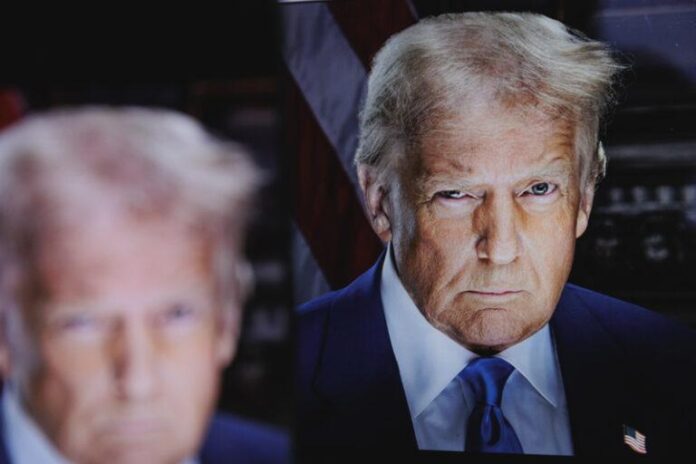
Less than 24 hours after a gunman opened fire at the White House Correspondents’ Dinner, President Trump erupted at CBS News correspondent Norah O’Donnell during a “60 Minutes” interview on Sunday, April 26, 2026, calling her “a disgrace” and “horrible people” as she attempted to question him about the suspect’s manifesto.
The outburst shattered a brief period of goodwill Trump had extended toward journalists who survived the attack alongside him, demonstrating how quickly any detente between the president and the media could collapse.
The clash occurred when O’Donnell quoted from writings that suspect Cole Tomas Allen emailed to family members minutes before the attack — passages that appear to reference sexual assault, pedophilia, and treason allegations against the president. Trump cut her off before she could finish.
“I was waiting for you to read that because I knew you would, because you’re horrible people. Horrible people,” Trump said, before adding, “Yeah, he did write that.” He then declared, “I’m not a rapist. I didn’t rape anybody.”
“You shouldn’t be reading that on ’60 Minutes.’ You’re a disgrace,” Trump told O’Donnell, according to video of the exchange. He accused her of recycling “crap from some sick person” and said she should be “ashamed” of herself.
When O’Donnell tried to establish whether Trump believed the gunman was definitely targeting him, given that the manifesto never mentioned Trump by name, the president instead turned the interview itself into the offense.
Saturday’s Shooting at the Correspondents’ Dinner
On April 25, 2026, a gunman charged the security checkpoint at the White House Correspondents’ Dinner, where the president, first lady, Vice President JD Vance, Cabinet members, and more than 2,500 guests had gathered to celebrate the First Amendment and the freedom of the press.
The attack unfolded at the same hotel where President Ronald Reagan was nearly assassinated by John Hinckley Jr. 45 years ago — a coincidence that hung over the building for the rest of the night.
Shots rang out as entertainer Oz Pearlman, known as The Mentalist, was on stage guessing the name of the baby that Press Secretary Karoline Leavitt is expecting. Weijia Jiang of CBS News, the president of the White House Correspondents’ Association, was steering the program when the room erupted. Security grabbed Vance by the coat and lifted him within seconds. A counter assault team flanked Trump within 10 seconds. He was evacuated within 20 seconds.
Federal investigators are still piecing together the motive of the alleged gunman, a 31-year-old teacher and engineer from Torrance, California, who has also been described as a tutor and video game developer. A federal grand jury has since indicted Allen on four criminal counts — attempting to assassinate the president, discharging a firearm during a crime of violence, transporting a firearm across state lines, and a fourth charge of assaulting an officer of the United States that was not included in the government’s initial complaint. Minutes before the attack, he emailed what a senior official described as a “manifesto” to members of his family and a former employer, writing that he was targeting members of the Trump administration.
From Olive Branch to Attack
April 25 a late-night press conference at the White House on April 25, Trump lavished unusual praise on reporters and, in a rare moment of self-reflection, conceded it would have been tone-deaf to deliver a speech he had prepared to skewer the press corps.
At the start of the “60 Minutes” interview, the next afternoon at the White House, Trump carried that warmer posture into his remarks, suggesting that surviving the attack alongside journalists might forge a new understanding.
“We have some great people in the press, some very fair people, and people that are just on my side,” Trump said. “I was really happy to see the — I don’t know how long it’ll last — the relationship, the friendship, the spirit after a very bad event took place.”
Yet within hours, Trump had struck a starkly different tone, as his confrontation with O’Donnell would demonstrate — laying bare how fragile any truce between the president and the media would prove to be.
What the Suspect Wrote
Trump described Allen as a deeply troubled man whose family had tried to raise alarms. The shooter’s brother had complained about him and reported him to the police, and his sister also voiced concerns. Trump said the gunman had transformed from a Christian believer into someone who had turned anti-Christian, and was “probably a pretty sick guy.”
Asked whether he feared for his safety as gunfire echoed through the ballroom, Trump told CBS News he “wasn’t worried.” He suggested the first lady, sitting beside him, had grasped the danger before he did, recognizing the sound as gunfire rather than a dropped tray.
But it was the section of the interview dealing with Allen’s manifesto — and its apparent allusion to longstanding allegations against Trump — that detonated the conversation. The rapid pivot from praising reporters to savaging O’Donnell reinforced what veteran observers of Trump’s relationship with the press have long suspected: that any ceasefire, no matter how heartfelt at the moment, exists on borrowed time.
By the evening of April 26, the bridges Trump had spoken about building less than 24 hours earlier appeared, at least with one network correspondent, already smoldering. Meanwhile, Allen’s case took an unexpected turn when U.S. Magistrate Judge Zia Faruqui expressed “grave concerns” about his treatment in custody and apologized to Allen in open court on May 5, saying it was “extremely disturbing” that a defendant with no prior criminal history had been held in five-point restraints and what amounted to solitary confinement. Prosecutors said Allen had been placed on suicide watch on FBI recommendation, after he told law enforcement following his arrest that he had not expected to survive the attack. Allen has not entered a plea. A preliminary hearing is scheduled for May 11.