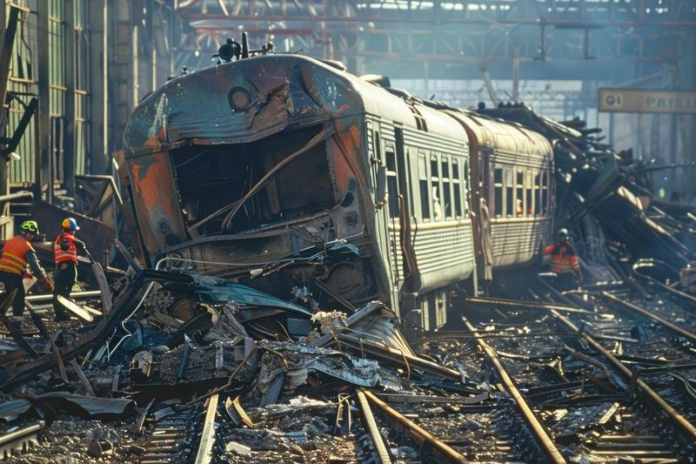
A suicide bomber struck a passenger train in the southwestern Pakistani city of Quetta on Sunday, May 24, 2026, killing at least 24 people and wounding more than 70 others in one of the deadliest militant assaults to hit Balochistan province this year. The attacker detonated an explosives-laden vehicle near a railway track as the train rolled through the area, sending two carriages flipping onto their sides and bursting into flames.
The force of the blast tore through a neighborhood where security forces are routinely stationed, badly damaging several adjacent houses and buildings and crumpling more than a dozen vehicles parked along the road. Footage circulating online showed charred train cars lying askew and thick plumes of black smoke billowing into the sky as rescuers scrambled to pull injured passengers from the wreckage.
Doctors at hospitals across Quetta said they had received scores of casualties, with at least 20 patients in critical condition. A state of emergency was declared at public hospitals in the city, and medical staff were ordered to remain on duty as ambulances ferried the dead and wounded from the scene throughout the afternoon.
Separatist Group Claims Responsibility
The outlawed Baloch Liberation Army (BLA), a separatist group that demands independence from Pakistan’s central government, claimed responsibility for the attack in a statement sent to reporters. The militant organization said it had deliberately targeted a train carrying security personnel, though officials confirmed that civilians, including women and children, were among the dead.
Three security officials, speaking on condition of anonymity, said bodies had been transported to hospitals across the city in the hours following the explosion. An investigation was launched immediately, according to provincial authorities, who pledged a full accounting of how the bomber managed to reach the railway track in such a sensitive area.
Shahid Rind, a Balochistan provincial government spokesperson, denounced the violence. “We strongly condemn the targeting of innocent civilians and are deeply saddened by the loss of precious human lives. Terrorist elements deserve no leniency,” he said.
Balochistan’s chief minister, Sarfraz Bugti, vowed in a post on X to hunt down those responsible, saying the militants had targeted “innocent civilians, including women and children.” Bugti and the federal government in Islamabad frequently refer to the BLA as “Fitna al-Hindustan,” alleging the group is backed by India — an allegation that New Delhi continues to deny.
National Leaders Vow Retaliation
Prime Minister Shehbaz Sharif strongly condemned the attack, calling it a “cowardly act of terrorism” in a post on X. “Such cowardly acts of terrorism cannot weaken the resolve of the people of Pakistan. We remain steadfast in our determination to eliminate terrorism in all its forms and manifestations,” he said, offering condolences to the families of the victims.
President Asif Ali Zardari also denounced the bombing, saying militants and their backers were seeking to undermine Pakistan’s role in regional and international peace efforts. Reporting from the scene, Al Jazeera’s Kamal Hyder noted that several houses and buildings adjacent to the railway line had been severely damaged, calling the scale of destruction emblematic of a recent surge in militant ferocity.
A Restive, Resource-Rich Province
Quetta is the capital of insurgency-hit Balochistan, an oil- and mineral-rich region that has long been the scene of a low-level insurgency. Separatist insurgents have frequently targeted security forces, government installations and civilians in the province and elsewhere in Pakistan. In 2024, at least 26 people were killed when a suicide bomber struck a train station in the same province.
According to on-the-ground reporting, attacks have increased in ferocity in recent months and have also been aimed at Chinese workers, reflecting local opposition to Beijing’s infrastructure projects in Balochistan. Under the China-Pakistan Economic Corridor, China’s Xinjiang region has been connected to Pakistan’s Gwadar port — a strategic artery that has become a flashpoint for Baloch separatist anger.
Bombing Strikes Amid Regional Diplomacy
The attack came at a delicate diplomatic moment. Just a day earlier, Pakistan announced that the United States and Iran were close to reaching a memorandum of understanding to end the war that has roiled the Middle East since February 28, when US and Israeli forces struck the Islamic Republic. The conflict has upended global travel and sent oil prices spiking, raising the stakes for the negotiations.
President Trump’s administration has been pressing for a breakthrough, and Pakistani officials have positioned themselves as intermediaries in the talks. The bombing also lands against the backdrop of long-running tensions with India, with whom Pakistan has fought two of its three wars over Kashmir, a region claimed by both nations in its entirety.
As night fell over Quetta on Sunday, families gathered outside hospital wards searching for news of missing relatives, while forensic teams combed the twisted remains of the train. With 20 victims still in critical condition, officials warned the death toll could climb in the coming days.