
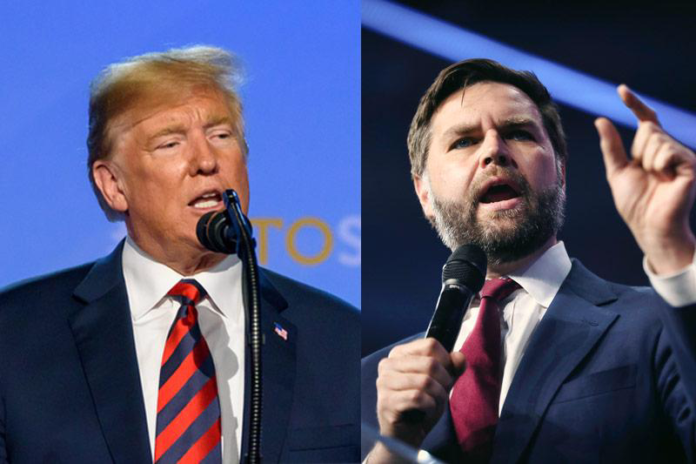
President Donald Trump has been reportedly issuing “snide, annoyed comments” regarding Vice President JD Vance and Director of National Intelligence Tulsi Gabbard due to their lack of zealous support for his Iranian military operations, according to fresh reporting that may indicate growing divisions inside the administration.
Sources within the White House informed Zeteo that Trump has been expressing private disapproval of both officials for their insufficient enthusiasm regarding the military operations that commenced with attacks on February 28, 2026. The president’s evident displeasure with his vice president, who is 41 years old, represents a significant change in their dynamic, with certain White House personnel reportedly surprised by Trump’s attitude.
A staffer sent a text message indicating that Vance “just opposes” conflict with Iran and expressed concern about “the success” of Operation Epic Fury, an operation that has not achieved the regime transformation Trump had guaranteed. Instead, the military effort has caused fuel costs to surge and sent his public support numbers plummeting.
Vance, whose position was “skeptical” before the attacks based on accounts from top White House personnel, has refrained from advancing the war through online platforms or television appearances with the intensity he has demonstrated for other policy objectives of the administration. This hesitancy sharply contradicts the anti-interventionist stance he promoted throughout the 2024 race, during which he penned in The Wall Street Journal that Trump “won’t recklessly send Americans to fight overseas.”
Vance remained conspicuously quiet on February 28, when the attacks were launched. In the preceding days, he had informed The Washington Post there was “no chance” of an extended conflict in the Middle East should the U.S. proceed—a forecast that has proven inaccurate as the military action continues into its eighth week with no conclusion apparent.
During questioning about his counsel to the president by a journalist from the Associated Press on March 13, Vance avoided answering directly, asserting that revealing his recommendations might potentially result in his incarceration because of classified intelligence rules.
The White House strongly refuted the Zeteo reporting. “President Trump has full confidence in his entire exceptional national security team. This ‘story’ is totally false—Vice President Vance and DNI Gabbard are important members of the president’s team and their work continues to serve him and this country well,” said White House spokesman Davis Ingle.
Gabbard similarly provoked Trump’s displeasure following her refusal to support the administration’s assertion that Iran constituted an “imminent threat” while providing testimony to the Senate Intelligence Committee. Both officials possess extensive records of resisting U.S. military involvement in Middle Eastern conflicts.
The vice president’s situation may advantage Secretary of State Marco Rubio, 54, who has surfaced as a potential replacement successor to Trump’s MAGA coalition. Rubio has assumed a progressively central position in his dual capacity as secretary of state and interim national security adviser, receiving lavish commendation from the president as possibly “the greatest Secretary of State in the history of the United States.”
According to NBC News, Trump surveyed contributors at Mar-a-Lago on February 28 regarding Vance compared to Rubio. The assembled guests clapped more enthusiastically for Rubio—”It was almost unanimous for Marco,” one participant informed the news organization. The president, age 79, has consistently avoided placing Vance before Rubio for the 2028 nomination, notwithstanding his prediction last August that Vance would be “most likely” the frontrunner.
Trump is currently dispatching Vance to Pakistan for directing peace discussions with Iran, an assignment that may additionally compound the vice president’s electoral prospects. The diplomatic efforts are anticipated to concentrate on restoring access to the Strait of Hormuz, which remained accessible prior to the commencement of strikes. Iran has indicated its preference for conducting negotiations with Vance rather than Trump’s designated representatives Steve Witkoff and Jared Kushner, individuals Tehran has charged with “backstabbing.”
Trump’s military initiatives in Venezuela and Iran contradict the commitments he made to MAGA supporters during the approach to the 2024 election. Vance currently confronts the difficulty of maintaining allegiance to a president who requires unwavering devotion while avoiding the estrangement of his own non-interventionist supporters in advance of a possible 2028 campaign.