Pope Leo XIV used his first Palm Sunday Mass to deliver a powerful anti-war message that reverberated across social media and diplomatic channels, declaring that God rejects violence and refuses to hear the prayers of those who wage war.
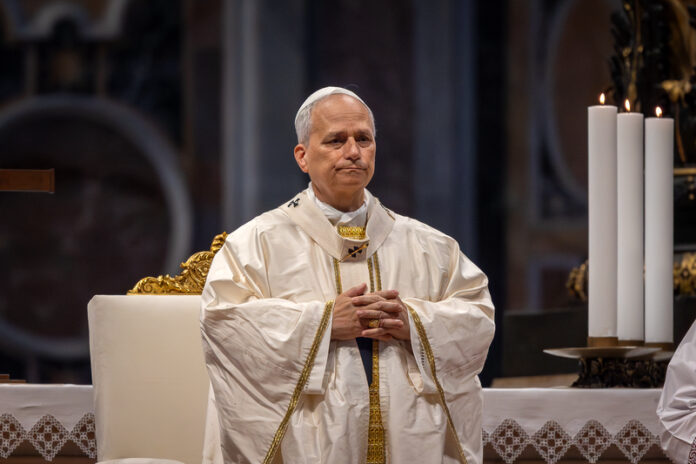
Thousands gathered in St. Peter’s Square on Sunday as history’s first American-born pope presided over the solemn ceremony marking Jesus’ entry into Jerusalem. The 70-year-old pontiff, dressed in red vestments symbolizing Christ’s Passion, dedicated his homily to denouncing the use of religion to justify military conflicts.
“Brothers and sisters, this is our God: Jesus, King of Peace, who rejects war, whom no one can use to justify war,” Pope Leo XIV said. “He does not listen to the prayers of those who wage war, but rejects them.”
The Pope’s remarks came as the U.S.-Israeli war against Iran enters its second month and Russia’s campaign in Ukraine continues. Leaders on all sides of these conflicts have invoked religious justifications for their military actions, including Defense Secretary Pete Hegseth, who has cast the Iran conflict in explicitly Christian terms.
The Mass began with a procession of cardinals, bishops, priests and laypeople carrying olive branches and intricately braided palm leaves through the square. About 60 cardinals and bishops participated as the procession circled the ancient Egyptian obelisk that Emperor Caligula brought to Rome in 37 A.D., a site traditionally associated with early Christian martyrdom including that of St. Peter.
Pope Leo XIV directed special prayers toward Christians in the Middle East who are “suffering the consequences of a brutal conflict” and often cannot fully observe Holy Week rituals. His words carried added weight after Jerusalem police prevented Cardinal Pierbattista Pizzaballa and the Custos of the Holy Land from entering the Church of the Holy Sepulchre for Palm Sunday Mass—the first time in centuries church leaders faced such restrictions at the site where Christians believe Jesus was crucified.
Israeli police closed major holy sites in Jerusalem’s Old City for security reasons amid Iranian missile strikes. Prime Minister Benjamin Netanyahu later said Israel would attempt to partially reopen the Church of the Holy Sepulchre in coming days following international criticism.
The ceremony held particular poignancy as it marked the first Palm Sunday since Pope Francis died on Easter Monday last year. Francis had rallied from a five-week hospital stay for double pneumonia to greet the faithful from St. Peter’s Square on Easter Sunday, making what became his final popemobile ride around the piazza. He suffered a stroke and died the following morning. His nurse, Massimiliano Strappetti, later revealed that Francis had told him: “Thank you for bringing me back to the square.”
Pope Leo XIV will preside over the full slate of Holy Week liturgical events, including the Holy Thursday foot-washing ceremony at the basilica of St. John Lateran, the Good Friday procession at Rome’s Colosseum, the Easter Vigil on Saturday, and Easter Sunday Mass in St. Peter’s Square. The new pope has returned the Holy Thursday ceremony to the basilica after Francis famously celebrated it by traveling to Rome-area prisons and refugee centers to wash the feet of Muslims and people of other faiths.
The Pope concluded his homily by quoting Venerable Bishop Tonino Bello, a pacifist and social justice advocate whom Pope Francis recognized as venerable in 2021. The bishop, who died in 1993, had prayed for a time when “the tears of all the victims of violence and pain will soon be dried up like frost beneath the spring sun.”
Russia’s Orthodox Church has declared its invasion of Ukraine a “holy war” against what it considers a morally fallen West, while President Donald Trump’s administration has framed military action in religious terms through statements by Defense Secretary Hegseth and other officials.
Palm Sunday marks the beginning of Holy Week, commemorating Jesus’ triumphant entry into Jerusalem before his crucifixion on Good Friday and resurrection on Easter Sunday. The liturgy includes readings of Christ’s suffering and crucifixion, setting the tone for Christianity’s most sacred week.
As history’s first U.S.-born pope navigates his inaugural Holy Week as pontiff, his forceful stance against religious justifications for warfare signals a continuation of recent papal emphasis on peace while establishing his own distinct voice on the global stage. His message resonated powerfully on social media, where clips of his homily sparked debates about faith, warfare and political leadership.