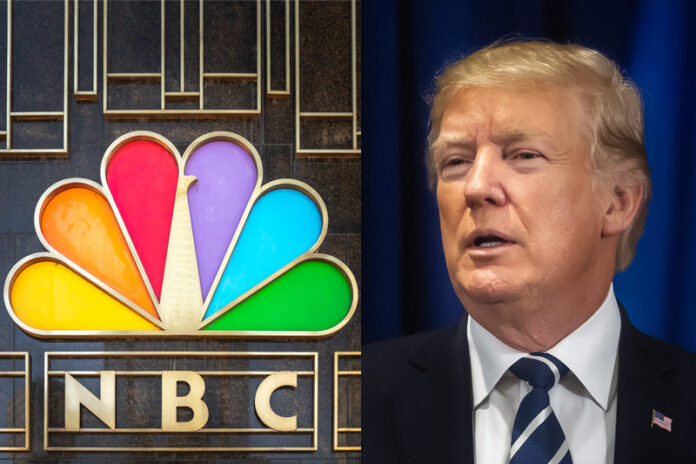
President Donald Trump attacked a reporter from NBC News on the White House lawn Saturday afternoon, declaring she lacks knowledge about Iran or the Strait of Hormuz — a confrontation that exposed the escalating tension between the administration and journalists as the United States conducts a sustained military and economic offensive against Tehran, Iran.
The incident occurred approximately 5 p.m. ET on April 11, 2026, when Trump paused to engage with multiple reporters before departing for Joint Base Andrews. After the NBC reporter questioned why the Strait of Hormuz remained closed following weeks of military operations, Trump instantly became aggressive.
“Why do you say that? You don’t know anything!” Trump snapped at the reporter. He subsequently demanded which news organization she represented. After she revealed herself as NBC News, Trump rejected it as “fake news.”
Instead of addressing the reporter’s inquiry regarding the blocked Strait of Hormuz, Trump embarked on an extensive proclamation of military success. He asserted that the United States had thoroughly destroyed the Iranian navy, eliminating 158 vessels. He said Iran possessed no radar, no air force, and that the Supreme Leader Ayatollah Ali Khamenei had been killed.
“We win, no matter what,” Trump told the gathered press. “We’ve defeated their military. They have no navy. They have no radar. They have no air force. Their leaders are all dead. Khamenei is gone. For many years, he ruled; he’s gone. With all of that, let’s see what happens — but from my standpoint, I don’t care.”
The issue, naturally, was that the reporter’s inquiry highlighted a situation that Trump’s celebration failed to acknowledge. The Strait of Hormuz — the restricted waterway through which approximately 20% of the world’s oil travels — remained closed at the time of the interaction. Intelligence had emerged that Iran could not even find the mines it had deployed in the waterway to block it, producing an unexpected complication even as Iran’s traditional military capabilities had been eliminated.
Trump’s open irritation with the inquiry represented a significantly broader strategic challenge. The U.S.-directed military operation, named Operation Epic Fury, began on February 28, 2026, with synchronized American and Israeli airstrikes hitting Iranian military installations, nuclear locations, and command. The strikes killed Khamenei and destroyed substantial sections of Iran’s traditional military strength.
However, Iran’s unconventional reaction — blocking the Strait of Hormuz beginning March 4 through mines, warnings, and assaults on commercial vessels — demonstrated significantly more difficult to reverse than the military objectives the U.S. had eliminated. The blockade successfully withdrew nearly 20% of worldwide oil resources from the marketplace and sparked economic disruptions that were still persisting weeks afterward.
Before the war, hundreds of vessels navigated through Hormuz daily. Following the conflict’s start, fewer than 10 ships a day managed to complete the passage on typical days. Iran had additionally started demanding millions of dollars in fees for transit, converting the waterway into a funding mechanism during armed conflict.
The International Energy Agency described the interruption as the “largest supply disruption in the history of the global oil market.” The Federal Reserve Bank of Dallas released a research report drawing parallels between the economic consequences of the oil crises following the 1973 Yom Kippur War, the 1979 Iranian Revolution, and the 1990 Persian Gulf War.
At the precise time Trump was criticizing the NBC reporter, U.S. and Iranian representatives, including JD Vance, were positioned opposite each other in Islamabad, Pakistan, where discussions had already extended beyond 21 hours. The negotiations proceeded into Sunday.
The opposing sides were fundamentally split. The U.S. stance continued to be centered exclusively on reopening the Strait of Hormuz. Iran was insisting that any peace agreement encompass its authority to enrich uranium and a halt to Israeli strikes in Lebanon — conditions Washington had rejected.
The unsuccessful negotiations would quickly intensify circumstances even more. By Monday, the U.S. Navy had established a complete blockade on Iran’s harbors, propelling oil costs to climb toward $100 per barrel. Brent crude for June delivery leaped more than 4% to $99.56, while U.S. crude futures rose nearly 3% to $99.37 per barrel.
Americans were already experiencing the burden at the pump. Gas costs had increased by more than $1.20 per gallon since the war commenced, achieving a national average of $4.12 — a 38% surge. JPMorgan Chase experts cautioned that the final tanker to exit Hormuz before the blockade on February 28 was anticipated to arrive at its destination around April 20, signifying the moment at which pre-closure oil supplies would be completely depleted from the worldwide supply network.
Moments after reprimanding the NBC reporter, Trump entered Marine One, headed to Joint Base Andrews. His location: Miami, where he witnessed UFC 327 at the Kaseya Center — his first attendance at a sporting event since the Iran war began.
Trump had been missing from the Super Bowl and the Winter Olympics in Italy earlier in 2026, bypassing both as the military operation dominated his agenda. The final major sporting event he had participated in was the College Football Playoff national championship game on January 19. UFC 327, showcasing Jiri Prochazka vs. Carlos Ulberg, signified his reappearance in the public sporting arena. He was accompanied by Secretary of State Marco Rubio, UFC CEO and President, Dana White, and several of his children and grandchildren.
Before leaving, Trump provided one additional remark to reporters about the wider conflict: “We’re in very deep negotiations with Iran. We win regardless. We’ve defeated them militarily. Whether we make a deal or not makes no difference to me. And the reason is because we’ve won, whether you listen to the fake news or not.”
The altercation with the NBC reporter represented part of a wider trend. In the weeks preceding the interaction, Trump had employed progressively hostile language toward Iran and the media simultaneously. On Truth Social, he had cautioned that “all US Ships, Aircraft, and Military Personnel” would stay in position around Iran until a “REAL AGREEMENT” was achieved. He supplemented that if the agreement was not respected, “the Shootin’ Starts bigger, and better and stronger than anyone has ever seen before.”
In conversations with Axios and ABC News, Trump stated there was a “good chance” of a deal but cautioned that if talks failed, “we’re blowing up the whole country.” He had earlier delivered multiple ultimatums for Iran to reopen the strait, postponing them on each occasion before escalating with fresh threats against Iran’s energy infrastructure and bridges.
Sen. Tim Kaine, D-Va., reacted to Trump’s language a week prior on NBC News’ “Meet the Press,” characterizing it as “embarrassing and juvenile.” Kaine said, “People see this president as having blundered into a war with no clear rationale, and there’s no amount of cursing or boasting or tough talk that will cover up for the fact that this president didn’t have a rationale and he doesn’t really have a plan.”
Trump’s assertion that the war was already victorious received minimal backing among America’s conventional allies. European officials from Berlin to London expressed reservations about Trump’s requirements for military assistance to reopen the waterway. German Defense Minister Boris Pistorius summarized the sentiment frankly: “This is not our war, we have not started it.”
White House Press Secretary Karoline Leavitt countered, contending that allied countries “are benefiting greatly from the United States military taking out the threat of Iran” and should contribute more to help reopen the strait. Iranian Foreign Minister Abbas Araghchi presented Tehran’s own interpretation, posting on Telegram: “From our perspective, the Strait of Hormuz is open, and only closed to enemies.”
Beyond the political spectacle on the White House lawn, the economic ramifications of the Hormuz blockade were intensifying. The war had more than doubled the cost of kerosene-based products like diesel and jet fuel. The 30-year mortgage rate increased to 6.38%, and the 10-year bond yield surged to 4.46% — its greatest level since July 2025. Stock markets dropped globally.
The economic harm extended well beyond fuel costs. The Persian Gulf represents roughly 30% to 35% of global urea exports and up to 30% of internationally traded fertilizers typically transit through Hormuz. With the spring planting season active, the interruption is expected to diminish U.S. corn yields and elevate global food costs higher well into 2027. Global fertilizer costs were forecast to average 15% to 20% higher during the first half of 2026.
Gulf Cooperation Council states that rely on the strait for more than 80% of their food imports encountered what was characterized as a “grocery supply emergency.” By mid-March, 70% of the region’s food imports had been interrupted, compelling retailers to airlift staples and provoking consumer price increases of 40% to 120%.
Against that context, the NBC reporter’s question about why the strait still wasn’t open appeared less like “fake news” and more like the most urgent question anyone could pose. Trump’s response — that the reporter knew nothing — left the actual question unanswered.