
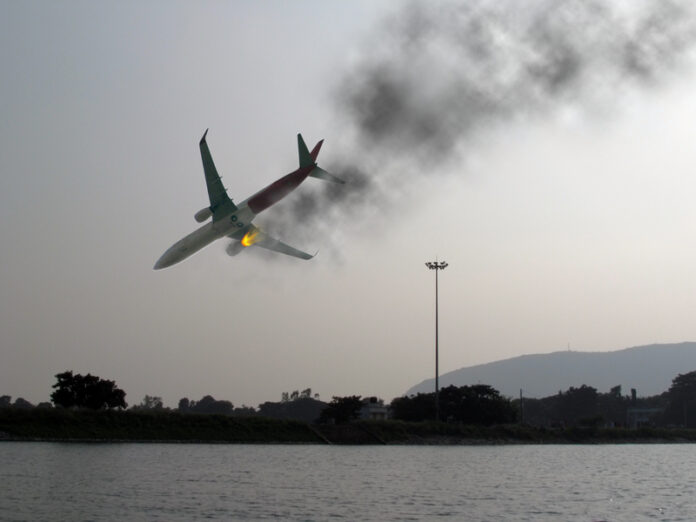
A compact aircraft fell from the air and slammed into a Brazilian eatery on Friday morning, resulting in the deaths of all four individuals on board and igniting a tremendous ball of flames that came dangerously close to people walking on a neighborhood street.
The Piper Malibu JetPROP departed from Capão da Canoa Airport at approximately 10:35 a.m. local time on Friday, April 3, headed for Ibitinga in the state of São Paulo. Just moments later, the single-engine turboprop struck a utility pole close to the runway’s end and fell into the Dom Inácio restaurant on Avenida Valdomiro Cândido dos Reis in Capão da Canoa, a coastal city on the shore of Rio Grande do Sul in southern Brazil.
Surveillance footage recorded the terrifying instant the aircraft, with its nose pointed steeply upward, collided with the shuttered eatery and detonated in a mushroom-shaped plume of flames and dense black smoke. Video shows the plane flying at a perilously low altitude above the neighborhood before collision, narrowly missing pedestrians and bicycle riders who fled as the flames burst forth.
A single individual seen in the security camera recording seemed to be close to where the impact occurred but succeeded in fleeing just as the aircraft went down.
The four deceased have been named as pilots Nelio Maria Batista Pessanha and Renan Eduardo Saes, together with businesspeople Déborah Belanda Ortolani and Luis Antonio Ortolani, who served as event management executives. All four perished at the location.
The aircraft had initially taken off from Itápolis in São Paulo state, made a refueling stop at Forquilhinha airport in Santa Catarina, and then proceeded to Capão da Canoa to collect the two business travelers before the deadly departure.
Officials from the Civil Defense of Rio Grande do Sul arrived at the accident location and verified the aircraft had “lost altitude and hit a restaurant that was closed,” according to Xinhua. Personnel removed people from surrounding homes and sealed off the zone as first responders worked to extinguish the inferno.
By a fortunate turn of events during the catastrophe, the Dom Inácio restaurant was not operating at the moment of the accident. No casualties on the ground were documented, although nearby residences suffered harm from the blast and flames. An adjacent store was also shuttered, averting additional deaths.
The Fire Department, Military Police, municipal teams, and the CEEE electricity company all rendered assistance at the location. Sabrina Ribas, communications coordinator for the Civil Defense of Rio Grande do Sul, verified that nearby inhabitants were removed as a safety precaution.
An eyewitness recounted observing the accident happen in the moment. “It went up, but it didn’t fully climb; it went up, lost power, the engine was making a noise,” truck driver Silvio Dias Luiz Júnior told Jornal Nacional.
The single-engine plane, belonging to Jetspeed Holding Ltda, was traveling at minimal elevation when it started descending, based on initial accounts referenced by Radio Gaúcha. Brazil’s National Civil Aviation Agency verified the plane was in proper airworthiness status, but was not permitted to function as an air taxi.
Rio Grande do Sul state Gov. Eduardo Leite offered his sympathies after the catastrophe. “I have been following, since the very first moments, together with the security forces, the full mobilization in responding to the incident,” Leite said. He added his solidarity with the families of the victims and the community of Capão da Canoa.
The general Institute of Forensics came to the location to collect evidence and retrieve the victims’ bodies. The Municipality of Capão da Canoa, together with the Military Brigade, kept providing security surrounding the accident location as the zone stayed blocked off.
Brazil’s Center for Investigation and Prevention of Aeronautical Accidents, a division of the Brazilian Air Force, is currently overseeing the probe into what triggered the accident. Officials are analyzing why the plane struck the pole during departure and what made it lose elevation so quickly.
The Aviation Safety Network has included the occurrence in its record of aircraft accidents as investigators attempt to reconstruct the last moments of the journey.
The accident represents another devastating aviation disaster in the area. A day before, four individuals died when a small Cessna 172 went down in the central Mexican state of Puebla just minutes after departure from Hermanos Serdán International Airport. Three people were declared dead at the location, while a fourth died from injuries at a medical facility.
The striking video from Capão da Canoa has spread extensively on the internet, depicting the frightening close call with people on the road beneath and the ensuing blast that consumed the eatery in fire. The recordings function as a powerful reminder of how rapidly aviation catastrophes can develop and the slim difference between disaster and even worse calamity.