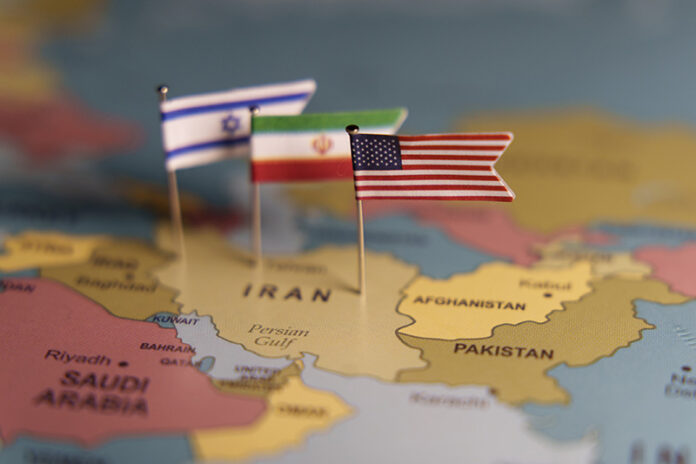
Global fears of nuclear conflict have exploded to levels not seen in decades as the U.S.-Israel war on Iran intensifies, prompting experts to warn the world may be entering the “early days” of World War III.
Economist Jeffrey Sachs delivered the stark assessment as military operations continue in Iran, while President Donald Trump showed no signs of backing down from the confrontation. The conflict has triggered a cascade of consequences: bunker sales have surged, oil prices hit $100 per barrel, and news outlets now regularly publish nuclear fallout survival guides for worried citizens.
The administration launched Operation Epic Fury on February 28, striking over 2,000 targets across 24 Iranian provinces in the first two days alone. By mid-March, CENTCOM forces had hit approximately 6,000 targets. The strikes killed Supreme Leader Ayatollah Ali Khamenei and targeted Iran’s nuclear facilities, which the U.S. claims were developing weapons capabilities.
“They can’t have a nuclear weapon. Very simple—we’re not going to allow that,” President Trump said.
The conflict marks a dramatic escalation from Israel’s Twelve-Day War with Iran last June, which saw coordinated strikes on nuclear sites. Despite those attacks, Iran had reportedly enriched uranium to 60% purity—far beyond the 3.5% cap established under the 2015 nuclear deal. Intelligence assessments indicated Iran maintained a stockpile of approximately 9,870 kilograms of enriched uranium, compared to the 300-kilogram limit previously agreed upon.
Iranian President Masoud Pezeshkian insisted before the war that his nation was not seeking nuclear weapons and remained ready for verification, but the International Atomic Energy Agency had been unable to inspect Iranian facilities for months.
The nuclear threat has dominated public discourse across multiple continents. In Ireland, media outlets published detailed maps showing estimated casualties from potential nuclear strikes—330,150 deaths and 481,860 injuries in Dublin alone if an 800-kiloton warhead detonated over the capital. Similar projections estimated 109,170 deaths in Cork and 48,510 in Galway.
American concerns center on vulnerable military installations and civilian infrastructure. Pennsylvania’s Raven Rock Mountain Complex, the secret “underground Pentagon” near the Maryland border, sits high on target lists. The so-called “nuclear sponge” states of Montana, Wyoming, and North Dakota face particular danger due to their 150 Minuteman III intercontinental ballistic missile silos.
The Trump administration evacuated diplomatic personnel from Baghdad, while authorizing voluntary departures for staff in Bahrain and Kuwait. White House spokeswoman Anna Kelly explained the moves resulted from routine security reviews, though the timing coincided with escalating tensions.
Israeli Prime Minister Benjamin Netanyahu told reporters his country’s strikes had killed a senior Iranian nuclear scientist and wounded several others, while creating conditions for regime change. Addressing the Iranian people directly, Netanyahu said Israel was working to give citizens “the space needed to go out to the streets.”
Former National Security Adviser John Bolton argued that military action only made sense if aimed at toppling the Iranian government. Bolton told DW News he feared Trump would “leave the battle before the regime has changed.”
Iran’s new Supreme Leader Ayatollah Mojtaba Khamenei, elected on March 8 after his father’s death in the initial strikes, vowed continued resistance. Iranian forces struck U.S. military bases across the Middle East, including a luxury hotel in Dubai housing American personnel. Iran’s closure of the Strait of Hormuz—through which approximately 20 million barrels of oil flow daily—has created what the International Energy Agency called “the largest supply disruption in the history of the global oil market.”
The economic shockwaves have reverberated globally. South Korea imposed government price caps on fuel for the first time since 1997. The U.S. Treasury Department temporarily eased sanctions on Russian oil to compensate for disrupted Iranian supplies, with analysts estimating roughly 128 million barrels of Russian oil sat aboard tankers awaiting buyers.
Britain announced plans to increase defense spending to 2.6% of GDP by April 2027. Chancellor Rachel Reeves told Parliament that the government would prioritize defense spending, providing an £11 billion increase to the Ministry of Defence amid what the government called “a new era of threat.”
Sanam Vakil, director of the Middle East and North Africa programme at Chatham House, captured the prevailing mood in a February analysis, warning that all sides are locked into a logic of escalation over restraint with no real diplomatic brakes remaining.
The conflict has also drawn attention to key arms control treaties that expired under the Trump administration, leaving fewer formal constraints on nuclear powers. Meanwhile, prediction markets briefly offered odds on nuclear detonations occurring within specific timeframes—a development that shocked nonproliferation experts.
Secretary of War Pete Hegseth reportedly told Pentagon officials there would be “no rules of engagement” limiting military operations, signaling an unprecedented willingness to escalate if necessary. The administration maintains that preventing Iranian nuclear capability justifies the risks, even as critics warn the conflict could spiral beyond anyone’s control.