
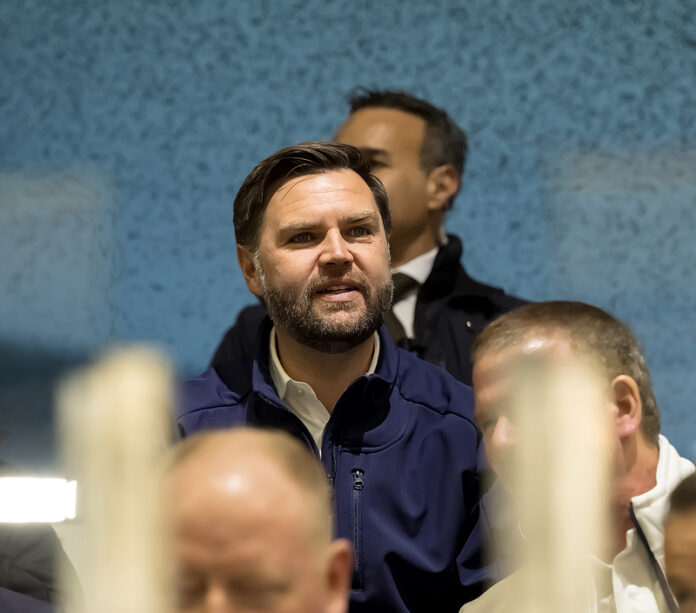
Vice President JD Vance finds himself at the center of a dramatic White House controversy as new reports emerge about his alleged role in the resignation of a top national security official and a heated internal dispute over the administration’s approach to the ongoing Iran conflict.
The 41-year-old vice president, who rose from poverty in Middletown, Ohio to become the nation’s second-highest officeholder, now faces scrutiny over his involvement in what sources describe as a bombshell confrontation regarding war objectives and Iran policy.
According to multiple reports, Vance met with Joe Kent and Director of National Intelligence Tulsi Gabbard at the White House on March 16, the day before Kent announced his resignation as NCTC Director. Kent, who served as Director of the National Counterterrorism Center, became the first senior Trump administration official to resign over the Iran war, posting a public letter declaring he could not “in good conscience support the ongoing war in Iran” and claiming that “Iran posed no imminent threat to our nation.”
The dispute centers on competing visions for the Iran campaign. President Donald Trump launched military operations against Iran on February 28, 2026, in what the administration calls “Operation Epic Fury.” Trump initially advocated for regime change, urging Iranian citizens to “take back your government” in social media posts following strikes in the region. However, Vance later appeared to downplay regime change as a primary objective during a Fox News interview, creating apparent daylight between his position and earlier White House statements.
When asked about possible disagreements, Trump acknowledged the tension, telling reporters, “He was, I would say, philosophically a little bit different than me,” while insisting there was no real split between them.
The vice president outlined what he characterized as Trump’s four specific objectives for the Iran conflict: destroying Iran’s missile capabilities, dismantling its navy, preventing nuclear weapon acquisition, and blocking funding for terrorism. These goals, Vance insisted, represented a departure from previous American military engagements that lacked clear endpoints.
On Fox News, Vance defended the administration’s approach: “There’s just no way that Donald Trump is going to allow this country to get into a multi-year conflict with no clear end in sight and no clear objective.”
The controversy comes as Vance attempts to carve out his role in an administration where tech billionaire Elon Musk has often commanded more attention than the elected second-in-command. Vance’s anti-interventionist political identity — built over years of opposing “regime change wars” — collides awkwardly with his current position defending military action against Iran.
The vice president made international headlines in February 2025 when a televised meeting with Ukrainian President Volodymyr Zelensky in the Oval Office erupted into a fiery confrontation. Vance accused Zelensky of being “disrespectful” for challenging the administration’s diplomatic approach, telling the Ukrainian leader: “I think it’s disrespectful for you to come into the Oval Office to try to litigate this in front of the American media.” Media outlets described the exchange as an unprecedented public confrontation between American leaders and a foreign head of state.
Reports indicate Vance, Gabbard, and Kent — all of whom built their political profiles opposing foreign intervention — have been uncharacteristically quiet about the Iran war. When Kent presented his resignation letter to Vance, a White House official said the vice president “encouraged him to be respectful to POTUS” and urged him to consult the White House chief of staff before making any final decisions.
The Ohio native’s journey from Marine Corps veteran to vice president has been marked by dramatic transformations. After graduating from high school in 2003, Vance served four years in the Marines as a combat correspondent, deploying to Iraq for six months in 2005 in a public affairs role. He attended Yale Law School and authored the bestselling memoir “Hillbilly Elegy” in 2016. He was elected to the U.S. Senate in 2022 before Trump selected him as his running mate in 2024.
The timing proves particularly delicate for Vance, who is considered the early frontrunner for the 2028 presidential race. Trump, at 78 the oldest person ever inaugurated as president, will be constitutionally barred from seeking another term. His predecessor Mike Pence saw his political career collapse after refusing to overturn the 2020 election results — a cautionary tale that looms over Vance’s efforts to maintain Trump’s favor while establishing his own identity.
Adding to the complexity, Vance and his wife Usha, whom he met at Yale Law School, announced in January that they are expecting their fourth child, a boy due in late July — making Usha Vance the first second lady in modern history to give birth while her husband serves in office. The couple, who married in 2014, already have three children: Ewan, Vivek, and Mirabel. Vance took his mother’s maiden name in 2013, honoring his maternal grandparents who raised him during a turbulent childhood.
For Vance, who once called Trump “reprehensible” and an “idiot” during the 2016 campaign before transforming into a loyal MAGA advocate, the challenge now is balancing his role as Trump’s deputy with his own political ambitions in an administration where loyalty is prized above all else — even as a war he once opposed threatens to define his political future.