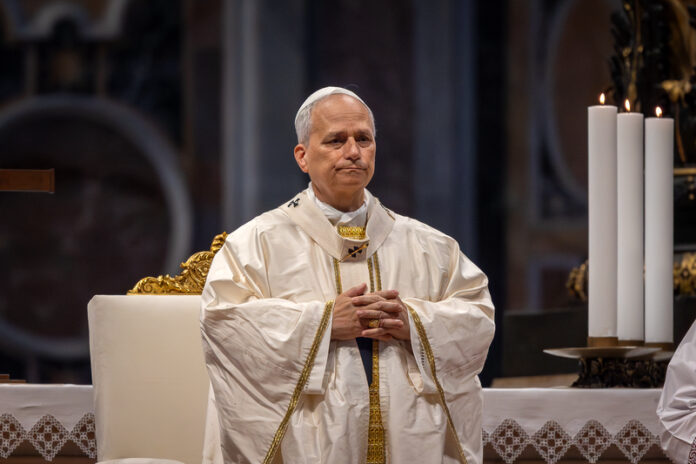
Pope Leo XIV issued his strongest rebuke so far of the intensifying Middle East violence on Sunday, March 15, 2026, urging an immediate ceasefire and asserting that force cannot produce lasting peace. The 70-year-old pontiff, the first American pope in history, referenced the devastating missile strike on an Iranian girls’ elementary school that killed over 165 people, mostly children.
From the Vatican, Pope Leo XIV spoke to tens of thousands in St. Peter’s Square after his Sunday noon blessing. Though he did not explicitly name the United States or Israel, his comments were clearly aimed at leaders who could stop the violence. “Cease fire so that avenues for dialogue may be reopened,” he declared. “Violence can never lead to the justice, stability, and peace that the people are waiting for.”
The emotional speech was the most forceful intervention yet from the Chicago-born pontiff, who has become more outspoken on global conflicts since his election on May 8, 2025. In the first two weeks of the U.S.-Israeli war on Iran, Leo had largely limited his remarks to restrained calls for diplomacy—apparently to avoid being seen as an American political foil to President Donald Trump.
His remarks reached beyond the immediate crisis to broader concerns about human dignity that have characterized his short papacy. Born Robert Francis Prevost in Chicago in 1955, he spent many years as a missionary in Peru before serving as Bishop of Chiclayo and later as Prefect of the Dicastery for Bishops under Pope Francis. His dual experience as an American and long-time resident of Latin America has led observers to call him “a bridge builder” with an international outlook.
The Minab school strike has provoked global condemnation and intensified appeals for diplomacy. The February 28 attack struck Shajareh Tayyebeh Primary School in southern Iran during morning classes, devastating families and prompting emergency U.N. meetings. Early U.S. military inquiries indicate a Tomahawk cruise missile likely hit the school after outdated intelligence misidentified it as a military site.
The Vatican has not proposed specific policy steps, but the Pope’s Sunday remarks made his stance clear. He offered prayers and solidarity with families who lost loved ones in attacks “which have hit schools, hospitals and residential centers.” The Vatican newspaper L’Osservatore Romano ran an aerial image of mass graves of young victims under the headline “The Face of War.”
Dr. Charlie Gillespie, a professor at Sacred Heart University, told PEOPLE after the May 2025 election that choosing Leo XIV signaled “a clear signal that the College of Cardinals felt the calling of the spirit to elect someone for the whole globe.” That worldly perspective has become clearer as the Pope speaks out more forcefully on international crises.
By taking the name Leo XIV the Pope honored Pope Leo XIII, the late-19th-century pontiff associated with the poor and social justice whose encyclical Rerum novarum shaped modern Catholic social teaching. Vatican sources said the name choice referenced men’s and women’s lives and labor—even in an era shaped by artificial intelligence. The earlier Pope Leo I, “Leo the Great,” is remembered for persuading Attila the Hun to turn back in 452, illustrating how moral authority can affect geopolitics.
The address comes as Pope Leo XIV nears his first anniversary. Since becoming pope, he has stayed connected to his Midwestern background while embracing global duties. A White Sox fan who still does the Times’ Wordle each morning, he maintains a plainspoken style, speaks to cardinals in his flat-voweled English, and keeps in regular phone contact with family.
His brother Louis Prevost, who described himself as a “MAGA type,” previously said his brother is “much more liberal” but expected him to steer the papacy “down the middle.” That judgment looks more complex as the Pope addresses divisive topics from Middle East violence to immigration and capital punishment.
The Pope’s intervention has potential consequences for U.S. foreign policy under President Trump. While Leo has tried to keep his language indirect and nonpartisan, some U.S. cardinals and the Vatican secretary of state have been more explicit. Cardinal Robert McElroy of Washington labeled the war morally unjustifiable. Chicago Cardinal Blase Cupich criticized the White House for using video-game-like imagery in war-related social media posts as “sickening.”
As the first American pope, Leo XIV holds a distinctive place. His remarks carry added significance in the United States, where many Catholics struggle to reconcile faith with national military actions. The Pope’s Sunday message urged Americans to weigh whether their country’s policies reflect the values of life and human dignity they profess to uphold.
Vatican watchers expect Pope Leo XIV to keep advocating for peace in the Middle East through diplomacy. Cardinal Pietro Parolin, the Vatican secretary of state, said the Holy See remains in dialogue with all sides. “When necessary we speak also with the Americans, with the Israelis,” Parolin said, “and show them what to us are the solutions.”