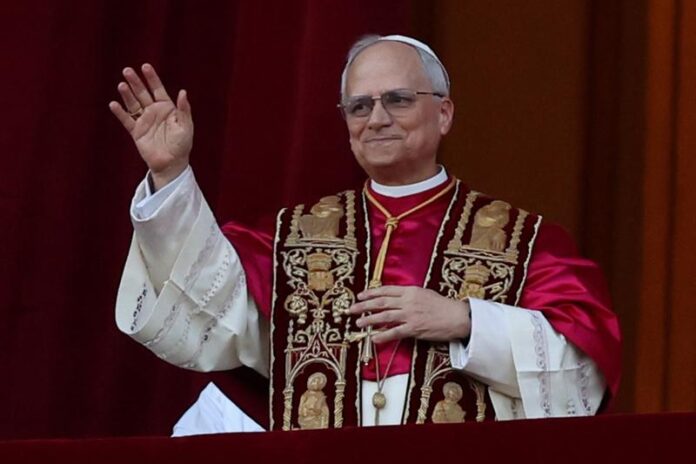
A rosary flung from a crowd of worshippers in Lima sailed over the barriers and caught the pope just below the eye.
Pope Leo XIV took the beads to the face on Monday, Nov. 16, 2026, while riding in the popemobile at Las Palmas Air Base in Lima, shortly before his farewell Mass in Peru.
The 71-year-old pontiff could be seen on video wincing, clutching his face and rubbing his eye. The popemobile had slowed as it neared the altar when the beads got past him. A wire photo caption described the object as a decade rosary.
Leo raised a hand to the spot, rubbed it and went back to greeting the faithful. He did not require medical attention, and he suffered no serious injuries. The Mass began as planned before a crowd the Vatican put at about 1.5 million people.
The pope forgave the worshipper who threw it and called the toss a sign of profound faith. He described the gesture as “an expression of deep religious devotion and affection.”
A Peruvian journalist apologized to him on the flight back to Rome. Leo brushed aside any suggestion of bad intent and said the throw reflected Peruvians’ enthusiasm and their hunger for God’s blessing. At the in-flight news conference, he said the moment was something he would carry in his heart — or perhaps in his eye.
Hands Out When the Driver Braked
Video from a second episode in Peru showed Leo waving from the back seat of a black 4×4 on a busy street when the driver braked abruptly, throwing the pope forward into the back of the front seat. He put his hands out to avoid hitting it face-first. The reason for the braking is unknown, and his use of a seatbelt was not confirmed. The episode was reported as occurring Tuesday night.
His Bodyguards Are Less Charmed
Crowds throw rosaries, stuffed animals and sports jerseys toward the popemobile wherever Leo goes, and he has impressed them by catching them. He has plucked stuffed animals and jerseys from the air, and once accepted a pizza. His bodyguards take a dimmer view of the practice, counting tossed objects among their chief concerns when he appears in public.
“Hasta Luego,” Not “Adiós”
Leo framed his departure as a “hasta luego” rather than an “adiós” — not a goodbye forever. He told residents of a home for the elderly in Callao that he would see them soon.
Callao Mayor Cesar Perez said Peruvians know him as “Father Roberto.” Perez recounted that during the pandemic the future pope drove roughly 12 hours from Chiclayo to Callao to look in on the home’s older residents. He left food and supplies at the door and never went inside, Perez said, because he did not want to expose them to the virus.
Many at the farewell Mass knelt on the dirt ground for his final blessing. The giant television screens failed, and some in the crowd said that left them unable to hear the pope. Firefighters sprayed others with water at their request to cool them off. Leo used his sermon to thank Peruvians for the hospitality they had shown him over six days, and he said, “The Peruvian people are my people too!”
His six days in Peru carried him through three climates: Chiclayo, his former diocese on the north Pacific coast; Cusco, in the Andes at 3,400 meters, or about 11,150 feet; and the Amazonian city of Pucallpa, before he returned to Lima. The trip took him high into the Andes and deep into the Amazon rainforest, to communities the Catholic hierarchy rarely visits.
The 12-day South American tour began Nov. 6 in Uruguay and continued through Argentina, with the Peru leg as its cap. It totaled 12 flights, two helicopter rides, nine Masses and 36 speeches. Three million people lined the streets of Lima when he arrived in the capital, and 2.5 million attended a Mass in Buenos Aires — a city his predecessor, Pope Francis, never saw again, having never returned to his native Argentina during his pontificate.
Leo took St. Turibius of Mogrovejo as his example for the trip and visited the saint’s sanctuary in the city of Zaña, in the diocese of Chiclayo. The first archbishop of Lima, who lived from 1538 to 1606, is revered for denouncing abuses against Indigenous and enslaved people by Spanish colonizers and for learning Quechua and Aymara to preach to his flock. Leo quoted him in his Monday, Nov. 16, homily on Indigenous Peruvians: “He insisted that priests learn Quechua and fought for the ordination of indigenous people and mestizos [people of mixed identity], whom many members of the clergy still held in contempt,” he said.
Doctors Rule Out Further Treatment
Born in Chicago, Leo spent two decades in Peru as a missionary priest and bishop, his posts including bishop of Chiclayo. He carries American citizenship and Peruvian citizenship alike, and the cardinals elected him pope in May 2025. On his arrival in Lima, he declared Peru his “patria,” or homeland, and sang the national anthem alongside President Keiko Fujimori.
Surgeons in Rome removed the lower lobe of his right lung on Oct. 13, about a month before the trip, and doctors confirmed he has lung adenocarcinoma. Rome’s Gemelli Polyclinic discharged him four days after the operation, and Leo said he would gradually return to his activities. At the start of the tour, he said he had “no doubt” he would make the journey.
Doctors said Oct. 21, before the trip, that the cancer had not spread, with final post-operative tests on tissue removed during surgery confirming the adenocarcinoma diagnosis. His personal doctor, Dr. Luigi Carbone, and his surgeon, Dr. Stefano Margaritora, said in a statement, “A subsequent oncology assessment confirmed that no further treatment is necessary.” Margaritora told Vatican News that doctors found the cancer by chance during routine abdominal examinations and that the pope had no symptoms.