
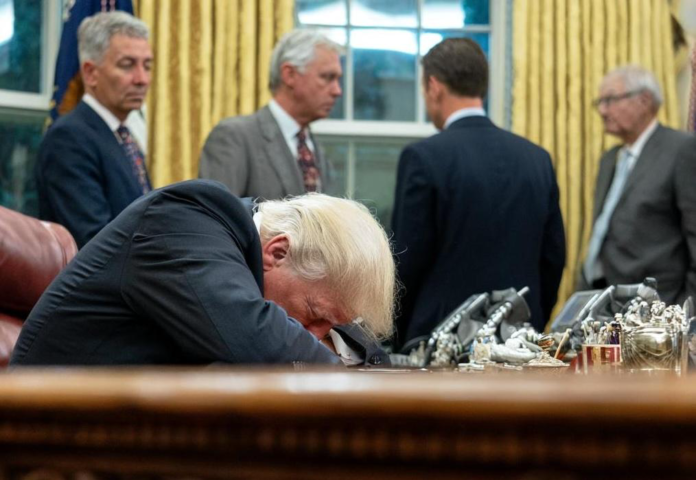
A psychologist who has spent years tracking President Donald Trump’s public behavior now says the president’s insults at female reporters point to something far darker than a bad mood.
Clinical psychologist Dr. John Gartner said in comments published Nov. 24, 2026, that Trump’s escalating aggression toward journalists could be a sign of frontotemporal dementia (FTD), a claim he made on the “Psycho Politics” podcast hosted by lawyer George Conway and produced by The Bulwark. No publicly confirmed diagnosis supports the claim.
Gartner pointed to the Nov. 20 confrontation in which Trump lashed out at NBC News White House correspondent Monica Alba during a press briefing in Washington, D.C. He described that moment as the newest entry in a pattern of attacks on women who cover the president, and he has a name for the episodes: the “Quiet, Piggy!” phenomenon.
Trump’s temper has always been short, Gartner said, but it has deteriorated sharply. The insults delivered from behind the White House podium have become the center of a renewed debate over the cognitive health of an 80-year-old president.
The Frontal Lobe as a Brake
Gartner anchored his argument in the diagnostic literature. “The number one diagnostic criterion for frontotemporal dementia is disinhibition of aggression, because the frontal lobe—which is our brake and our filter—is deteriorating,” he said on the podcast.
The established diagnostic criteria for the behavioral variant of the disease list disinhibition as one of six possible behavioral or cognitive features. A diagnosis requires additional clinical evidence, including progressive deterioration — not aggression on its own.
Frontotemporal dementia is a neurological condition that affects personality, behavior and language. The U.S. National Institute on Aging says the behavioral variant can hit personality, behavior and judgment first, leaving memory relatively unaffected, and no single test identifies it. The U.K. National Health Service describes a diagnosis that involves assessing symptoms and mental abilities, reviewing a patient’s medical history and, where necessary, blood tests and brain scans.
Gartner argues that public appearances alone are enough for an assessment. He has raised concerns about Trump’s mental well-being frequently.
A Comparison Conway Pushed Back On
Gartner reached for Adolf Hitler. He compared Trump’s mental state to the dictator’s in the days before Germany lost the war, when Hitler retreated to the Führerbunker and shot himself. “We’re dealing with a demented Hitler on the way to the bunker,” Gartner said.
Conway noted that Hitler was only in his 50s near the end of World War II, when he retreated to the bunker beneath the Reich Chancellery garden in Berlin, Germany, with Allied forces closing in on the capital. Trump, 80, is already the oldest sitting president in U.S. history.
Gartner’s remarks followed an earlier exchange between Trump and NBC News reporter Yamiche Alcindor, whom the president told she would not notice “broken windows, where you come from.” Many critics called the comment racist.
The psychologist argues Trump has a severely destructive personality disorder, with dementia making it 10 times worse. Reduced impulse control carries far heavier consequences in a man with authority over national security decisions, he warned, raising the scenario of Trump deciding at 4 a.m. to launch a nuclear strike on Iran with no one able to stop it.
A Second Clinician Studies the Walk
Psychologist and cognitive neuroscientist Dr. Frank George raised similar questions in comments reported Nov. 18 on “The David Pakman Show.” George discussed footage that appeared to show Trump walking in an S-shaped pattern, and said the gait could come from any of several motor disturbances while also fitting frontotemporal dementia. He acknowledged it was not a primary symptom. George also raised questions about Trump’s speech and public conduct.
A Perfect 30 at Walter Reed
Trump’s annual physical, conducted May 26 at Walter Reed National Military Medical Center in Bethesda, Md., produced normal neurological findings across mental status, cranial nerve function, motor strength, sensation, reflexes, gait and balance. Presidential physician Capt. Sean P. Barbabella laid out the results in a memorandum dated May 29.
Trump scored 30 out of 30 on the Montreal Cognitive Assessment (MoCA), a screening test for cognitive impairment. The Centre for Addiction and Mental Health identifies scores of 26 to 30 as generally within the normal range. Barbabella described the president as in “excellent health” and “fully fit” to serve as commander in chief. The original memorandum is available through the American Presidency Project at the University of California, Santa Barbara.
The White House has repeatedly denied any mental or physical problems in Trump and went as far as releasing his test results, describing him as “the sharpest, most accessible, and energetic president in history.” Trump says he keeps taking and “acing” cognitive assessments, which he incorrectly calls IQ tests. He has also been seen slurring his words, nodding off during public appearances and making incomprehensible noises during speeches.
The president has pushed back on public concern about his age and stamina. He often appears with makeup covering bruises on his hands, and photographs have shown swollen feet, ankles and calves. Trump is the oldest person ever elected U.S. president.
He has talked about how good he feels and joked about his fondness for fast food and minimal exercise beyond frequent golf outings. His predecessor, Joe Biden, was 82 when he left office, after dropping out of the 2024 race amid widespread concerns he was too old for the job.