
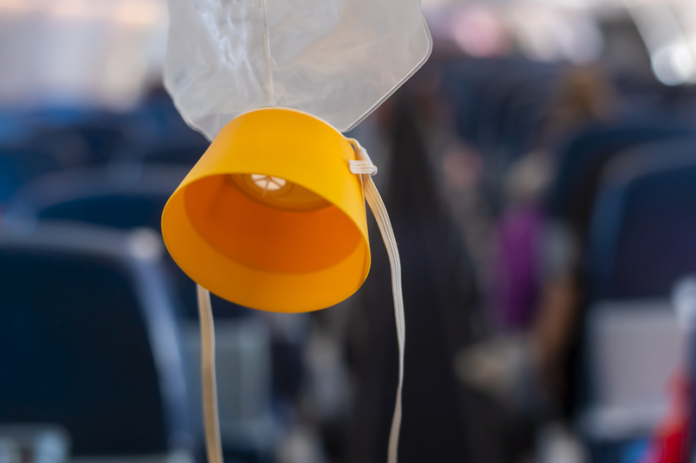
Ceiling panels tore loose and crashed down onto screaming travelers aboard a Sepehran Airlines Boeing 737 on September 15, 2026, and a passenger’s video of the scene inside the cabin has since traveled around the world. The jet, with 127 passengers and crew aboard, turned back to Mashhad, Iran, after a mechanical failure shortly after takeoff.
The flight was headed from Mashhad Hashemi Nejad International Airport (MHD) to Kermanshah International Airport (KSH) in western Iran. Unofficial reporting has pointed to a burst tire, with one account saying the aircraft “had burst a tyre shortly after take off,” according to the outlet SimplyFlying, and describing the panels collapsing “as it comes in to land.” Neither the airline nor investigators had officially confirmed the tire report as of September 16. Other reporting places the cabin damage earlier, saying “disaster struck shortly after takeoff.”
What the Cabin Footage Captured
A passenger shot the footage, which the agency Jam Press distributed. It shows the interior vibrating hard before whole sections of the ceiling swing down and fall into the aisle, leaving the aircraft’s internal fixtures and structure exposed. Damaged overhead bins spilled items onto some of the people in the seats below. The person holding the phone is hit at one point, and the camera swings toward the floor, where a large square of cabin casing is visible.
Passengers prayed aloud. Some clutched the seatbacks in front of them; others raised their hands against the falling panels or tried to push the ripped-away lining back into place. Female passengers shriek on the recording, and a man seems to cry out to Allah again and again, desperation in his voice. The clip spread quickly after it was shared on Reddit and X.
An Emergency Declared to the Tower
The tire failure “caused engine damage and severe vibrations that shook the aircraft violently,” according to Simple Flying, prompting the captain to declare an emergency and return to Mashhad. The captain asked the control tower for permission to go back to the departure airport, and the 737 turned around and landed safely. Flight-tracking data shows the aircraft, identified as a Boeing 737-300, departed at 5:30 p.m. on September 15 and landed back at Mashhad at about 5:39 p.m. Everyone on board was escorted off once the aircraft had come to a complete stop, and no injuries were reported among the 127 people aboard.
The travelers reached their destination in the end. At Mashhad they were transferred to another aircraft to complete the journey to Kermanshah.
Operations on the ground took a hit as well. Mashhad International Airport closed one of its two runways for assessment before reopening it later in the day.
Still No Official Cause
Iran’s Civil Aviation Organization has launched a probe, and technical investigators are examining the aircraft. No official cause has been published.
Until that investigation reports, how a problem on the ground roll ended with panels detaching from the ceiling remains an open question for investigators rather than a settled account. The outcome, though, is not in doubt: an emergency declaration, a return to the airport of departure, a safe landing and an aircraft with a partly collapsed cabin interior.
Sepehran Airlines was founded in 2016, is based in Mashhad and operates 13 aircraft with an average age exceeding 30 years. International sanctions on Iran make the carrier’s aging 737-300s and 737-500s difficult to maintain. As of September 17, Sepehran had never recorded a fatal incident.
An Earlier Sepehran Incident at the Same Airport
Sepehran has run into trouble at Mashhad before this year. On August 25, a Sepehran Boeing 737-500 flying from Tehran to Mashhad ran off the runway after touching down and stopped with its nose landing gear collapsed. That aircraft was also carrying 127 people, and no injuries were reported. Iran’s Civil Aviation Organization opened an investigation into that runway excursion as well.
Footage of cabin failures travels faster than the paperwork that explains it, and this clip is a case in point. Within a day of the flight, outlets in the U.S., Europe and Australia had picked it up, running freeze-frames of the gap opening in the ceiling and of the panels swinging down onto the rows beneath. The images are dramatic, and the raw facts of the flight are not in dispute.
What the footage cannot supply is the reason. That will depend on the technical examination of the aircraft now in progress, and on whatever Iran’s Civil Aviation Organization decides to release when its review of the September 15 incident is finished.