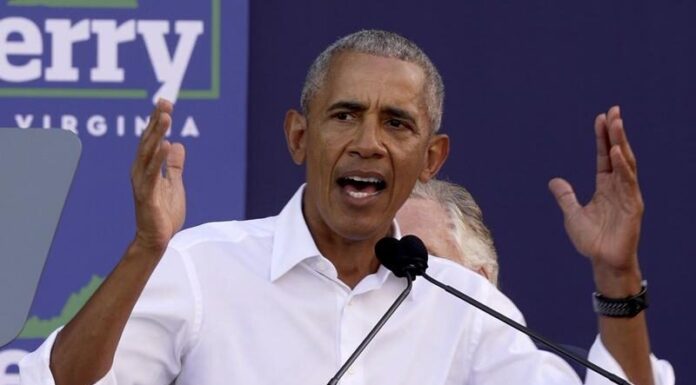
Barack Obama is heading back onto the campaign trail at the worst possible moment for President Donald Trump’s Republicans, headlining a fundraiser for Senate Democrats in the Washington, D.C., area on Oct. 7, 2026.
The former president, who remains a popular and influential figure among Democratic voters, is looking to hand his party a financial boost with the event, which will be his first appearance at a Democratic Senatorial Campaign Committee (DSCC) fundraiser this midterm cycle. It lands in the closing stretch before the Nov. 3 elections.
Obama will also join Sen. Lisa Blunt Rochester of Delaware, a DSCC vice chair, for a conversation centered on “the importance of flipping the Senate and the stakes of the election,” a DSCC spokesperson said.
Democrats Eye Four Senate Seats
Democrats need to flip four seats to take control of the upper chamber in November, and they are increasingly optimistic about their odds as several red states move into play. That includes Texas, where Trump’s endorsed candidate, Republican Ken Paxton, is trailing Democrat James Talarico in multiple polls. Talarico could become the first Democrat to win a statewide election in Texas since 1988.
Obama’s sales pitch still carries weight with the party’s base. An NBC News poll conducted in September found that 43 percent of registered voters — including 77 percent of Democrats — said they would be more likely to support a candidate he endorsed. Democrats are likely to view his involvement as a lift at a time when voters are becoming more engaged in the midterms.
He has also headlined a campaign event in the New Jersey governor’s race and appeared at the dedication ceremony for the opening of the Barack Obama Presidential Center in Chicago on June 18. Not every indicator favors his party, though: Democrats face a staggering spending disadvantage in Georgia’s tight race for governor.
Republicans Keep Their Distance
The contrast with the president’s own standing is stark. Trump is recording near-record-low approval ratings, and multiple GOP lawmakers have concluded that putting space between themselves and the 80-year-old could help them in November, scrubbing references to him from their campaign websites and publicly criticizing his unpopular policies.
CNN data analyst Harry Enten reported a striking measure of that drift: less than 1 percent of Republican political ads that aired in the first half of September mentioned Trump at all, compared with 20 percent of Democratic ads.
The GOP is widely predicted to lose control of the House, with backlash to Trump’s policies, his handling of the economy, his war with Iran and the party’s razor-thin majority in the lower chamber all cited as factors. Should the Senate follow, Trump would spend his final two years in office with Democrats running Congress — a near-mirror image of Nov. 10, 2016, when Obama welcomed then-President-elect Trump to the Oval Office for the symbolic start of the transition after Republicans won the White House and both chambers.
Obama’s Quiet Push on AI
The fundraiser is only the most visible part of Obama’s role in his party. Described as still his party’s standard-setter 10 years out of the White House, he is regularly in touch with the rising generation of Democratic leaders and has been pressing likely 2028 presidential candidates on artificial intelligence, telling them what he has seen so far is nowhere near enough for the scale of the issue or its politics.
He is not alone. Former Federal Trade Commission Chair Lina Khan and former Commerce Secretary Gina Raimondo are among the Democratic figures demanding more from the emerging field. Obama, for his part, has talked with leaders of all the major AI companies, including Sam Altman of OpenAI and executives at Google and Anthropic, along with outside experts and informal advisers such as Jason Goldman, the former Twitter executive who ran his Office of Digital Strategy. He has been reading deeply on the subject, favoring articles by Ezra Klein, Derek Thompson, Charlie Warzel and Casey Newton.
Trump is pulling in the opposite direction. He hosted several AI leaders at the White House on Tuesday, Sept. 29, announcing a new industry commitment to police itself, and said he would soon sign an executive order renaming artificial intelligence “super intelligence,” Trump said.
Most Republicans in Washington have taken their cues from the president and pushed back against broad federal regulation of AI. On the Democratic side, no consensus plan has emerged — not even from Obama — and some 2028 hopefuls are wary of landing on the wrong side of the industry’s enormous campaign spending.