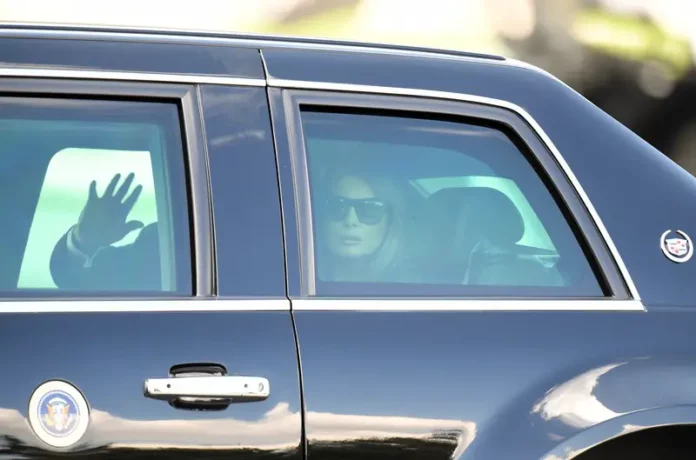
First Lady Melania Trump has kept a light public schedule through much of her husband’s second term, but on Wednesday, September 23, 2026, she stepped back into view. Chinese President Xi Jinping had just landed outside Washington for a three-day state visit, and she explained why the president would set protocol aside and meet him at the plane.
The September 23 welcome at Joint Base Andrews was staged for the cameras. A 100-foot red carpet ran from the bottom of the aircraft staircase, a 21-person honor guard stood at attention, and two B-1 bombers passed overhead as the Trumps shook hands with Xi and his wife, Peng Liyuan.
The first lady, appearing on Fox News Channel’s “Fox & Friends,” said President Donald Trump decided to go to the base himself because of the rapport between the two leaders. “He’s coming on our soil, and we need to welcome them with the most respect,” she said of Xi and Peng.
A U.S. president rarely meets a foreign leader at the plane instead of waiting for the guest to reach the White House. Papal arrivals have been among the exceptions. Pope Francis was welcomed by then-President Barack Obama in 2015, and Pope Benedict XVI was greeted by then-President George W. Bush in 2008, as each arrived in the United States. Trump also greeted Vladimir Putin on the tarmac for their Alaska summit last year.
The First Lady’s Announcement
The airport greeting was only the opening act. Her office published the details of the visit on Monday, September 21, in a statement that used the honorific “Excellency” eight times. The release called the trip a significant milestone in the relationship between the two countries and noted that more than a decade has passed since Xi and Peng were last at the White House. Obama was the host for that earlier state visit, in September 2015.
Such enthusiasm marks a shift for a first lady whose public appearances have been infrequent. She skipped the president’s May trip to Beijing, the Republican midterm convention in Dallas and his September trip to Ireland. Her outings have been selective. The Pentagon held a ceremony marking 25 years since the September 11 attacks, and she attended; the Freedom 250 Grand Prix brought her to Washington, D.C., in August; and her Be Best initiative took her to a North Carolina stop. She did travel to China with Trump during his first term.
Pomp at the White House
The Trumps hosted the centerpiece event on Thursday, September 24, a state arrival ceremony that spanned the South Lawn, the State Floor and the Rose Garden. It drew 479 military personnel from every branch of the U.S. Armed Forces, and an Armed Forces Full Honor Cordon lined the South Drive leading to a display of American and Chinese flags. The U.S. Army Herald Trumpets sounded a fanfare from the South Portico, and “The President’s Own” U.S. Marine Band played both national anthems before the two leaders spoke.
Much of the ceremony took place indoors. Photographs from the day show the Trumps greeting Xi and Peng on the South Portico and an arrival ceremony in the Grand Foyer of the White House, with the two couples watching a silent drill platoon review on the new helipad from the Blue Room Balcony. A B-2 Spirit bomber and four F-22 Raptors capped the proceedings with a flyover. Melania Trump and Peng Liyuan have since toured the Smithsonian’s National Museum of Asian Art, an outing watched for both diplomacy and style.
The couples met again that evening at the North Portico for a black-tie dinner in the East Room, the same room where the Trumps hosted Britain’s King Charles III and Queen Camilla on April 28. Technology and finance were expected to dominate the guest list: Jensen Huang of Nvidia, Tesla and SpaceX chief Elon Musk, Amazon founder Jeff Bezos, Sundar Pichai of Google, OpenAI chief Sam Altman, Jane Fraser of Citigroup and Dell Technologies founder Michael Dell. Tea in the Red Room winds the visit down on Friday, September 25, along with a stop at the National Archives to view records tied to the relationship between the two countries.
As the summit got underway September 24, Trump hailed a “truly great friendship” with Xi, while Xi urged “healthy” competition between the two powers.
Objections From the President’s Own Party
Not everyone in Washington is applauding the red carpet. In a Senate speech on Tuesday, September 22, Sen. Roger Wicker, R-Miss., chairman of the Senate Armed Services Committee, criticized the welcome and said Trump should not have invited the Chinese leader “based on all of the troubling issues we have with President Xi and the Chinese Communist Party.” China’s military buildup and its support for Iran were among the topics Wicker then proposed for discussion at the state dinner.
Real friction hangs over the visit. Commerce, AI, the president’s conflict with Iran and Beijing’s ambitions regarding Taiwan have all weighed on ties between the two countries, and expectations for a breakthrough are low.
Even so, Treasury Secretary Scott Bessent announced on Fox News Channel on September 23, as Trump welcomed Xi at Joint Base Andrews, that the two countries’ trade truce — scaling back tariffs and holding off new trade restrictions — had been extended to January 10. “I don’t know whether a bigger deal can be done. I don’t know whether we will just roll the current deal,” Bessent said in the interview, noting that the extension could give the leaders more time to talk at upcoming summits in China in November and Florida in December.
A closed-door meeting between the two leaders is scheduled before the dinner. Trump wants relations between the rivals to hold steady, even as he has lavished praise on Xi and called him a friend. He has made no secret of wanting the staging to impress. His new helicopter landing pad will be ready in time, he told reporters, expressing delight, though he complained that construction leaves his planned White House ballroom unavailable as a venue for Xi.
Trump’s own reception in Beijing went differently: Xi was not at the airport, and Chinese Vice President Han Zheng handled the arrival instead. But a red carpet was rolled out to Air Force One, hosts assembled a military honor guard and a military band, and about 300 Chinese youths waved Chinese and American flags, the children wearing white and light blue uniforms in the colors of the presidential plane.