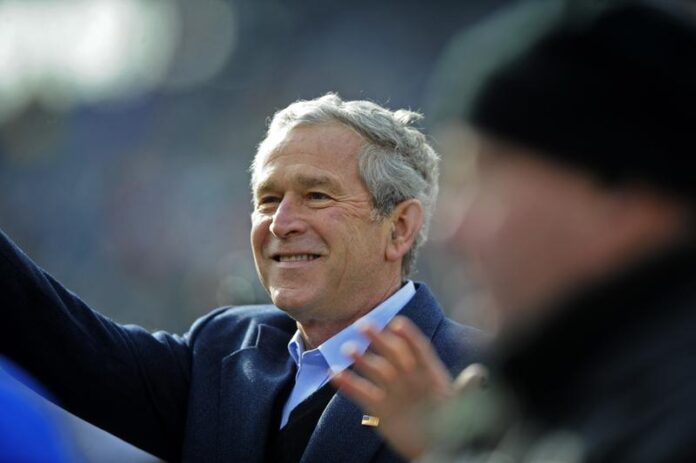
Former President George W. Bush turned up as a special guest at a Dallas, Texas fundraiser for Republican Senate candidates on Monday, September 21, 2026, lending his name to campaigns in several states — but not to Ken Paxton, the Texas attorney general who carries President Donald Trump’s endorsement in the state’s Senate race.
The event benefited the Maintain the Majority fundraising committee and was hosted by Sen. John Cornyn, R-Texas, who lost to Paxton in what was the most expensive Republican Senate primary ever. The proceeds were earmarked for Republican Senate candidates — a mix of sitting senators and challengers — in Alaska, Iowa, Maine, Michigan, New Hampshire and Ohio, with Minnesota added late.
The Republican running in the host’s own state was left off that roster. The crowd of old-guard Republicans offered Paxton no public endorsement, leaving the former president raising money for Senate Republicans across the map while skipping Paxton in the marquee contest unfolding in his own state.
A Texas Seat Republicans Fear Losing
The snub lands at a delicate moment for the party. Some Republicans have warned that Paxton could sink the GOP’s hold on a seat Texas normally delivers without drama, and several polls have shown Democrat James Talarico narrowly ahead of him — a Texas Southern University survey taken September 15–19 had it 47% to 46% — in a contest both parties count among the most closely watched on the map. Voters decide the race on November 3.
The stakes stretch well beyond Texas. A Talarico victory would go a long way toward putting the Senate within reach for Democrats, and the GOP is also widely expected to lose control of the House in November. No Democrat has captured a statewide office in Texas since 1994, a drought Talarico is trying to end — and a win by him would also give his party its first Texas Senate victory since Lloyd Bentsen in 1988.
Impeachment, a Divorce and a Primary Win
Paxton’s baggage is considerable. The Republican-controlled Texas House impeached him in 2023 on accusations of corruption, bribery and obstruction of justice. The Texas Senate acquitted him, but corruption allegations kept dogging him afterward. His wife filed for divorce, citing “biblical grounds,” after rumors of an affair surfaced.
That record is precisely why establishment Republicans lined up behind Cornyn during the primary. Senate Majority Leader John Thune was among the figures who endorsed the incumbent, with party veterans arguing that Cornyn stood a far better chance of holding the seat. Primary voters disagreed, and Paxton took the nomination anyway.
Not the First Bush-Paxton Collision
Paxton has collided with the Bush family before. Back in 2022, the challenger he beat for the GOP’s attorney general nomination in Texas was George P. Bush, a nephew of the former president.
The Bush name nonetheless remains stitched into Texas institutions. The Bush School of Government and Public Service at Texas A&M University opened in 1997, built around a conviction held by President George H.W. Bush: that there is nobility in serving the public. It continues to train students in College Station, Washington, D.C., and online.
Rove Breaks With a Texas Republican
Bush is not the only figure from the Republican old guard putting distance between himself and the party’s newer standard-bearers in Texas. Karl Rove, the veteran GOP strategist who steered Bush to victory in both the governor’s mansion and the White House, has said his ballot in the Texas Railroad Commission contest will go to Democrat Jon Rosenthal rather than Republican Bo French.
Rove’s vote against French followed a post on X in which French circulated an image of University of Texas students who are not white cheering a college football win, captioned: “The problem is now obviously far worse than anyone imagined.”
Rove wrote in an opinion piece for The Wall Street Journal that the GOP now has a growing number of “Bo Frenches,” describing a party increasingly home to antisemites who hide behind innocent-sounding questions, misogynists devoted to hypermasculinity, conspiracy theorists chasing clicks for profit, and religious bigots who lump Muslim American patriots in with terrorists.
For Paxton, the Dallas event underscores a problem no amount of Trump’s support resolves on its own: the party’s old guard in Texas is, at minimum, declining to vouch for him in public. The committee’s checks are headed to Senate races from Alaska to Maine. The one it skipped is in the state where the money was raised.