
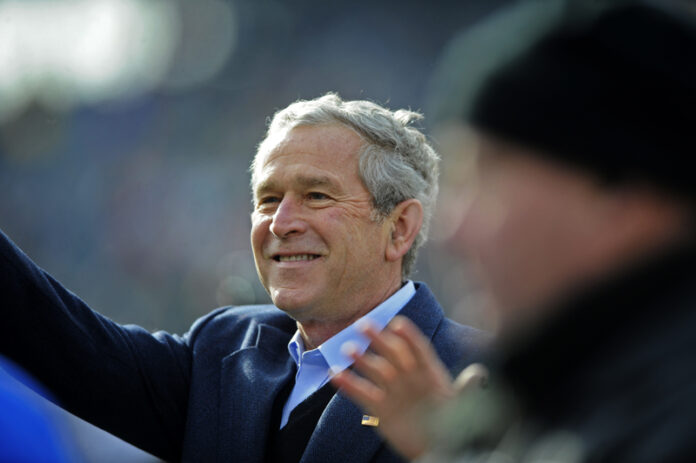
Former President George W. Bush said reports of Muslim women being harassed in public are why he visited a Washington mosque during his first week after the September 11, 2001, attacks. Speaking at his presidential center in Dallas, Texas on Wednesday evening, September 9, 2026, Bush, 80, revisited one of the defining decisions of those days.
Bush appeared onstage with former Secretary of State Condoleezza Rice for a program billed as “A Legacy of Service: America at the 25th Anniversary of 9/11.” Rice was national security adviser when al-Qaeda struck the World Trade Center and the Pentagon; she became secretary of state in 2005.
“This decision, shortly thereafter, was to go to a mosque,” Bush said. “I did so because I was deeply concerned about stories of women in coverings being harassed at shopping centers, particularly in Michigan.”
Revisiting the Islamic Center Visit
The trip came up when Rice steered the conversation toward it, inviting the former president to explain the steps he had taken to assure Muslim American citizens that no blame for the attacks fell on them. Bush described the visit as a test of the country’s own principles. The fight, he said, was an ideological struggle, and giving up the freedom to worship as one chooses would mean surrendering a central piece of American ideology.
“I also made it clear that Islam was a religion of peace, not a religion of war, and that these people subverted their religion,” he added.
What He Told the Country in 2001
Nearly 3,000 people died in the attacks, and no part of Bush’s response was more visible than the mosque visit. On September 17, 2001, six days afterward, he went to the Islamic Center of Washington and declared, “Islam is peace.” Meeting with Muslim community leaders there, he raised how Muslim women in head coverings were being treated, relaying accounts of some who were afraid to leave home or go shopping for fear of intimidation. “That should not and that will not stand in America,” he said at the time.
The address, known variously as “Remarks at the Islamic Center of Washington” and “Islam Is Peace,” separated the hijackers sharply from the faith they claimed. The attackers had perverted Islam, Bush told the country, and terrorism did not represent the religion’s true face. He praised the contributions Muslim Americans make to national life, and he quoted a passage from the Quran during the remarks.
He had reached for that message before the mosque stop. On September 13, 2001, he told journalists that Americans should treat Arab Americans and Muslim Americans with respect. A day later, on September 14, 2001, he addressed a memorial service held on a National Day of Prayer he had proclaimed; Muzammil H. Siddiqi, a Muslim imam, also took part. Earlier that year, on March 7, 2001, he had issued a statement marking the holiday Eid al-Adha — his first public comments about Islam as president.
Response to the 2001 speech was not uniform. Hate crimes against Muslims fell after the remarks, compared with the days immediately before them. Some conservative Christians criticized the administration for drawing a distinction between Islam broadly and terrorist organizations such as al-Qaeda. Sociologist Rosemarie Skaine argued that the speech showed how Bush generally helped reduce Islamophobia in the United States. Sociologist Louise Cainkar called it a positive speech, though she said Bush undercut the message in other addresses that cast Muslims as hostile to America. On June 27, 2007, Bush returned to the Islamic Center to speak at its rededication ceremony.
Inside the Days After the Attacks
Topics well beyond the mosque visit came up during the Dallas conversation. “9/11 was a clarifying moment for me and you and others in our administration because we realized that we were vulnerable to attack based upon what we believe,” Bush said, adding, “Based upon a belief system.”
He walked the audience through the day of the attacks, beginning with the moment the news reached him. “I was in a classroom listening to a little child read, and Andy Card whispered in my ear, ‘second plane has hit,’” he said. Of the attacks themselves, he said: “There was no doubt in my mind that this was not a law-enforcement event. This was a war.” The American public rallied afterward, he told the room, and military recruitment and volunteering surged — a response he said he got to see firsthand.
Rice gave the view from inside the White House. On the morning after the attacks, she said, the administration had to get the FBI and the CIA sharing intelligence for the first time; civil liberties concerns had left them unable to really talk to each other. Every morning, then-FBI Director Robert Mueller and then-CIA Director George Tenet carried the threat matrix into the Oval Office. Between September 10 and September 12, 2001, she said, it swelled to the size of a phonebook.
Public support for Bush climbed in the weeks after the attacks to a 90 percent approval rating, a peak no president had reached in the history of polling. Osama bin Laden, the mastermind of the attacks, eluded U.S. forces throughout Bush’s presidency. U.S. special forces killed him in 2011 during the Obama administration.
“The sad thing is one-third of our nation has no clue what we’re talking about,” Bush told the Dallas audience. Those Americans, he said, never saw the sacrifice and courage of that time, and he pressed for keeping the history alive.
Joint Chiefs Chairman Gen. Dan Caine also spoke at the September 9 event, telling Bush he “didn’t sign up to become a wartime president, but you became one.” He added, “Leadership starts at the top.”
A ceremony marking the anniversary in New York City on Friday, September 11, drew Bush and former First Lady Laura Bush. Each of the 2,983 names on the 9/11 memorial wall was read aloud there, accompanied by soft music. Daniella Wald, daughter of victim Victor Wald, spoke from a pulpit at Ground Zero. “Daddy, wow, 25 years,” she said.