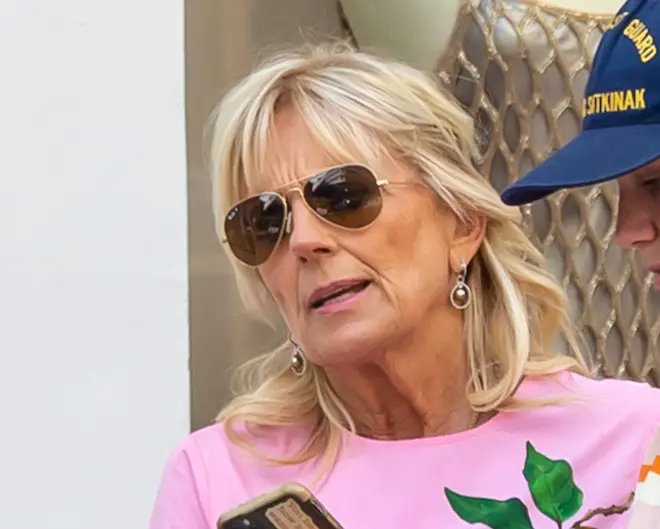
Former First Lady Jill Biden directly confronted Democratic critics of her memoir during a June 3, 2026, appearance in Washington, issuing a pointed invitation to one former aide to speak with her face-to-face rather than through media outlets.
The 75-year-old author defended “View from the East Wing” during an interview with journalist and MS NOW contributor Paola Ramos at the Sixth & I Synagogue, where a capacity audience had gathered for the second event of her national publicity tour. The memoir, released days earlier, has reignited tensions within the Democratic Party over the circumstances that led President Joe Biden to withdraw from the 2024 presidential campaign.
Direct Challenge to Former Aide
Andrew Bates, who worked as deputy press secretary during the Biden administration, had questioned the timing of the book’s release to reporters, expressing confusion about why such a painful subject for Democrats warranted revisiting. He noted that Democrats “had a duty to win and we didn’t.”
Biden responded by noting that only a single chapter addresses the political upheaval, while the rest of the volume chronicles her four-year tenure as first lady. She then delivered a sharp retort to her former colleague.
“I want to say to Andrew: Call me up, and say it to my face, buddy,” she told the crowd.
The confrontation underscored ongoing Democratic concerns about Biden’s influence over her husband’s choice to pursue reelection despite widespread worries regarding his physical condition and mental acuity. Instead of quieting those concerns, the publication and promotional campaign have intensified scrutiny from within the party.
Biden justified her approach by drawing parallels to her career as a community college professor, explaining that she speaks candidly to her 83-year-old spouse when others remain silent, and she takes the same approach with her grandchildren, maintaining that her goal is to help people improve themselves.
Atlanta Debate Remains Central Focus
The memoir’s most controversial passages concern the June 27, 2024, debate in Atlanta, during which Joe Biden’s unsteady showing against Donald Trump hastened his exit from the race. Throughout the tour, Biden has disclosed that watching her husband left her terrified and questioning whether he had experienced a stroke. During her conversation with Ramos, she acknowledged her continued uncertainty about the evening’s events, emphasizing that her lack of answers stems from genuine confusion rather than concealment. She noted that she had been away on the campaign trail during his Camp David debate preparations, preventing any pre-debate contact, and revealed that the book tour has repeatedly forced her to confront footage she wished to avoid as journalists continually requested her reaction to it.
According to Biden, what she observed reflected normal aging rather than serious deterioration — her husband moved more slowly and his stutter became worse when fatigued. The book describes how she abandoned her stroke theory after talking with him and determining he was fine, though in the memoir she acknowledged briefly considering whether someone might have slipped him a drug. Her primary worry, she explained, centered on public perception of the performance. A critical New Yorker assessment observed that she devotes minimal space to substantiating her version of events, treating the debate primarily as an unexplained occurrence while portraying her White House tenure in glowing terms, comparing the experience to living inside a snow globe.
Biden has consistently positioned herself as a devoted partner rather than a political strategist. She has described experiencing moments of happiness during her East Wing tenure despite its difficulties, pointing to her continued teaching and international trips. Yet her justification ultimately relies on marital devotion instead of detailed explanations — she repeatedly emphasizes her love for Joe and her unwavering commitment as his spouse to stand beside him under any circumstances. Whether Democrats still recovering from their 2024 defeat will accept this reasoning continues to be uncertain.
In a BBC interview with Paddy O’Connell that aired August 7, 2026, Hunter Biden delivered a sobering assessment of his father’s condition, saying “the cancer has spread” and that “it’s not good.” He said the former president’s prostate cancer had “metastasized into his bones and further,” called it “very painful and it’s very debilitating,” and admitted that watching his father’s decline has been “really, really hard and it’s really sad to watch” — even as he stressed that Joe Biden has not given up. The 83-year-old former president revealed an aggressive prostate cancer diagnosis in May 2025, one his office described as a Gleason 9 case that had already reached the bone but remained hormone-sensitive and treatable. His son’s remarks were the clearest signal yet from the family that the illness has advanced in the months since.