
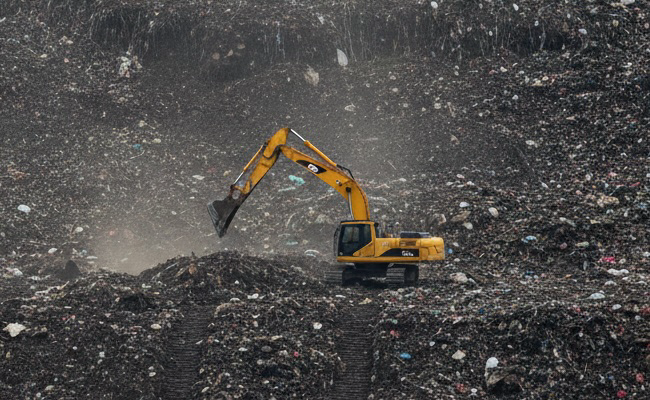
At least 34 people died when a towering open-air garbage dump collapsed in Guinea’s capital on August 23, 2026, burying shacks at the base of the mound and trapping residents under tons of refuse. Another 33 were injured.
The collapse struck Dar Es Salam, the largest waste site in Conakry, the seaside capital of the West African nation. The dump had grown over the years into a mountain of trash, with informal housing pressed up against its edges — a common arrangement in cities where scavengers earn a living sorting through discarded material.
The weight of the sliding waste caved in a three-story building beneath the mound. Six of the injured were hurt seriously, the slide flattened several homes, and rescue crews began combing the debris for anyone still alive.
The slope gave way at about 2 a.m. Authorities said an overnight downpour had soaked the refuse, leaving the landfill dangerously unstable. Staff with ANGUCH, the national agency for the management of emergencies and humanitarian disasters, were photographed at the scene as crews worked across the shifting slope of garbage. Residents living nearby were seen leaving their homes in the hours after the slide, carrying what they could.
A Landfill That Was Due to Close
What makes the disaster especially wrenching is that the site was not supposed to be operating at all. The landfill had originally been scheduled to close on Sunday after officials warned about hazardous conditions there, according to Lt. Col. Baldé Mamadou Bailo, who oversees sanitation for the army’s engineering battalion.
That order followed an earlier incident at the dump in recent years that had raised safety concerns. As a precaution, officials had also served eviction notices on residents living beside the landfill, requiring them to leave.
But many people were still in the immediate vicinity when the waste came down. For families with nowhere else to go, the dump has long been both a hazard and a livelihood, and the eviction orders did not empty the neighborhood.
Djénabou Touré, Guinea’s minister of territorial administration and decentralization, said at the scene: “We will ensure that the remaining families are relocated elsewhere.”
Echoes of a 2017 Mudslide
The same landfill has turned deadly before. Torrential rains in 2017 set off a mudslide at the site that left at least nine people dead, an episode that fed years of warnings about the stability of the ever-growing pile.
Waste sites like Dar Es Salam pose a well-documented danger during heavy rain. Water soaks into loosely packed layers of trash, adding weight and lubricating the material until a slope gives way, often with little warning and enormous force. In Conakry, where the rainy season brings sustained downpours, that risk is seasonal and recurring.
The toll climbed through the first two days. A government communiqué put it at 30 on the afternoon of the collapse; it reached 31, then 32, on August 24, when the count still stood short of its final figure. Health Minister Khaïté Sall announced 34 dead and 33 injured on August 25, a figure ANGUCH confirmed and one that has not moved since.
A Week of Fallout
The response widened in the days that followed. Prime Minister Amadou Oury Bah visited the site on August 24, and officials identified about 1,500 people for relocation. Bulldozers began demolishing neighboring houses on August 26, and evicted residents protested the following day; roughly 150 were still awaiting rehousing by August 28. President Mamadi Doumbouya toured the site on August 29 with Gen. Amara Camara, who announced that the ground would be converted into an urban park. On August 30, the FFSG called for an independent inquiry.
As of that date, the government had declared no period of national mourning, opened no formal investigation and issued no order closing the landfill.
For the surrounding community, the practical questions are immediate: where displaced families will sleep, how the destroyed homes will be replaced, and whether the closure that was supposed to take effect on August 23 will now be enforced — for families who had been living, until that morning, in the shadow of the city’s biggest dump.