
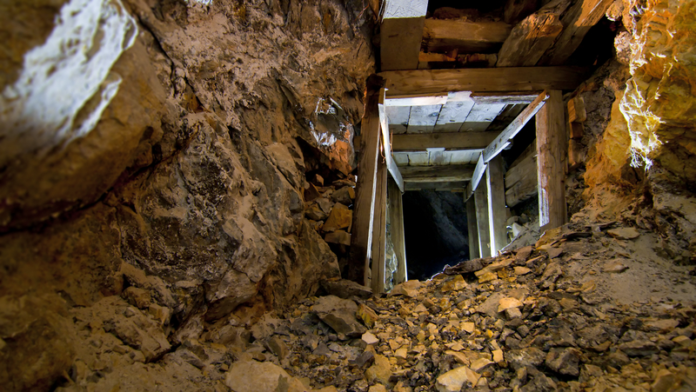
Zamboye, a village in the Nana-Mambéré prefecture of the western Central African Republic, was the scene of an artisanal gold pit cave-in on Tuesday, August 18, 2026, and Red Cross volunteers and local officials say more than 100 miners were killed there. A Red Cross volunteer gave that figure to The Associated Press, a senior official at a local mining association gave it to Reuters, and local sources gave it to Agence France-Presse. The government has put the official toll at 49 — a count local sources describe as far below the true figure while crews continue picking through unstable earth in search of those unaccounted for.
Days later, harrowing footage circulating online brought the scale of the disaster into focus. One video from the sprawling open pit, where hundreds of artisanal miners dig, captured the ground giving way and swallowing people where they stood. In other clips, mud-covered workers, men and women, hauled a body out of the hole as others moved across the site, several of them shouting for help.
Several people were still missing, and others remained pinned beneath the debris, said Bertrand Be Yangué, a member of the Zamboye youth council, who expected the toll to climb as the search went on. “Finding them alive would be a miracle,” Yangué said. The community had been left devastated, he added: those who died were young men and women who had made the journey to the pit hoping to support their families.
Some families are going home without their dead. Roger Bana Nzala traveled overnight from Bouar to Zamboye after learning his brother was in danger. “We weren’t able to find our brother; he is still in the ground, he is buried in the ground,” Nzala said, adding, “In the end, we are forced to return empty-handed.” The family had hoped to take the body back to Bouar for burial; as of August 21, 2026, they had left the site without it.
How the Ground Gave Way
Several of the underground tunnels being worked by miners appear to have given way, triggering the slide, according to a statement from the Baboua public prosecutor. Investigators are trying to establish what caused the collapse, identify the victims and determine whether anyone should face criminal liability. Some 50 kilometers (31 miles) separate the village from the town of Baboua, which sits near the Cameroonian frontier.
The collapse was catastrophic, said Cedric Mbango, a miner at the site, who described the ground beneath the workings simply giving way. Rescuers and villagers recovered 30 bodies in the hours after the cave-in, said Souleymane Bi, deputy mayor of the sub-prefecture, who appealed for outside assistance to reach those still buried. Crews were still searching for trapped colleagues, said Florian Gaguende, a miner who survived, though the prospect of finding anyone alive “is getting slimmer.”
A Search Slowed by Scarce Gear
No one knows how many people were inside the workings when the ground moved. More than 100 bodies had been recovered, according to Gervais Ganagoroh, a local Red Cross volunteer involved in the relief effort, and a senior official at a local mining association confirmed the same figure. A hospital in Baboua received several survivors who were critically injured, and the search went on through Wednesday, August 19.
There were no modern safety standards at the mine and no heavy equipment, and its crews worked with hand tools and improvised structures. Remoteness and the lack of specialized rescue gear slowed the push to reach anyone still alive. Tractors and other heavy machinery had been brought in for the recovery, local reporting in the Central African Republic said — a method that risks crushing survivors trapped below. Fixing a formal toll remained difficult, Laurent Ngon Baba, an elected official in Baboua, said on August 19. A visit to the site that day by Mines Minister Rufin Benam-Beltoungou produced an official count of 49, and seven injured miners were taken to a hospital in Baboua, about 50 kilometers from the mining site. On Thursday, August 20, 2026, authorities temporarily shut the Zamboye artisanal gold mine, barring access to it and suspending the search because the pit kept collapsing and heavy rains had flooded its lower sections. Security around the closed site was reinforced, and Agence France-Presse reported on August 20 that personnel from the Russian paramilitary group Wagner were among those deployed. No other wire has carried that detail.
Three countries lost citizens in the pit. The Mines Ministry listed 34 Central Africans, 13 Cameroonians and two Chadians among the 49 victims in the official count. His administration was coordinating closely with Central African officials on the aftermath, Grégoire Mvongo, governor of Cameroon’s eastern region, said on public broadcaster CRTV. Any wounded who crossed the border could be admitted to Cameroonian hospitals, the country said.
A Pattern of Deadly Collapses
Zamboye ranks among the deadliest mining accidents in recent years, and it follows a string of smaller collapses. The Be-Mbari gold site, which also straddles the border zone shared by the Central African Republic and Cameroon, saw a comparable cave-in on May 6 that killed dozens of people, and a further collapse at Kinyeme in the same prefecture killed at least eight in June. In the middle of March, a landslide at a mine in Ngourroum, in the west of the country, killed seven people. Gordi, in the northeast, was where another 20 died in February. Counted together, the tolls officials gave after each of those collapses put the year’s mining deaths well past 100 before Zamboye.
Small-scale, informal extraction employs somewhere between 150,000 and 400,000 people in the Central African Republic, depending on the estimate, largely beyond government control. Protective gear is rare, and the accidents often kill. Rules for artisanal mining exist on paper, but plenty of miners and traders operate without permits, work in off-limits areas or route their gold around official channels, researcher Aicha Pemboura has noted in writing for the Central Africa Observatory on Organised Crime and Violence Project. The sector employs tens of millions across sub-Saharan Africa, standing in where formal economies are too weak to absorb workers — even in places where the practice is criminalized.
Blame, Politics and Regulation
Responsibility for the repeated tragedies rests directly with the government, said Martin Ziguélé, who heads the Movement for the Liberation of the Central African People. Evariste Ngamana, the Central African Republic government spokesman, offered condolences to the victims’ families and said authorities were pressing to deliver relief and assistance.
In Cameroon, opposition leader Maurice Kamto, who finished second to President Paul Biya in the 2018 election, condemned those who grow rich from illegal mineral extraction, saying they show no concern for the destitute workers who labor at unregulated sites without safety measures. Cameroon adopted a new mining code in 2023 and is counting on iron, diamonds, gold, bauxite and cobalt to develop its economy. Its government has tightened oversight of the gold sector after finding a gap between declared exports and the imports logged by receiving countries, notably the United Arab Emirates, and says more than 200 companies mine there without a permit or authorization.