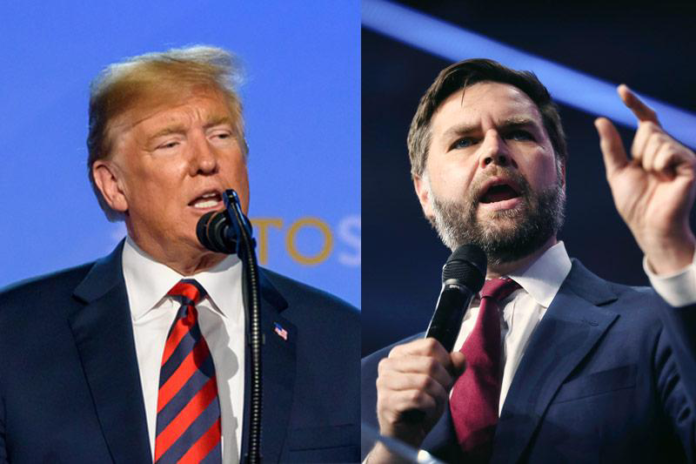
Vice President JD Vance, 41, has begun carving out political distance from President Donald Trump in what biographer Michael Wolff describes as the clearest sign yet that the president’s own party is preparing for a post-Trump future. Wolff made the assessment during an appearance on the Daily Beast’s “Inside Trump’s Head” podcast, which published its latest episode on July 21.
Speaking with co-host Joanna Coles, Wolff pointed to Vance’s Joe Rogan interview as proof the vice president is now “basically publicly proclaiming his distance from Donald Trump.” During that podcast appearance, Vance acknowledged the White House had been “guilty” of fumbling its response to the Jeffrey Epstein files scandal, a rare public rebuke from within the administration itself.
Republicans Eye the Exit
Wolff argued the maneuver signals a broader pattern taking hold across the Republican Party. With the 2028 presidential race already forming, serious contenders are looking to establish their own identities separate from the 80-year-old president, whose approval sits at 37 percent and whose handling of the economy and Iran conflict have generated widespread public disapproval.
The author, who first gained notoriety chronicling dysfunction inside Trump’s White House with his 2018 book “Fire and Fury: Inside the Trump White House,” drew a comparison to the previous election cycle. After President Joe Biden withdrew from the 2024 race, advisers urged then-Vice President Kamala Harris to create separation from Biden — counsel she mostly rejected. Vance, by contrast, appears eager to stake out independent ground while Trump still holds office.
Congressional Republicans are also showing less willingness to rubber-stamp the president’s agenda, Wolff suggested. He cited resistance to the Save America Act, a Trump priority that lawmakers repeatedly told the White House they couldn’t deliver, as evidence of waning deference. The bill eventually cleared the House of Representatives on July 23, but the friction around it illustrated strains that Wolff expects to deepen. Trump’s own coalition, he said, is moving “further and further away from him.”
Congress Becomes the Enemy
Beyond internal party politics, the president confronts institutional hostility from Capitol Hill. Democrats are projected to retake the House following the November midterms, a result Wolff said would transform the legislative branch into “an incredible noose around his neck, a burden on his shoulders.”
Wolff predicted that a Democratic majority would make frustrating and humiliating Trump its central objective, though he noted such aggressive tactics have sometimes backfired in the past. Still, the combination of a hostile Congress and a Republican field testing messages for the next presidential cycle leaves the president squeezed from both directions, he argued.
Discontent among Trump allies over Congress leaving for recess without advancing key administration priorities has added to the fractures, creating the kind of tensions that typically grow more acute as a presidency nears its end.
The White House Strikes Back
White House representatives offered no immediate comment on Wolff’s latest remarks. The administration has long dismissed the author as unreliable, with White House Communications Director Steven Cheung previously calling him a fraud and accusing him of inventing his accounts.
Wolff’s original tell-all earned him lasting enmity from the Trump circle. Staffers quoted in that book reportedly described the president as resembling a child who “does not read, does not listen.” Wolff also told PBS News at the time that individuals closest to Trump were “afraid” — both for their own careers and for the nation’s future.
Then-White House press secretary Sarah Sanders branded the work “trashy tabloid fiction,” and Trump’s attorney Charles Harder sought to block its release. The effort failed, and the book became a commercial success. Wolff’s earlier career included writing for New York magazine and Vanity Fair, along with authoring a 2008 biography of media mogul Rupert Murdoch titled “The Man Who Owns the News.”
Regardless of whether Wolff’s interpretation proves accurate or is dismissed as more fiction by the White House, the underlying dynamics he identifies — a lame-duck president, resurgent opponents and would-be successors jockeying for position — follow a familiar script in American politics. New episodes of the podcast, co-hosted by Wolff and Coles, are released on YouTube Tuesday, Thursday and Saturday evenings, with availability on additional podcast platforms Wednesday, Friday and Sunday mornings.