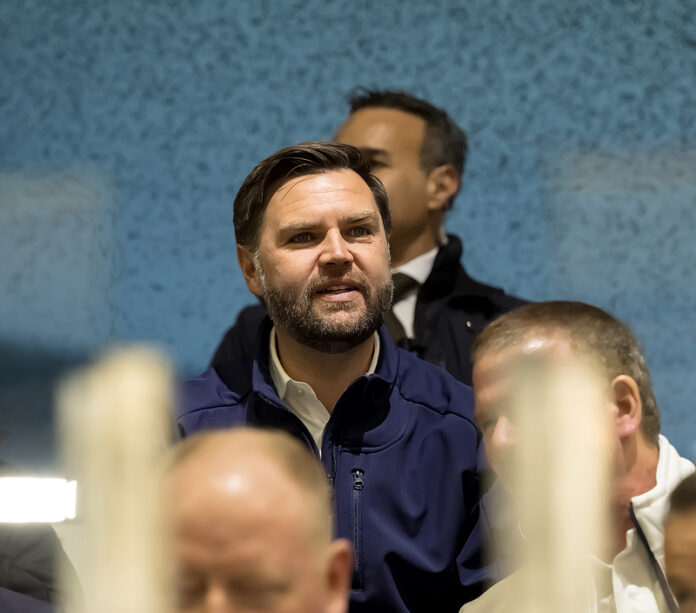
Vice President JD Vance erupted at reporters Monday afternoon during a White House fraud prevention event, accusing the media of attempting to “drive a wedge” between him and President Donald Trump over the ongoing war in Iran.
The 41-year-old Marine veteran stood directly behind Trump when a journalist questioned him about his previous skepticism toward U.S. military involvement in the Middle East, sparking an awkward exchange that has fueled fresh speculation about tension within the administration.
“What the President said consistently, going back to 2015, and I agreed with him, is that Iran should not have a nuclear weapon,” Vance fired back. “I think all of us, whether you’re a Democrat or Republican, should pray for success and pray for the safety of our troops.”
The confrontation comes as at least 13 U.S. service members have died in Operation Epic Fury, Trump’s decision to join Israel in bombing Iran following the assassination of Supreme Leader Ayatollah Ali Khamenei on February 28. More than 1,300 Iranians and several Israelis have also been killed in the conflict.
Body language expert Judi James analyzed the Monday afternoon encounter for the Daily Mail, describing Vance’s demeanor as notably submissive. She observed that Vance adopted a “dutiful and submissive pose behind his boss, rocking gently from side to side in what looked like a self-soothing gesture.”
The confrontation highlights a growing rift between Vance’s long-held anti-interventionist stance and the administration’s current military posture. The vice president, who deployed to Iraq as a Marine combat correspondent, has spent years advocating against U.S. wars in the Middle East. In 2024, he penned an op-ed supporting Trump’s candidacy by arguing the then-candidate would not draw the country into armed conflict.
Trump himself acknowledged the philosophical divide earlier this month. “He was, I would say, philosophically a little bit different than me,” the President said. “I think he was maybe less enthusiastic about going, but he was quite enthusiastic.” Trump has referred to the military operation as an “excursion” and suggested U.S. citizens are willing to endure inflated gas bills and stock market volatility to prevent Iran from developing nuclear weapons.
According to a POLITICO report citing two senior Trump administration officials, Vance has been characterized as “skeptical” and “worried about success” regarding the Iran conflict, with one official saying he “just opposes” the military action.
Last week, Vance refused to disclose his private advice to Trump about the Iran strikes during another tense media exchange in Rocky Mount, North Carolina. “I hate to disappoint you but I will not show up here in front of God and everyone else and tell you what I said in the classified room,” Vance declared. “Partially because I don’t want to go to prison, and partially because I think it’s important for the president of the United States to talk to his advisors without those advisors running their mouth to the American media.”
The Iran war has cast a dark shadow over Vance’s political future. The Vice President’s odds of winning the White House in 2028 have plummeted this week as Secretary of State Marco Rubio has swung into ascendancy among Republican circles. On the Kalshi prediction market, Rubio now leads at 20 percent while Vance has dropped to 18 percent — a dramatic reversal from before the war, when Vance held a commanding lead. NBC News reported that Trump polled a group of GOP donors at Mar-a-Lago who overwhelmingly supported Rubio over Vance for the 2028 nomination.
Democrats have seized on Vance’s predicament, mocking the Vice President’s awkward positioning on a war he reportedly opposed. CNN reported that Vance initially counseled against another Middle East war but shifted his stance when it became clear Trump favored military action, ultimately advocating for the president to attack quickly and decisively.
The human cost continues to mount. Among the American casualties is Sgt. Declan Coady, a 20-year-old Army Reserve soldier from West Des Moines, Iowa, killed by an Iranian drone strike in Kuwait on March 1. Vance attended the dignified transfer of six fallen soldiers at Dover Air Force Base on March 7, a somber duty that underscored the stakes of a war he reportedly opposed.
Meanwhile, Trump has hinted at further military action, telling associates he plans “another foreign excursion” and is considering “taking Cuba,” according to sources familiar with the conversations.
As the war drags on with no clear end in sight, Vance finds himself trapped between his anti-war principles and loyalty to a president whose military adventurism threatens to define — and potentially derail — the vice president’s political trajectory.