
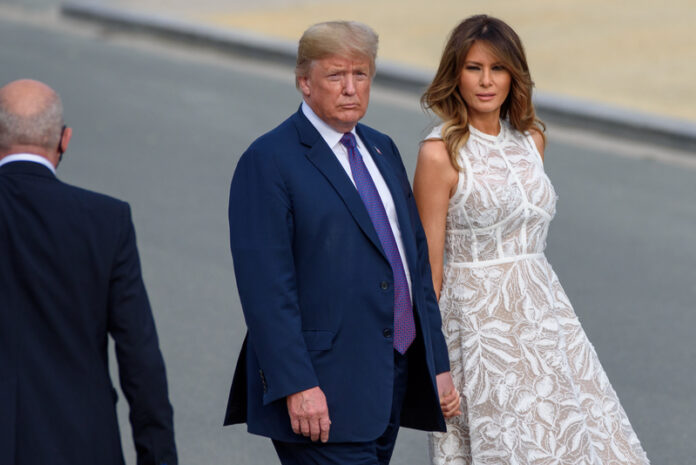
President Donald Trump has privately acknowledged to First Lady Melania Trump that his administration’s aggressive immigration enforcement strategy has become “election poison,” according to sources familiar with conversations between the President and his top aides. The stunning admission comes as the commander-in-chief faces mounting pressure to overhaul Immigration and Customs Enforcement following a series of controversial raids that shocked the nation.
The acknowledgment follows violent clashes in Los Angeles that erupted when ICE raids sparked confrontations with law enforcement, prompting Trump to deploy approximately 700 U.S. Marines from the Marine Corps Air Ground Combat Center Twentynine Palms to the city. The troops joined National Guard forces already protecting federal personnel and property in the greater Los Angeles area.
Over the past year, immigration enforcement operations have fundamentally transformed under the leadership of Gregory Bovino, the Border Patrol commander-at-large who became the public face of the administration’s interior enforcement surge. Congress approved roughly $178 billion in DHS funding through reconciliation—the largest single package of DHS supplemental appropriations ever—enabling aggressive enforcement operations across the country.
But the human cost has been severe. The killings of Renee Good and Alex Pretti by ICE and Customs and Border Protection officers galvanized critics who say the administration abandoned its promise to focus on immigrants with criminal convictions. Both victims were 37-year-old U.S. citizens shot in Minneapolis during Operation Metro Surge in January 2026.
“Immigrants, refugees, asylum seekers, and their allies are no longer safe,” said HIAS staff in a statement following the shootings.
The administration conducted a sweeping overhaul of Immigration and Customs Enforcement, with more than a dozen senior officials in various cities replaced by officials from Customs and Border Protection. Jason Houser, who served as ICE chief of staff from 2021 to 2023, characterized the reorganization as politically motivated rather than based on law enforcement needs.
“What’s unfolding under Bovino isn’t law enforcement. It’s political stagecraft directed from Washington, not the field,” Houser wrote in an analysis of the enforcement overhaul.
White House Deputy Chief of Staff Stephen Miller has been instrumental in shaping the administration’s immigration policy, working closely with Homeland Security Secretary Kristi Noem and “border czar” Tom Homan. Miller runs daily 10 a.m. conference calls demanding updates from agencies and exerts pressure on senior officials who deliver less-than-satisfactory results. The trio pushed forward plans that include deploying ICE agents to airport security lines during a partial DHS shutdown and establishing temporary detention compounds to process thousands of immigrants.
The enforcement surge has affected nearly every corner of the country. More than 400,000 people have been processed through the immigration detention system, which has expanded dramatically to support the administration’s goal of one million removals per year.
The scale of potential deportations is staggering. More than 16.7 million people share a home with at least one undocumented family member, and roughly six million of these are children under eighteen. Undocumented adults make up nearly 5% of the workforce. The ACLU has called for cutting the size of the immigration detention system by at least 75%.
In Los Angeles, where the recent clashes occurred, local officials have clashed with federal authorities over enforcement tactics. California Governor Gavin Newsom has been a vocal critic of the administration’s approach, calling the deployment of troops a “serious breach of state sovereignty” and filing multiple lawsuits against the administration.
In San Antonio, Texas, community leaders gathered at City Hall on February 20, 2026 to protest the administration’s policies. Similar demonstrations have erupted in cities across the country—from Atlanta to New York City—as word spreads about the administration’s enforcement operations.
Community organizers have emerged across the country, working with advocacy groups like HIAS to provide resources and support to immigrant families facing the threat of detention or deportation. In Minneapolis, thousands attended candlelight vigils in the aftermath of the Good and Pretti shootings.
Naureen Shah, ACLU director of policy and government affairs for immigration, warned that the administration’s plans to deploy ICE agents to airports represents an unprecedented escalation. The deployment would mark the first time armed immigration agents have been sent to replace trained security personnel at airports.
Vice President JD Vance has remained largely silent on the controversy, though sources say he has privately expressed concerns about the political fallout. The administration’s approval ratings on immigration have dropped sharply since early 2026, with polling showing growing unease even among Republican voters about the tactics being employed.
As Trump approaches his 80th birthday in June, the President faces a critical decision about whether to continue the current enforcement approach or chart a new course. His admission to Melania suggests he recognizes the political peril, though translating that recognition into policy changes would require abandoning the hardline stance that has defined his presidency.
For millions of immigrant families, the stakes could not be higher.