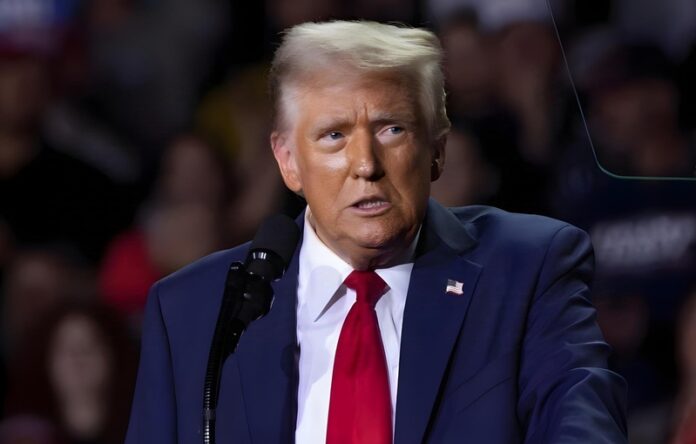
At CPAC 2026 just days ago, evangelist Franklin Graham urged attendees to do “everything we can to get him re-elected,” an impossible constitutional request that nevertheless earned applause, while former White House strategist Steve Bannon told MSNBC on March 27 that he is actively pursuing “five or six different alternatives” to keep President Donald Trump in office beyond 2029. The scene directly contradicts Trump’s own September 2024 claim that the 2024 campaign would be his last — a vow he has spent the past 16 months steadily undoing, line by line.
The pressure has been constant since Trump won the 2024 election and took office in January 2025. At a January 2026 rally, he asked supporters, “Should we do it a fourth time?” During his February 24, 2026 State of the Union address, Trump joked mid-speech, “In my first year of my second term — should be my third term, but hey…,” referencing his repeated assertions that the 2020 election was stolen. A few days later in Texas he said, “Maybe we do one more term… we are entitled to it.” In January he wrote on Truth Social: “RECORD NUMBERS ALL OVER THE PLACE! SHOULD I TRY FOR A FOURTH TERM?”
The irony is striking. In September 2024, Trump told an interviewer plainly, “No, I don’t… I think that will be it. I don’t see that at all,” when asked about 2028. At 79, he drew direct parallels to President Biden, who had just left the race amid concerns about his mental fitness. Trump won in November, and within months that earlier pledge had vanished.
The 22nd Amendment clearly bars anyone from being elected president more than twice. Trump has occasionally acknowledged this limit. On Air Force One, he told reporters the Constitution is “pretty clear” — “I’m not allowed to run. It’s too bad” — and dismissed the idea of a vice-presidential workaround as “too cute.” Still, those concessions haven’t stopped him from raising the possibility immediately afterward.
Bannon is more straightforward. “We’re working on five or six different alternatives that President Trump could run again and be president,” he told MSNBC. “On the afternoon of January 20th, 2029, Donald Trump is going to be president for his third term.” At CPAC on March 26, Franklin Graham proclaimed, “We’ll never get another president like Donald Trump. That’s why we need to do everything we can to get him re-elected.”
Jeremy R. Paul, a constitutional law professor at Northeastern University, called the most-talked-about workaround — running as vice president on a cooperative ticket and then assuming the presidency — “a ludicrous argument,” noting that the 12th Amendment also prevents anyone ineligible for the presidency from serving as vice president. Democrats have pursued preemptive measures in legislation; California state Senator Tom Umberg introduced a bill to let the state’s secretary of state require proof of a candidate’s eligibility before the 2028 ballot.
Even among Trump supporters, the push for a third term is showing signs of faltering. Several CPAC participants told the Washington Examiner they were looking past Trump toward younger Republican figures in 2028. “He’s got to pass the torch to JD Vance,” said Matthew Kingston, 26, of Lubbock, Texas. “I think we deserve a younger slate of leaders coming up the pike.” A congressional hopeful in Mississippi cited the 22nd Amendment bluntly: “That’s a nonstarter… it’ll be somebody else’s turn.”
Trump’s approval remains below water, with roughly 4 in 10 Americans approving of his second-term performance according to an AP-NORC poll, and 56% of voters disapproving of his handling of the economy, immigration, and cost of living, per a New York Times-Siena poll. Other surveys show 70% of Americans oppose a third Trump term outright.
The man who vowed in 2020 that losing to Biden would mean “you’ll never see me again” — yet dominated the GOP for four years afterward — made a similar permanent vow in September 2024. With Bannon openly counting down to Inauguration Day 2029 and “Trump 2028” merchandise selling well at CPAC, that promise now seems as short-lived as the previous one.