
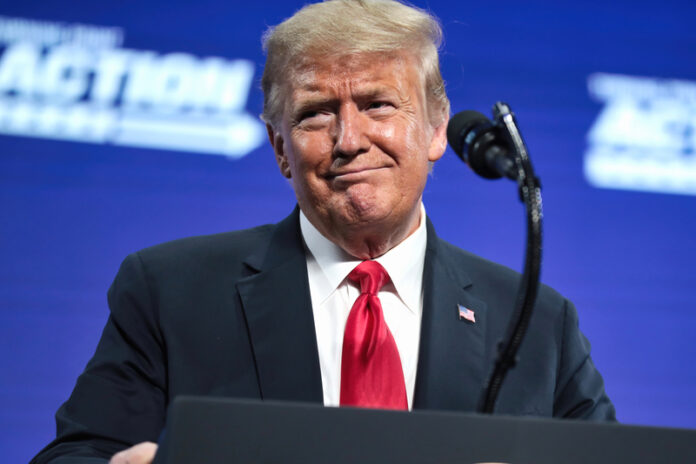
President Donald Trump drew intense criticism on Sunday evening, March 1, after skipping urgent inquiries about U.S. military activity in Iran to instead admire newly added statues in the White House Rose Garden. He told reporters: “Unbelievable statues, you’ll see. Come and look at them.”
Trump returned to Washington from Mar-a-Lago on Sunday, a day after initiating what the Pentagon has labeled “Operation Epic Fury” against Iran. The joint American‑Israeli operation killed Iranian Supreme Leader Ayatollah Ali Khamenei, 86, along with several senior figures, including Iran’s defense minister and the head of the Islamic Revolutionary Guard Corps. Three U.S. service members have been killed, and five others critically injured.
As reporters pressed him about the mission’s goals and who he envisioned leading Iran after Khamenei’s death, Trump paused to admire statues of Thomas Jefferson and Benjamin Franklin that had been installed while he was away. When asked if he had a message for the relatives of the fallen U.S. troops, Trump walked off without answering.
CNN’s Kaitlan Collins noted that Trump declined to speak with press aboard Air Force One during the trip back from Florida, a break from his usual routine. He did, however, speak to some journalists by phone earlier in the weekend as events unfolded.
The statues had not been installed when Trump left for Texas on Friday. They are the newest features added to the Rose Garden since Trump ordered renovations in June 2025.
Criticism of Trump’s priorities surfaced quickly across social media, with many contrasting his interest in garden aesthetics with the seriousness of U.S. casualties and a growing conflict that has triggered Iranian retaliation throughout several Gulf nations.
The dispute escalated Monday when U.S. Central Command confirmed that three American F‑15E Strike Eagle jets were mistakenly shot down by Kuwaiti air defenses late Sunday night. All six crew members ejected and survived, and they are reported to be in stable condition. Kuwait’s Ministry of Defense had earlier announced that “several” U.S. aircraft went down.
Trump initiated the unexpected bombing campaign Saturday night after attending a black‑tie gala at Mar‑a‑Lago, where he was photographed dancing to Lee Greenwood’s “God Bless the U.S.A.” The strikes killed Khamenei as well as Iran’s defense minister and the IRGC commander.
In a video message Sunday addressing American casualties, Trump delivered a bleak outlook: “And sadly, there will likely be more before it ends, that’s the way it is. But we’ll do everything possible where that won’t be the case.”
Trump, who received five draft deferments during the Vietnam era, did not dismiss the possibility of sending U.S. ground forces into Iran “if they were necessary.” He also warned that Iran would face complete destruction if it struck back at American leadership.
Public backing for the strikes is weak. A Reuters/Ipsos survey taken February 28–March 1 found just 27% of Americans supported the action, while 43% opposed it and 29% were undecided. Even among Republicans, only 55% approved, and about one‑quarter believe Trump is overly eager to use military force.
When urged to respond to the poll numbers, Trump brushed them off, saying: “It’s not a question of polling. You cannot let Iran, which is a nation that has been run by crazy people, have a nuclear weapon.”
NATO Secretary General Mark Rutte voiced support for the mission during an interview with Fox News. “There is no sliver of light between us,” he said, asserting that European allies back the removal of Khamenei and efforts to restrict Iran’s nuclear program.
Iran’s Revolutionary Guard vowed major retaliation, declaring that “the most intense offensive operation in the history of the armed forces of the Islamic Republic of Iran will begin in moments.” Satellite images from Airbus revealed extensive damage at Khamenei’s compound in central Tehran.
Trump signed a National Security Presidential Memorandum in February 2025, reinstating his “maximum pressure” stance toward Tehran, laying the groundwork for the ongoing confrontation. The overall scale and expected duration of Operation Epic Fury remain uncertain as the conflict enters its third day.