
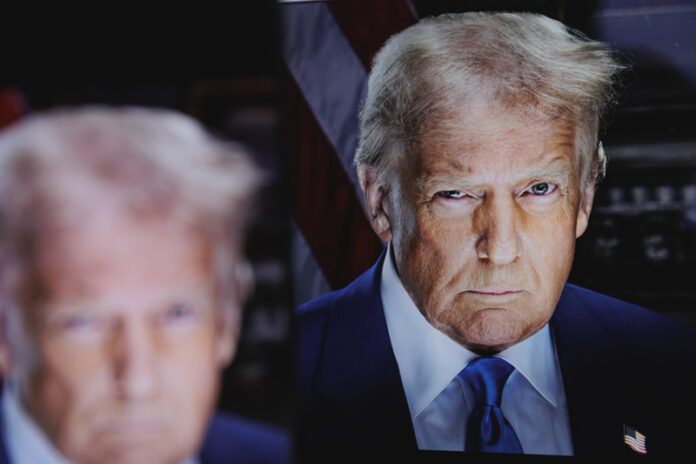
On Thursday, January 8, 2026, the Senate approved a vote to restrict President Donald Trump from initiating further military action in Venezuela. This decision, which is seen as a significant censure to the president, was facilitated by five Republican senators who joined Democrats in progressing a War Powers Resolution.
The 52-47 procedural vote paves the way for comprehensive Senate floor discussions next week on a resolution that would mandate Trump to obtain congressional consent before deploying military force again in Venezuela. This resolution comes in the wake of Trump’s recent authorization of a strike that captured Venezuelan leader Nicolás Maduro, who is now facing drug-related charges in New York City, New York.
Republican senators—Rand Paul of Kentucky, Susan Collins of Maine, Lisa Murkowski of Alaska, Josh Hawley of Missouri, and Todd Young of Indiana—who voted with Democrats drew immediate criticism from Trump. The president used Truth Social to express his disapproval of their decision.
Trump wrote, “Republicans should be ashamed of the Senators that just voted with Democrats in attempting to take away our Powers to fight and defend the United States of America,” adding that these five GOP senators should never be elected to office again.
Compared to a similar resolution in November which was defeated, this vote signals a significant shift, as more Republicans—Paul and Murkowski—joined Democrats in backing the measure. This increase in Republican support indicates mounting unease within Trump’s party regarding his growing military aspirations and his threats of military action against multiple countries, including Venezuela, Greenland, and Colombia.
The War Powers Resolution, proposed by Democratic Senator Tim Kaine of Virginia and Republican Senator Rand Paul, necessitates Trump to seek congressional consent before re-engaging the military in Venezuela. To reach the president’s desk, the measure must be approved by both chambers of Congress, where Trump has the power to veto it. To override such a veto would require two-thirds support from both chambers—an objective that seems unachievable given the current political alignments.
“Make no mistake, bombing another nation’s capital and removing their leader is an act of war plain and simple,” Paul stated in a release. “No provision in the Constitution provides such power to the presidency.”
Reacting to Trump’s condemnation, Collins expressed her support for the operation that captured Maduro but opposed prolonged military involvement without congressional approval. Her stance mirrors the intricate balance that many Republicans are trying to maintain—supporting Maduro’s capture while expressing reservations about Trump’s comprehensive military plans for the region.
The constitutional disagreement centers on diverging interpretations of presidential authority. Trump and his congressional allies argue that the strike was a law enforcement operation, thus bypassing the need for congressional consultation. Under this viewpoint, the capture of Maduro—who faces drug-related charges—does not fall within the purview of war powers that would require legislative approval.
However, critics postulate that this interpretation exceeds constitutional boundaries. Trump had been amassing military presence around Venezuela for several months prior to capturing Maduro, and has since threatened the country with further attacks. The president’s declaration that the United States would temporarily govern Venezuela has raised questions concerning the extent and duration of American military involvement.
The resolution is set to be debated in the Senate next week, where it is likely to pass given the count from Thursday’s vote. The measure would then move to the House of Representatives, where Republicans maintain a slim majority. Even if it is approved by both chambers, the legislation is likely to face a veto from Trump, and supporters admit they do not have the numbers to override such action.
Nonetheless, the vote holds symbolic importance. It signifies one of the first major congressional challenges to Trump’s foreign policy in his second term and indicates that there are concerns within his own party about unregulated executive military power.
Additionally, Trump’s threats of military action have extended beyond Venezuela, causing concern among legislators who worry about unilateral military decisions being made without congressional involvement. Trump has specifically threatened interim Venezuelan leader Delcy Rodriguez, warning her of greater consequences than those imposed on Maduro if she does not comply with American demands.
Democratic leaders, including Senate Minority Leader Chuck Schumer of New York and Senator Adam Schiff of California, co-sponsored the resolution with Kaine and Paul. Their support is indicative of the unified Democratic opposition to what they perceive as presidential overreach in matters of war and peace.
Before the vote, Senate Majority Whip John Barrasso of Wyoming urged his colleagues to reject the measure, arguing it would undermine presidential authority and compromise America’s safety. His stance echoes the views of most Senate Republicans, who continue to support Trump’s Venezuela operation and his wider use of military force in the region.
This constitutional debate raises fundamental questions about the division of powers in the American government. While the Constitution grants Congress the power to declare war, the president serves as the commander-in-chief of the armed forces. The War Powers Resolution of 1973 sought to clarify these competing authorities, but disagreements about its application have persisted for decades across administrations of both parties.
The nighttime raid on Caracas which resulted in Maduro’s capture marked one of the most dramatic foreign policy actions of Trump’s presidency. The operation, carried out on January 3, removed a leader who had ruled Venezuela for years despite American opposition and international sanctions. Maduro is currently in custody in Brooklyn, New York, awaiting prosecution on drug-related charges that the Trump administration contends justified the military operation.
As the resolution moves toward a full Senate vote next week, the focus will be on whether additional Republicans join the five who broke with Trump on Thursday. The outcome will help determine the boundaries of presidential military authority and congressional oversight for the remainder of Trump’s term, with implications that extend beyond Venezuela to other potential conflict zones where Trump has suggested military intervention remains an option.