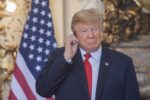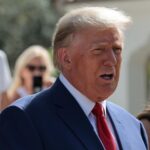
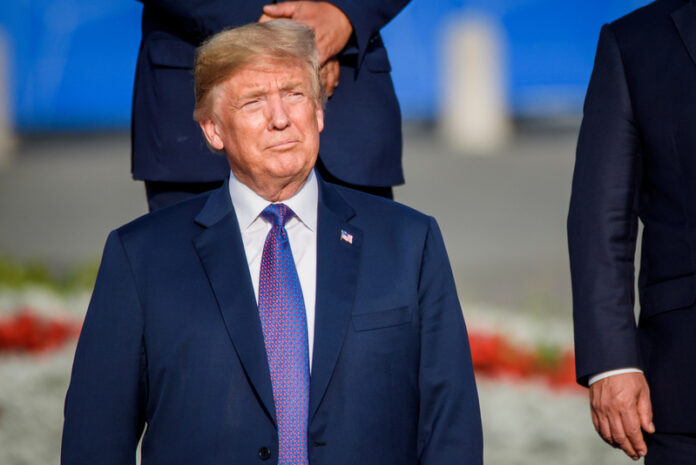
In an apparent warning to President Donald Trump, Iran’s Supreme Leader Ayatollah Ali Khamenei uploaded an image of a crumbling statue mirroring Trump. The post hinted that the US president might face a similar downfall as historical despots. This cautionary note surfaces amid rising tensions over widespread protests in Iran.
Trump declared a 25 percent tariff on nations trading with Iran, and consistently threatened military intervention in support of the protesters, contending with a violent governmental backlash.
On his official Farsi-language account, Khamenei stated that the “father figure who sits there with arrogance and pride” would encounter the same destiny as historical tyrants such as Pharaoh, Nimrod, and former Iranian leaders Reza Khan and Mohammad Reza. He added that Trump “too will be overthrown” at the height of his arrogance.
Trump suggested that Iran is keen on negotiations with the US shortly before Khamenei’s response. He claimed that Iranian leaders had approached him, and a meeting was being arranged, although he maintained that military action may precede any diplomatic engagement.
White House Press Secretary Karoline Leavitt reaffirmed that all options regarding Iran, including airstrikes, are being considered. However, she emphasized that diplomacy is the president’s preferred method.
Protests in Iran began in late December in central Tehran due to surging inflation and the depreciating value of the rial. The demonstrations quickly spread to 186 cities across 31 provinces, with activists reporting 585 protest sites.
Iran Human Rights disclosed that the death toll had increased to a minimum of 2,500 people, including at least 12 children below 18. The organization reports thousands more injuries, but the actual casualty count could be greater, as an internet blackout imposed by authorities currently prevents independent verification.
The Iranian government portrayed the protesters as armed agitators spurred by the United States and Israel to create disorder. A mass funeral for 100 security forces was held near Tehran University, with authorities stating that 109 security personnel had been killed during the protests.
Monitoring groups have recorded over 10,000 arrests during the government’s suppression. Iran’s judicial chief, Gholamhossein Mohseni-Ejei, suggested that detained protesters would face swift trials, telling state media that prompt action was required for maximum effect.
Erfan Soltani, a 26-year-old protester, could potentially face execution as the first anti-government protester sentenced to death. His family was informed by prison authorities that his execution had been postponed, although human rights groups warn that hangings could occur soon.
Trump previously threatened “very strong action” if executions begin, stating that Iran was “looking at FREEDOM, perhaps like never before” and that the United States was ready to assist.
The State Department issued a security alert advising Americans to immediately exit Iran due to escalating protests and heightened security measures. The alert recommended departing overland to Armenia or Turkey and planning for alternate communication methods due to the ongoing internet blackout.
In response to escalating tensions, the United States and the United Kingdom pulled out some staff from the al-Udeid base in Qatar as a safety measure. Iran then shut its airspace to most flights, while Germany’s Lufthansa announced it would avoid flying over Iranian and Iraqi airspace until further notice.
Tehran cautioned regional countries hosting American bases, including Saudi Arabia and Turkey, that it would target these installations if the United States attacked Iran. Iranian Foreign Minister Abbas Araghchi insisted that the situation was under control, urging Washington to pursue diplomatic engagement.
US Treasury Secretary Scott Bessent announced new sanctions targeting 18 companies and individuals involved in Iran’s energy exports. Ali Larijani, secretary of Iran’s Supreme National Security Council, along with other officials involved in the crackdown, was also sanctioned. Larijani was among the first Iranian leaders to advocate violence in response to the protesters’ demands.
As tensions appeared to reach a peak, Trump softened his stance. He stated that he had been informed “on good authority” that the killings in Iran had ceased and that no executions were planned.
Mustafa Hijri, leader of the Democratic Party of Iranian Kurdistan in Iraq, said his group was prepared to support the protesters. However, he cautioned that the time for armed intervention had not yet arrived, fearing it could give the regime a reason to intensify its suppression.
Hijri showed a desire for international assistance, specifically American airstrikes targeting suppression forces and judicial institutions. He warned that deploying armed forces across the border without broader support could backfire and endanger peaceful protesters.