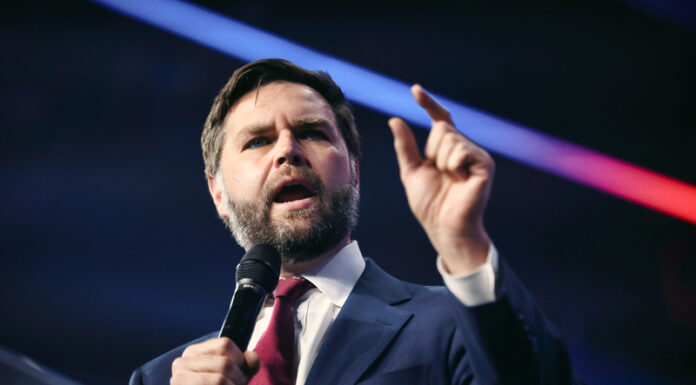
Vice President JD Vance publicly acknowledged being a conspiracy theorist during a Dec. 16, 2025, appearance in Allentown, Pennsylvania, responding to sharp criticism from White House Chief of Staff Susie Wiles while simultaneously defending her loyalty to President Donald Trump.
The unexpected admission came after Wiles, the first female White House chief of staff, told Vanity Fair that Vance has been “a conspiracy theorist for a decade.” The characterization emerged from a series of 11 interviews Wiles conducted over several months in 2025 with journalist Chris Whipple for a two-part feature that has sent Trump administration officials scrambling into damage control mode.
When confronted about Wiles’ comments during his Pennsylvania visit to promote the Trump economy, Vance grinned awkwardly as audience members groaned. He had not read the article but embraced the label with a qualifier that drew cheers from his pro-Trump crowd.
“Sometimes I am a conspiracy theorist, but I only believe in the conspiracy theories that are true,” Vance said. The vice president claimed he and Wiles have joked publicly and privately about his conspiratorial thinking for years, framing their disagreement as friendly banter between colleagues who largely align on policy matters.
Vance offered three examples of conspiracy theories he believes in, including accusations that President Biden wanted to imprison political opponents rather than defeat them through democratic debate, despite the absence of supporting evidence. He regularly makes claims without citing sources, positioning himself as someone who sees through mainstream narratives to underlying truths others miss.
The vice president’s defense of Wiles proved equally notable. Despite her criticism, he praised her as someone who maintains consistency whether speaking directly to Trump or discussing him privately. “Susie Wiles, we have our disagreements. We agree on much more than we disagree, but I’ve never seen her be disloyal to the president of the United States,” Vance said. He called her the best White House chief of staff Trump could ask for, emphasizing loyalty as her defining characteristic.
The Vanity Fair interviews revealed more than just Wiles’ assessment of Vance. She described Trump as having an “alcoholic’s personality,” called Russell Vought a “right-wing absolute zealot,” suggested Elon Musk is “microdosing,” and criticized Attorney General Pam Bondi’s handling of the Epstein files. Wiles also characterized Vance’s political conversion from Never Trumper to MAGA devotee as “sort of political,” suggesting his transformation coincided conveniently with his Senate campaign.
Trump defended Wiles despite admitting he had not read the Vanity Fair feature. The president agreed with her assessment of his personality, acknowledging he has a “possessive and addictive type personality” and noting there was a reason he abstains from alcohol. He called Wiles “fantastic” while dismissing the magazine as having “lost its way” and “lost its readers.”
Wiles herself moved quickly to contain the fallout, calling the feature a “disingenuously framed hit piece on me and the finest President, White House staff, and Cabinet in history” in a rare statement posted on social media. She claimed significant context was disregarded and much of what she and others said about the team and Trump was omitted from the published articles.
The controversy highlighted tensions within Trump’s inner circle even as officials publicly rallied around Wiles. Secretary of State Marco Rubio also participated in the interviews and posed for photographs included in the feature alongside Vance and other top administration figures.
Vance used the opportunity to criticize mainstream media, telling his Pennsylvania audience that the episode should teach administration officials to give fewer interviews to traditional outlets. He described Wiles to Vanity Fair as a “facilitator” who works to make Trump’s vision “come to life,” positioning her role as implementing rather than constraining the president’s agenda.
The interviews were conducted over months throughout 2025, starting shortly before Trump’s return to office. Wiles spoke with Whipple on topics ranging from internal policy debates to personnel decisions, offering remarkably candid assessments of key administration figures including Kash Patel, Dan Bongino, and Stephen Miller.
Vance’s admission that he identifies as a conspiracy theorist, even with qualifications, marked an unusual moment of political candor. Most officials deflect such characterizations or deny them outright. His embrace of the label, combined with his defense of Wiles, illustrated the complex dynamics within Trump’s second administration, where personal loyalty often trumps policy disagreements and public criticism can coexist with professions of mutual respect.
The episode concluded with Vance answering one final question before wrapping his Pennsylvania event. He did not address Wiles’ comment that his shift to full MAGA was partly a matter of political expediency.
Sources:
https://www.thedailybeast.com/vance-backs-wiles-and-admits-hes-a-conspiracy-theorist/
https://www.thedailybeast.com/susie-wiles-delivers-astonishing-verdict-on-jd-vance/
https://www.yahoo.com/news/articles/wiles-says-trump-alcoholic-personality-194808424.html
https://www.thedailybeast.com/trump-offers-bonkers-defense-of-loose-lipped-chief-of-staff/
https://www.vanityfair.com/news/story/trump-susie-wiles-interview-exclusive-part-1