
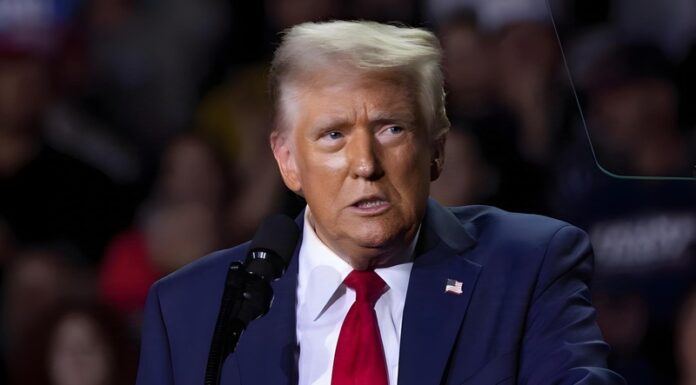
Donald Trump accused The New York Times of being a national security threat in a Truth Social post on Tuesday, December 23, 2025, escalating his ongoing attacks against the newspaper in what critics described as an assault on press freedom.
Trump called The New York Times a serious threat to national security and an enemy of the people in the social media post. The post marked the latest in a series of attacks against media organizations the president has long criticized.
A spokesperson for The New York Times responded to the attack with a statement defending the newspaper’s role. The spokesperson said they will report fully on government no matter which party is in power.
The newspaper published a report in November revealing Trump reduced public appearances, drawing the president’s ire. The Times also recently published a detailed examination of Trump’s friendship with Jeffrey Epstein, the late financier whose criminal activities sparked national controversy.
In one account from the Epstein report, a mother who accompanied her 14-year-old daughter to a party at Mar-a-Lago with other young models claimed Marla Maples warned about keeping the daughter away from men. Maples denied making the remark to the newspaper.
Trump also criticized The New York Times during a Monday press conference about prescription drugs at Mar-a-Lago. The president claimed drug prices lowered by 2000-3000 percent, a mathematically questionable assertion that drew scrutiny.
During the same press conference, Trump rambled about robots and AI for shipbuilding. Trump said robots will help build ships. “I’m a very aesthetic person,” Trump said.
The president’s comments came as he announced a new Navy Trump-class battleship during the Mar-a-Lago event. Pete Hegseth and Marco Rubio flanked Trump during the announcement.
White House Deputy Press Secretary Anna Kelly defended Trump policies when contacted for comment on the president’s remarks about technology and employment.
Economic indicators show challenges ahead despite Trump’s optimistic projections. Unemployment rose to 4.6 percent, according to recent labor data. Analysts estimate AI could cost 6-7 percent of U.S. workers their jobs as automation advances across industries.
The attacks on The New York Times reflect Trump’s longstanding antagonism toward media organizations he considers hostile to his administration. The president has repeatedly used the phrase “enemy of the people” to describe news outlets, language that press freedom advocates say threatens democratic norms and journalist safety.
Trump’s social media presence continues to generate controversy as he uses platforms like Truth Social to bypass traditional media channels. The posting pattern has become a signature aspect of his communication style, allowing him to reach supporters directly while avoiding press scrutiny.
The president’s characterization of a major American newspaper as a national security threat represents an escalation in rhetoric against the press. First Amendment advocates worry such language could inspire harassment or violence against journalists, particularly when issued by the nation’s highest elected official.
Constitutional scholars note that press freedom protections exist precisely to enable media organizations to scrutinize government actions without fear of official retaliation. The New York Times has published journalism through multiple presidencies and maintained its editorial independence despite pressure from various administrations.
Trump’s attacks on the newspaper come as he faces coverage of sensitive topics including his personal relationships, policy decisions, and public appearances. The November report about reduced public appearances particularly angered the president, who has long been sensitive to suggestions about his age or stamina.
The Monday press conference at his Mar-a-Lago resort illustrated Trump’s tendency to shift between topics rapidly. His discussion ranged from pharmaceutical pricing to shipbuilding technology to media criticism, often without clear transitions between subjects.
The newspaper indicated it would not alter its coverage approach in response to presidential pressure, maintaining that reporting on government actions remains a core journalistic responsibility regardless of which political party holds power.
As the confrontation between the president and one of America’s most prominent news organizations continues, questions persist about the broader implications for press freedom and government accountability. The episode underscores ongoing tensions between Trump’s administration and media outlets that investigate and report on presidential activities.