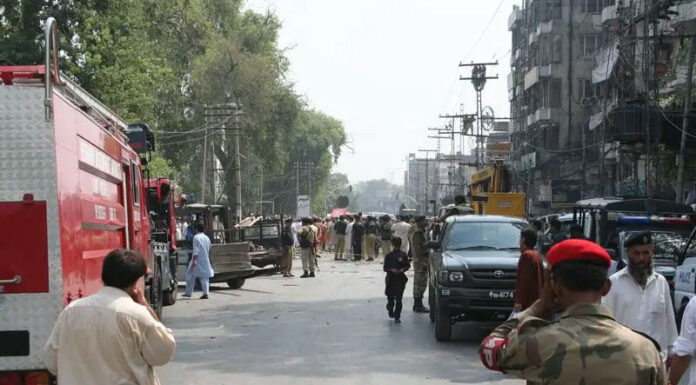
Five police personnel were killed on Tuesday, Dec. 23 when their van was ambushed in a coordinated bombing and shooting attack in northwest Pakistan’s Karak district, authorities confirmed. The assault marks another violent episode in the country’s struggle against resurgent militant activity.
Provincial police officials said the vehicle was first targeted with improvised explosives before attackers opened fire on the occupants. The attack claimed the lives of four officers and their driver in Khyber Pakhtunkhwa province, a region where security forces have increasingly come under fire from militant groups.
The incident occurred in Karak district, an area that has been relatively unscathed by militant attacks compared to other parts of the volatile northwestern region. The targeted nature of the assault, involving both explosive devices and small arms fire, suggests a level of coordination and planning by the perpetrators.
Prime Minister Shehbaz Sharif condemned the attack in a statement following the incident. “Police have always played a frontline role in the war against terrorism,” Sharif said, praising the role of law enforcement in combating militant violence across the country.
Interior Minister Mohsin Naqvi and Khyber Pakhtunkhwa Chief Minister Suhail Afridi also condemned the attack, with officials stating that “the assailants would be brought to justice,” according to provincial reports. The ministers expressed condolences to the families of the slain officers.
The Tehreek-e-Taliban Pakistan, commonly known as the Pakistani Taliban or TTP, claimed responsibility for the attack. The militant group has waged war against the Pakistani state for nearly two decades, launching attacks on security forces, government installations, and civilian targets across the country’s mountainous border regions.
Following the initial attack, security forces engaged with the militants, reportedly killing eight of those involved in the ambush, according to provincial police reports. The operation demonstrated the immediate response capabilities of Pakistani security forces, though the toll on police personnel underscores the continuing dangers faced by law enforcement in the region.
The attack comes at a time of heightened tensions between Pakistan and neighboring Afghanistan. Relations between the two countries have collapsed following a surge in violence along their shared border. The countries have struggled to maintain a truce following their worst border clashes since the Taliban came to power in October.
Islamabad has consistently blamed the rise in militancy on groups using Afghan soil to plot their attacks against Pakistani targets. Pakistani officials argue that militant sanctuaries across the border enable groups like the TTP to launch cross-border raids and retreat to safety.
The Afghan government in Kabul denies these charges, insisting that Pakistan’s security challenges are an internal problem that should be addressed domestically rather than blamed on Afghanistan. This fundamental disagreement has prevented meaningful cooperation between the two governments on counter-terrorism efforts.
Talks between Pakistani and Afghan officials in Istanbul last week ended without reaching any agreement on security cooperation or border management. The failure to find common ground has left both nations at an impasse while militant violence continues to escalate.
Pakistan’s mountainous border regions have long served as strongholds for Islamist militant groups, including various factions of the Tehreek-e-Taliban. The rugged terrain and porous border make it difficult for security forces to establish complete control, allowing militant groups to maintain operational capabilities despite ongoing military operations.
The TTP’s nearly two decades of insurgency against the Pakistani state has killed thousands of security personnel, government officials, and civilians. Despite periodic military operations and periods of reduced violence, the group has demonstrated resilience and the ability to regenerate its fighting capacity.
The attack in Karak district highlights how militant groups can strike even in areas previously considered relatively secure. This unpredictability complicates security planning and stretches law enforcement resources across the province. Police forces, often operating with limited equipment and training compared to military units, face particular vulnerability when conducting routine patrols and operations.
As Pakistan continues to grapple with the resurgence of militant violence, the deaths of five police personnel serve as a reminder of the ongoing security challenges facing the country. The combination of cross-border tensions, militant sanctuaries, and difficult terrain creates a complex security environment that defies easy solutions, leaving frontline security forces exposed to continuing attacks.