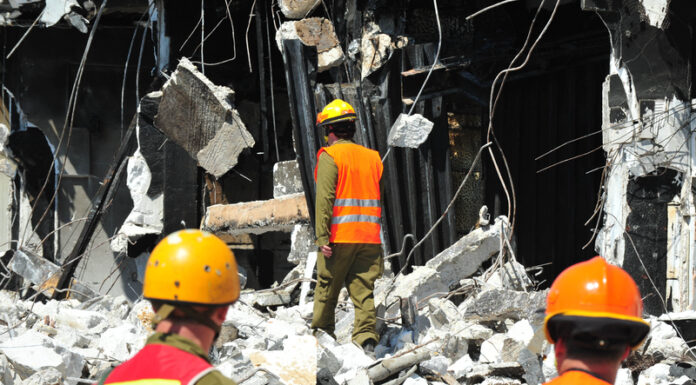
At least 22 people were killed and 16 others injured when two adjacent four-story buildings collapsed in Fez, Morocco, marking one of the deadliest structural disasters in the North African kingdom in recent years.
The buildings, located in the densely populated Al-Mustaqbal neighborhood in the western part of the city, were home to eight families. The collapse occurred late Tuesday night/Wednesday morning local time, after residents heard loud cracking sounds echoing through the area.
One of the buildings was unoccupied at the time, while the other was hosting an Aqiqah celebration, a traditional Muslim ceremony marking the birth of a child. Four children were among the dead, according to the Fez prosecutor’s office, which has opened an investigation to determine the cause of the collapse.
The tragedy unfolded with devastating speed. An older woman who escaped described the chaos to state television: “My son who lives upstairs told me the building is coming down. When we went out, we saw the building collapsing.”
Rescuers and residents immediately began digging through the rubble in search of survivors. The injured were transported to Fez university hospital, where some remained in serious condition. A survivor who lost his wife and three children in the collapse told local media: “I lost my wife and three children. Rescuers were able to recover one body, but I am still waiting for the others.”
The disaster has renewed scrutiny of building safety standards across Morocco. State television reported that the buildings had shown signs of cracking for some time before the collapse, raising questions about whether preventive measures could have averted the tragedy. Housing Secretary of State Adib Ben Ibrahim announced in January that approximately 38,800 buildings across Morocco have been classified as at risk of collapse. The buildings that collapsed were constructed in 2006 under self-construction schemes as part of the Fez City Without Slums program.
This is not the first time Fez has experienced such a disaster. Five people died in a similar building collapse in the city in February 2024, while six perished during building disasters in 2016. The current incident ranks among Morocco’s worst structural failures since a minaret collapse in Meknes killed 41 people in 2010.
The collapse comes at a particularly sensitive time for Fez, Morocco’s third-largest city. The city is set to host matches during this month’s African Cup of Nations football tournament and the 2030 World Cup.
The incident has highlighted broader issues in Morocco. The country experienced a wave of anti-government protests two months ago, with demonstrators focusing on deteriorating living conditions and poor public services. These youth-led protests later devolved into riots.
The unrest turned violent when three people were shot dead during the protests. More than 400 people were arrested before the violence subsided. The protests reflected deep-seated anger over poverty and the quality of public services, particularly as the government pursues ambitious infrastructure projects and stadium construction ahead of the 2030 World Cup.
Building code enforcement remains a persistent challenge in Morocco. The Al-Mustaqbal neighborhood where the collapse occurred exemplifies these challenges, as densely packed residential areas often lack adequate oversight and maintenance.
As rescue operations concluded by Wednesday afternoon, authorities continued their investigation into what caused the buildings to fail. The prosecutor’s office has emphasized that determining accountability for the disaster remains a priority.
The tragedy underscores the urgent need for Morocco to address its aging building stock and enforce safety standards more rigorously. With nearly 39,000 buildings identified as at risk nationwide, the potential for future disasters looms large over communities throughout the country. For the families who lost loved ones in Fez, however, the focus remains on mourning those who perished and supporting the survivors struggling to rebuild their lives.